What did Air Canada actually build on its 747s?
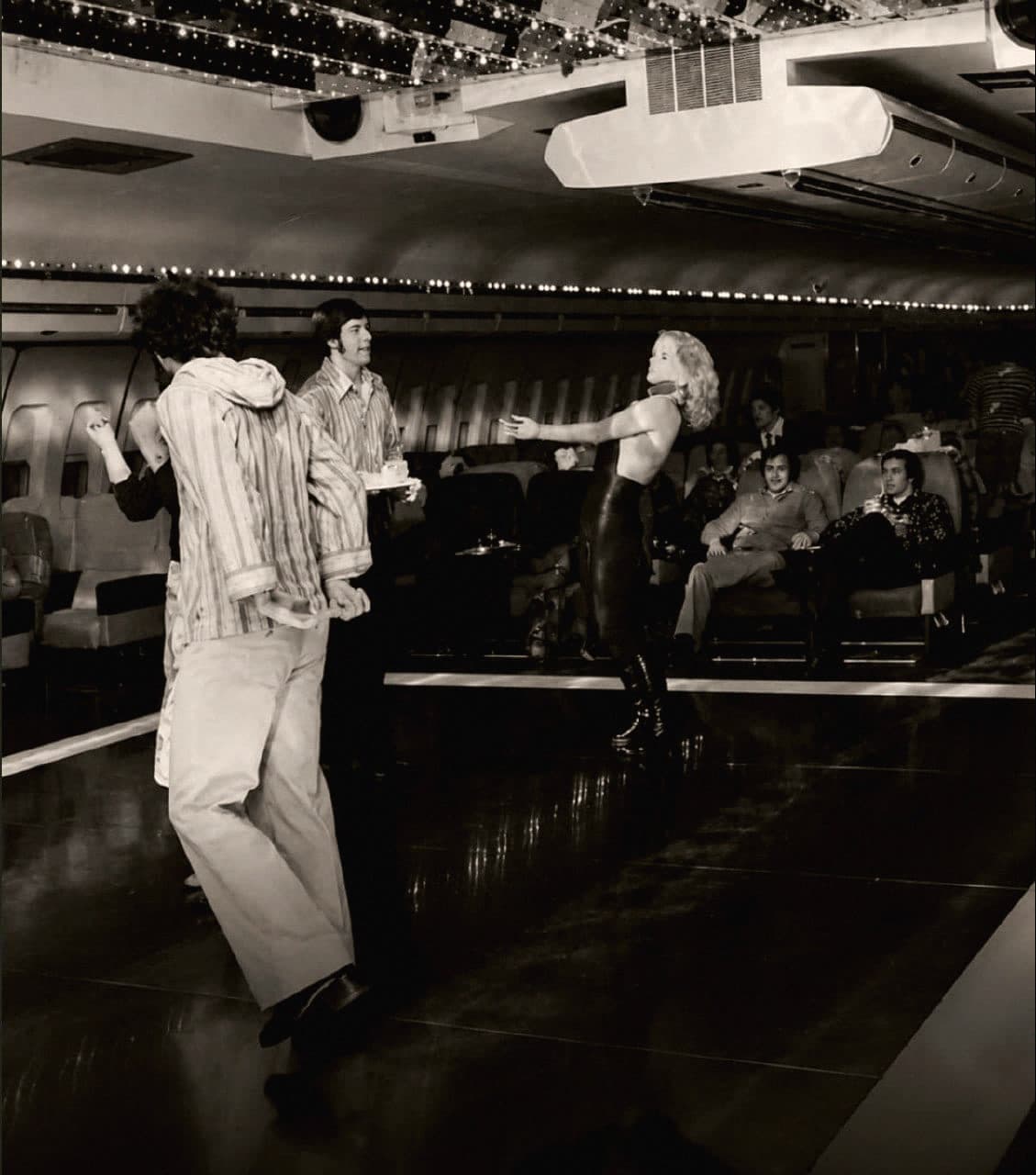
When Air Canada put its first Boeing 747s into transatlantic service in 1971, it used the extra headroom behind the cockpit, the aircraft's distinctive upper-deck "hump," for something other than more seats. On flights between Toronto and Europe, the space became a proper lounge: a mirrored wall, an open dance floor, and music running off 8-track tapes instead of a jukebox. Flight attendants worked the room in lounge dresses rather than standard uniforms, and, depending on the crew and the flight, some danced with passengers rather than just serving them. "It was all so gracious," former Air Canada flight attendant Heather Tregaskes told the Toronto Star in 2004. "We even had a mirrored wall and a dance floor, and sometimes stewardesses would even dance with customers."
"We even had a mirrored wall and a dance floor, and sometimes stewardesses would even dance with customers.", Heather Tregaskes, former Air Canada flight attendant
Why didn't it last?
About a year. Aviation historian Ross Smyth, in his book Aviation Memories: A Love Affair with Flight, recounts that Air Canada's own marketing team briefly considered promoting the space under the name "Mile High Club," before someone pointed out the phrase already had a reputation of its own. The bigger problem wasn't the branding, it was the economics: a dance floor doesn't sell a ticket the way a seat does. Once Air Canada, and every other airline running an early 747, did the math on revenue per square foot of cabin, the upper-deck lounges across the industry went the same way, ripped out and refitted with rows of paying seats within a few years of the aircraft's debut.
Was this just an Air Canada thing?
No, it was an entire era's fad. Pan Am, which flew the first 747 in 1970, turned its whole upper deck into a first-class "restaurant in the sky," with tableside carving. Qantas built a nautical-themed lounge it called the Captain's Club. Air Canada's version leaned into the disco moment instead, mirrors and a dance floor rather than white tablecloths. All of them were dead within the decade, victims of the same arithmetic: a lounge without a ticket doesn't pay for itself, and airlines were about to enter the fuel-shock, load-factor-obsessed 1970s that made every unsold square foot of cabin a cost, not a perk.
Why does a 1970s airline gimmick belong on a house music site?
Because it's a clean, dated example of something the scene rediscovers every few years: people will build a dancefloor into almost any space if the mood is right, and whoever is paying for the space will eventually ask what the dancefloor is worth per square foot. Air Canada's answer, in 1971, was: less than a seat. Fifty years on, promoters, airlines and club owners keep running the same experiment, with the same tension between the reason people show up (the floor) and the thing that pays the bills (the ticket).