What does the Ambrio SPM actually let a DJ do?
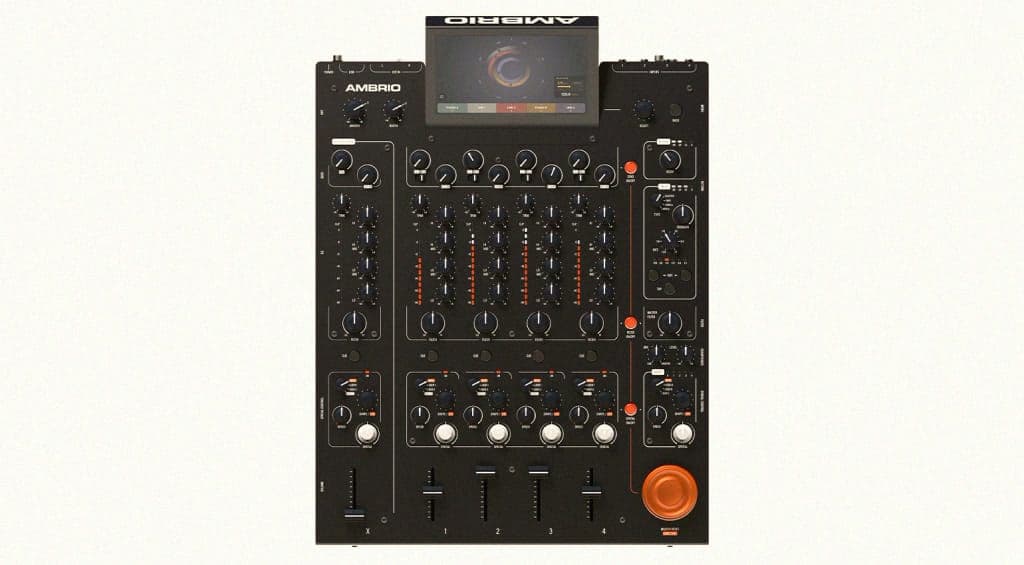
Strip away the spatial layer and the Ambrio SPM reads like any serious club mixer: five channels, four-band EQ, a highpass/lowpass filter, trim and cue on every strip, plus USB-C for a DAW, four RCA line pairs, two phono inputs with custom preamps, two XLR/TRS combos, Ethernet audio and MIDI/OSC control. The layer that isn't normal is independent 360-degree positioning on each channel. A DJ can send a kick drum circling the back wall while a vocal sits dead center, then let the reverb and delay physically travel through the room instead of just decaying in a stereo field.
"Most spatial systems ask the performer to plan spatial effects in advance and hand them to someone else to run," said co-founder and technical lead Ulrik Van Hecke. "We wanted to put that control in the hands of the artist."
Why does a club need four speakers to use it?
The SPM needs a minimum of four speakers to do anything spatial at all, and it outputs up to 8.1 channels. The part that matters for a working club is what it doesn't need: no proprietary surround system, no matched speaker brand. A custom algorithm converts whatever is being mixed to whatever array is already bolted to the ceiling, which is the entire commercial argument, since dedicated spatial-audio installs can run roughly ten times the cost of a venue's existing four-to-six-speaker rig. Most clubs still run a straight stereo PA, so the SPM's real audience, for now, is the rooms that already overbuilt their sound system for reasons that had nothing to do with DJ mixers.
Who's getting to try it first?
Ambrio isn't selling the SPM yet. It hasn't announced a price, and shipping is pegged to 2027. In the meantime the Brussels company is running an Incubator Program, loaning units to clubs, festivals, collectives and academic institutions across Europe, North America and Australia from October 2026, and giving it a public coming-out at Amsterdam Dance Event: a demonstration on October 23 as part of FIBER's Currents spatial-sound program, followed by two masterclasses at Loods6 on October 24.
The ADE date reads like a launch, but the tech isn't new. It has quietly been road-tested for several years at CTM Festival in Berlin, Intonal in Malmo, Wonderfruit in Thailand and Wintercircus in Ghent before Ambrio ever put a name and a price question on it.
"The technology is here, and now it's up to artists to discover how they want to use it." - Ulrik Van Hecke, Ambrio co-founder
Why it matters
Real-time spatial control has lived almost exclusively in installation art and bespoke concert systems, run by an engineer, not the performer. Putting that control on a five-channel mixer that plugs into speakers a club already owns is what could actually push 360-degree sound off the festival-stage novelty list and onto a normal Saturday night.
What we think
The detail that matters more than the ADE buzz is the years of quiet field-testing at CTM, Intonal, Wonderfruit and Wintercircus: this isn't vaporware wheeled out for a trade show, it's a mature system finally getting a product name. But a 2027 ship date with no announced price is the catch. Most clubs will not retrofit a whole PA for a gimmick. They'll buy an SPM if it genuinely works with the four speakers they already own, and that's the bet Ambrio is actually making.