What is a physics synthesizer, exactly?
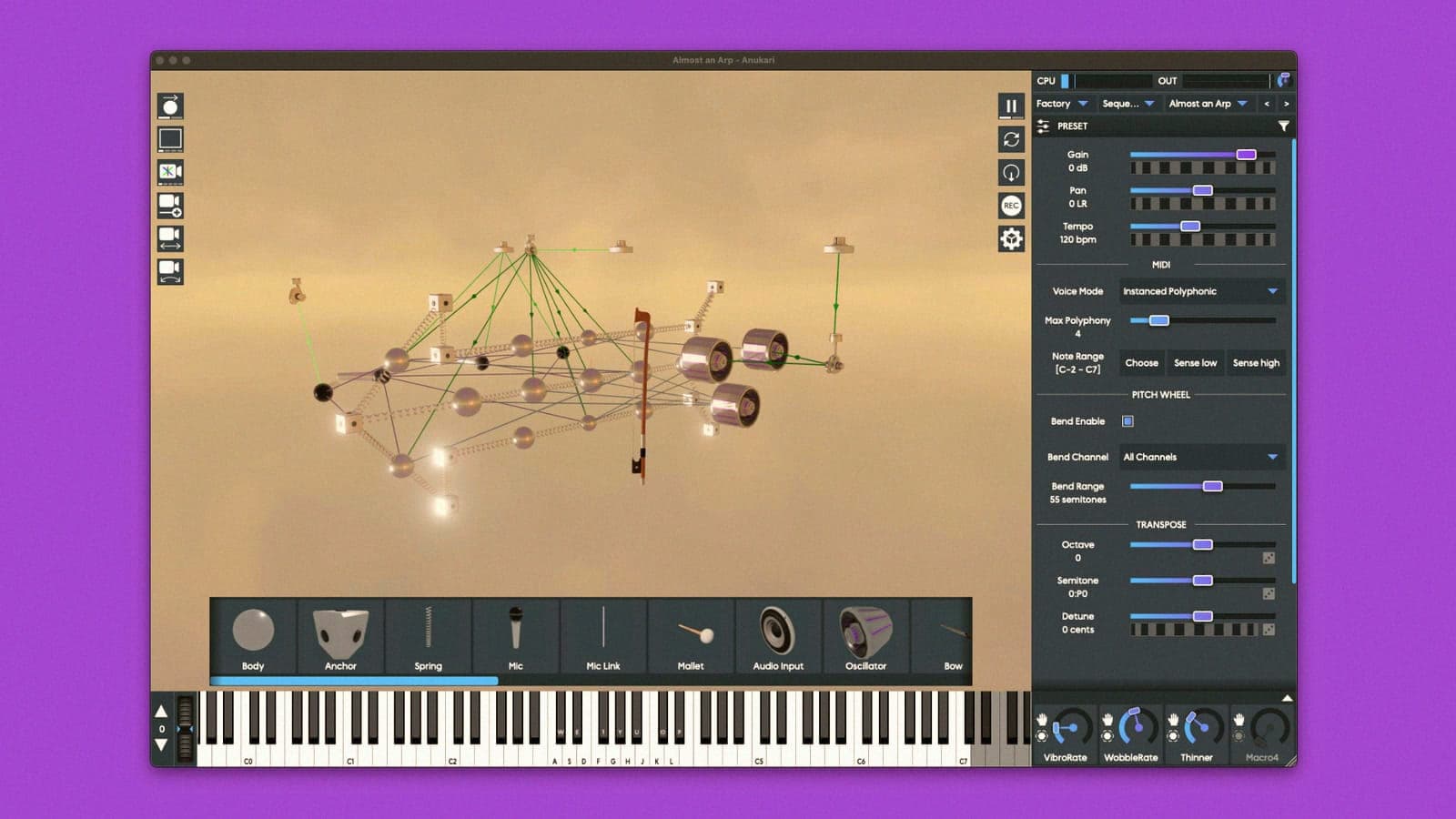
Most synths start from an oscillator: a waveform you filter and shape. Anukari throws that out. You drop masses into a 3D space, connect them with springs, pin some down with anchors, and then hit the whole thing with a virtual mallet, a bow, a MIDI note or a stream of audio. The structure rings, resonates and decays the way a real object would, and that motion is the sound.
Physical modelling is not new; it has lived inside string and wind instruments for decades. What Evan Mezeske has done is make it tactile and visual. You are not dialling in abstract parameters, you are building a thing and watching it move.
Why would a house or techno producer care?
Because it is one of the few ways left to get a sound nobody else has. Tune a lattice of springs one way and you get glassy plucks and mallets; loosen it and you get groaning drones and detuned metallic clangs that evolve as the structure settles. Route a kick or a vocal through it in effects mode and the physics chew on your audio instead of a note.
The visual feedback loop is the real hook. When the on-screen rig vibrates in time with what you hear, sound design stops being guesswork. The catch: it leans on your graphics card, so you need a GPU with Vulkan on Windows, and there is a real learning curve before the happy accidents start landing in tracks.
What does it cost and what do you need to run it?
Anukari is 149 dollars, with an introductory discount to 99 and a free trial, sold once rather than rented. It runs as a VST3, AU or AAX plug-in or as a standalone app on Windows 10 and up and macOS 12 and up (Apple Silicon, or Intel Macs from around 2015). You will want a GPU with Vulkan support on Windows, an AVX2-capable CPU and about a gigabyte of disk.