Beyond the thinking mind
We spend much of our lives inside our heads. Analyzing, anticipating, judging, planning and interpreting the world through the filter of our personal experiences.
Modern society rewards this way of functioning. Rationality, productivity, self-control and intellectual understanding have become central to how we measure intelligence and even personal success.
Yet some of the most meaningful experiences of our lives occur precisely when we stop trying to understand them.
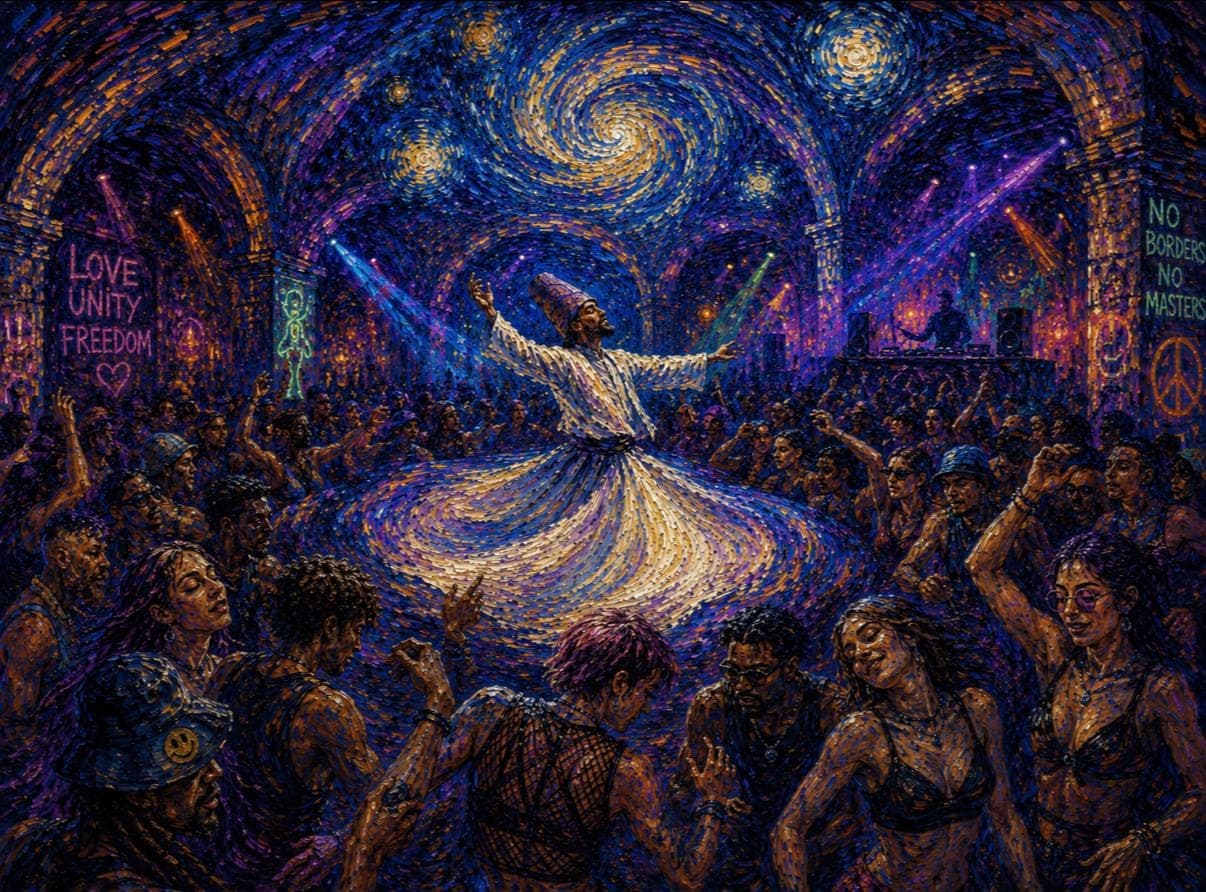
Standing beneath an immense night sky. Witnessing an extraordinary work of art. Watching the sun rise after dancing through the night. Finding yourself surrounded by thousands of strangers, moving to the same rhythm, overcome by an emotion that no words seem capable of capturing.
Psychologists call this experience awe.
In her November 2026 essay for Big Think, cognitive and social psychologist Dr. Valerie van Mulukom explores how awe reveals an often-overlooked dimension of human consciousness.
“During awe, analytical thinking recedes; we simply experience.”
Her research invites us to reconsider whether thinking is always the most meaningful way to engage with reality.
The psychology of feeling part of something greater
Psychologists Dacher Keltner and Jonathan Haidt characterized awe through two fundamental components: the perception of vastness and the need to revise our existing understanding of the world.
This vastness does not have to be physical. It can be emotional, intellectual, social or spiritual.
On the dancefloor, it might emerge through the overwhelming beauty of a musical composition, the energy of a crowd or the sudden realization that hundreds of people are sharing an experience that feels deeply personal.
Awe can produce what psychologists describe as the small self: a temporary reduction in our sense of individual importance.
Rather than making us feel insignificant, this experience can remind us that we belong to a reality much larger than our individual identities, ambitions and concerns.
A 2015 series of studies involving 2,078 participants found that experiences of awe could reduce self-centered thinking and encourage generosity, cooperation and concern for others.
For a moment, the distinction between me and we becomes less pronounced.
The rave as a modern ritual
Long before electronic music existed, humans gathered around rhythmic sounds, danced collectively and participated in ceremonies that allowed them to move beyond ordinary states of consciousness.
The contemporary rave shares some of these characteristics.
In 2021, researchers Martha Newson, Anam Khurana, Javier Cazorla and Valerie van Mulukom published a study in Frontiers in Psychology examining the transformative potential of rave culture.
They investigated four elements commonly associated with collective rituals, which they called the 4Ds:
- Dance
- Drums and repetitive rhythms
- Sleep deprivation
- Drugs and psychoactive substances
Among the 481 ravers surveyed, dancing and psychoactive substance use were particularly associated with awe. Participants who described their experiences as transformative also reported stronger connections to fellow ravers and greater willingness to support their community.
However, intensity alone was not enough. In the absence of awe, these same activities were associated with less personal growth.
The study was retrospective, meaning it establishes associations rather than proving causation. It also does not establish that substances or sleep deprivation are necessary for transcendence.
What appears particularly meaningful is the psychological quality of the experience itself.
From thinking to feeling
Electronic music offers an interesting environment in which to explore consciousness because it does not necessarily depend on language or intellectual interpretation.
A repetitive bassline does not need to be explained. A melody does not need to be translated. The emotional progression of a DJ set can be understood through the body before it can be articulated through words.
As we become absorbed in music and movement, our attention may gradually shift away from our internal narrative and toward our immediate sensory experience.
We become less concerned with how we appear, what others think of us or what tomorrow might bring.
We move from observing ourselves to experiencing ourselves.
This is not an argument against rational thinking. It is an invitation to recognize that analytical thought is only one of the ways through which we engage with the world.
There are experiences the intellect can describe but cannot substitute for.
Why some nights stay with us forever
In her 2026 research, van Mulukom and her colleagues followed 200 people in the United Kingdom over six weeks, examining whether the frequency or intensity of awe was more closely associated with well-being.
Their findings suggested that the strength of these experiences mattered more than how often they occurred. Particularly powerful moments of wonder were associated with a greater sense of meaning and well-being at the end of the study.
This offers an interesting perspective on our relationship with nightlife.
Perhaps it is not the number of festivals we attend, the hours we spend dancing or the intensity of the stimulation we seek that makes an experience meaningful.
Perhaps it is our capacity to be genuinely moved by it.
Anyone who has spent years on dancefloors can probably remember one particular night that stands apart from all the others. A moment when something shifted internally, when the music felt unusually profound, when strangers became friends, or when life suddenly appeared from a different perspective.
Such experiences may last only a few minutes, yet their emotional significance can remain with us for years.
Escaping reality or reconnecting with it?
Rave culture is often dismissed as a form of escapism: a temporary departure from the responsibilities and difficulties of everyday life.
And sometimes it is.
But there is a fundamental difference between escaping reality and temporarily escaping our habitual interpretation of reality.
One can be a form of avoidance. The other can offer an opportunity to encounter life differently.
The transformative potential of the dancefloor may lie in its ability to interrupt the psychological patterns through which we ordinarily experience ourselves.
It can remind us that connection does not always require conversation, that belonging does not always require similarity, and that meaning does not always require an explanation.
The challenge is not simply to seek these extraordinary states again and again, but to bring something of them back into our ordinary lives.
More openness. More curiosity. More compassion. More presence.
Perhaps the greatest gift of the dancefloor is not that it allows us to forget who we are, but that it reminds us that we are more than who we think we are.