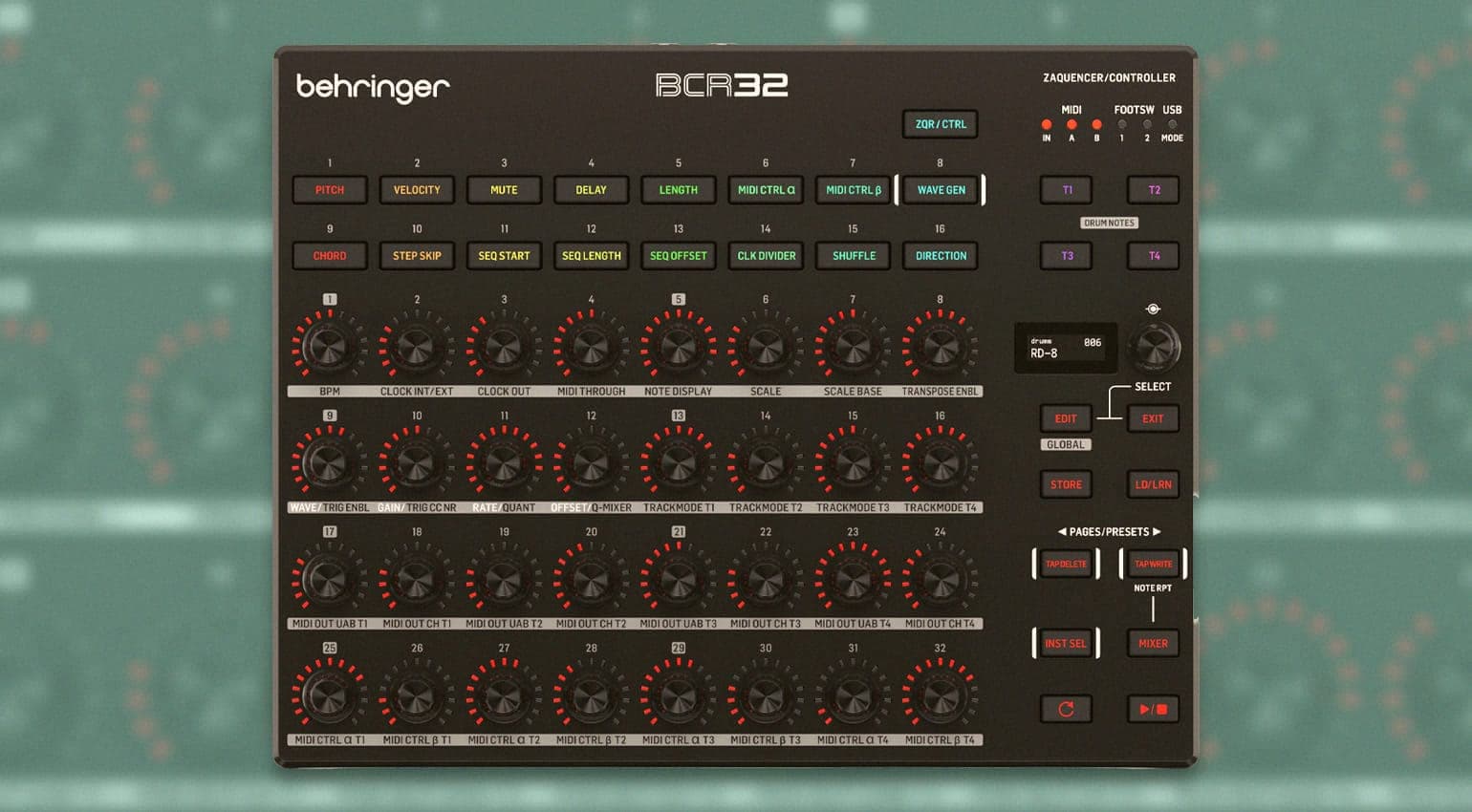
Behringer has finally shipped the successor to one of its most quietly beloved controllers. The Behringer BCR32 opened for pre-order this week at 169 euros, and it does something the original BCR2000 never officially did: it sequences on its own, no host software required.
The BCR2000 was a cheap, sturdy bank of 32 rotary encoders that studio heads used for years to twiddle plugin parameters without touching a mouse. Behringer discontinued it, and for a long stretch the only way to turn it into a hardware step sequencer was an unofficial firmware hack from ZAQ Audio called the Zaquencer, passed around forums and Reddit threads by producers who didn't want to give up their BCR2000s. Behringer eventually noticed and, rather than fight the mod scene, hired it.
What does the Zaquencer actually add?
The BCR32 keeps the same 32 encoders with LED value rings and adds 16 freely assignable buttons, but the headline feature is onboard: a 4-track, 32-step sequencer built directly into the hardware, storing up to 192 patterns. Flip a switch and the same knob bank that was a MIDI CC controller a second ago becomes a standalone sequencer driving external gear, no laptop in the loop. An OLED screen handles parameter readouts, and the unit talks to the rest of a rig over full 5-pin MIDI in and dual out, plus four CV/Gate outputs for analog synths and drum machines that don't speak MIDI at all.
Flip between controller and sequencer modes at the press of a button, no reflashing required.
Why did it take this long to ship?
Behringer first floated the BCR32 back in 2021, promising an affordable revival of the BCR2000 with the Zaquencer folded in from day one. It then sat in beta for years while the company worked the firmware into something stable enough to sell rather than flash yourself. That long silence is exactly why the pre-order news landed hard with the crowd who kept BCR2000s alive on secondhand marketplaces: this is a controller people specifically held onto, waiting for an official successor, rather than one anybody was clamoring for out of nowhere.
Who is this for?
Dual USB-C ports cover both bus power and data, and the hardware is built for a hybrid workflow: tweak plugin parameters from the encoders during a session, then flip modes and use the exact same box to sequence a modular rack or an external drum machine via CV/Gate, all without opening a laptop.