What is the BM-14M, and why does it matter?
The Moogerfooger MF-104M was one of the great analog delays, a bucket-brigade box Moog discontinued years ago that now changes hands for north of 1,000 euros when it shows up at all. Behringer has rebuilt it as the BM-14M and put it on the shelf for 119 euros. That is not a typo. The same warm, smeared, slightly unstable repeats that producers chased on the secondhand market are now a budget impulse buy, and the unit is finally shipping in Europe after first batches went out late last year.
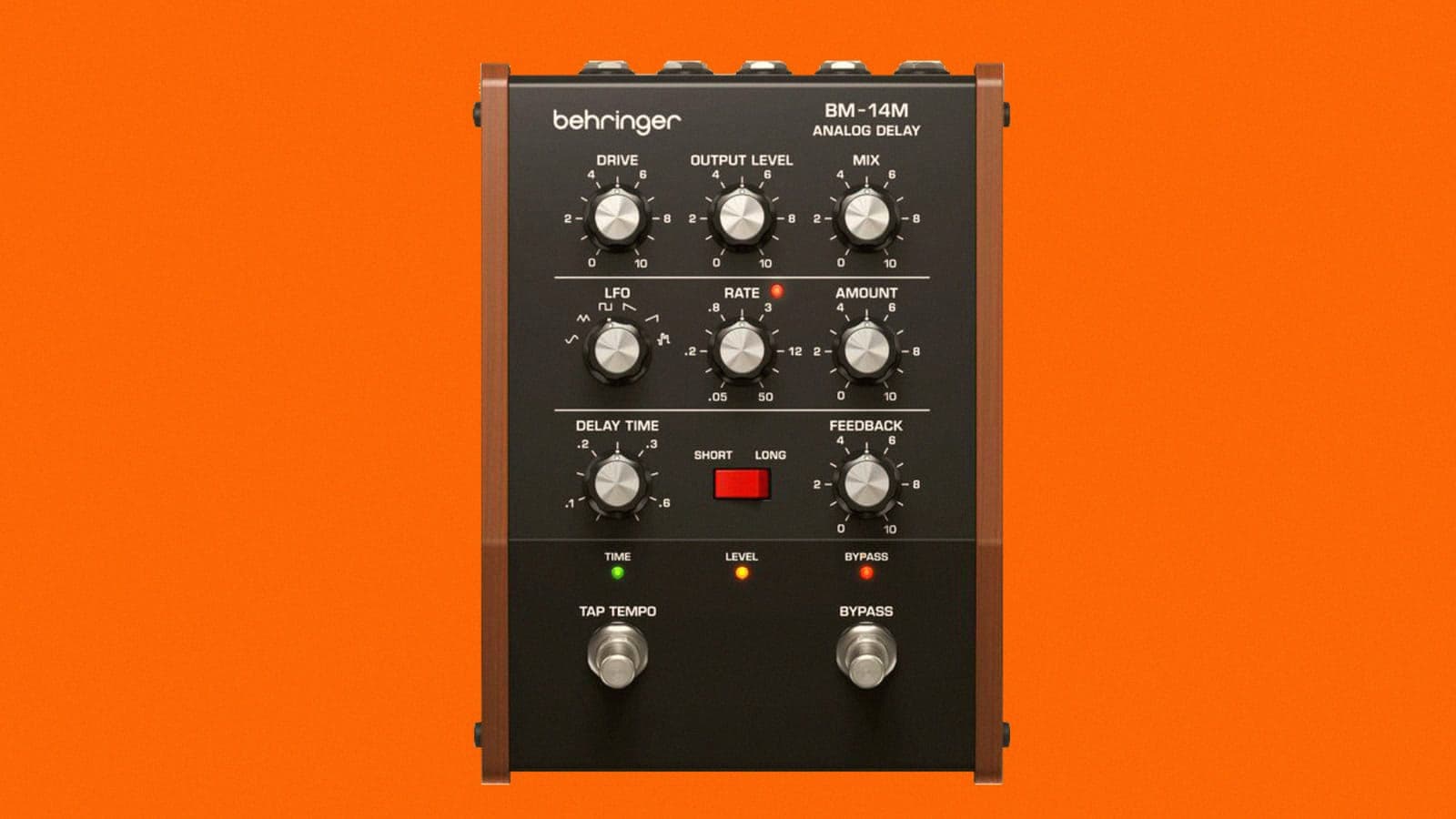
On paper it is a faithful copy. Up to 800ms of true analog delay, a six-waveform LFO for chorus and flange-style movement, tap tempo, a drive stage, CV control over the parameters, full MIDI, and a feedback insert so you can drop other pedals or a whole synth into the regeneration loop. That last feature is the one that turns a delay into an instrument.
How close does it really get to the Moog?
Close, but not all the way. Behringer swapped the original Panasonic bucket-brigade chips for CoolAudio reissues, and in side-by-side tests the BM-14M tracks the Moogerfooger almost exactly through normal use. Where it parts company is at the edges: crank the feedback into self-oscillation and chase the glitchy, screaming chaos the MF-104M is loved for, and the clone is a little tamer, a little less alive. Reviewer Starsky Carr was blunt that it is not a perfect copy.
The question is not whether it sounds identical. It is whether the last ten percent is worth ten times the price.
For most people making house and techno, where the delay sits in a groove rather than screaming over the top of it, the answer is obvious. This is the kind of tool that used to be a luxury and is now a line on a starter pedalboard.
Is this homage or vampirism?
That argument never ends, and Behringer keeps feeding it. The BM-14M closes out the company's first run of Moogerfooger remakes, alongside clones of the phaser, the filter, the ring modulator and the filter bank. Moog stopped making the originals, so nobody is being undercut on a current product, and the cloned circuits are old. Still, watching a beloved boutique design reappear at a tenth of the price stings for the people who paid full freight. The counter-argument is just as loud: a classic effect that was priced out of reach for a generation is now in reach, and that is how tools spread.