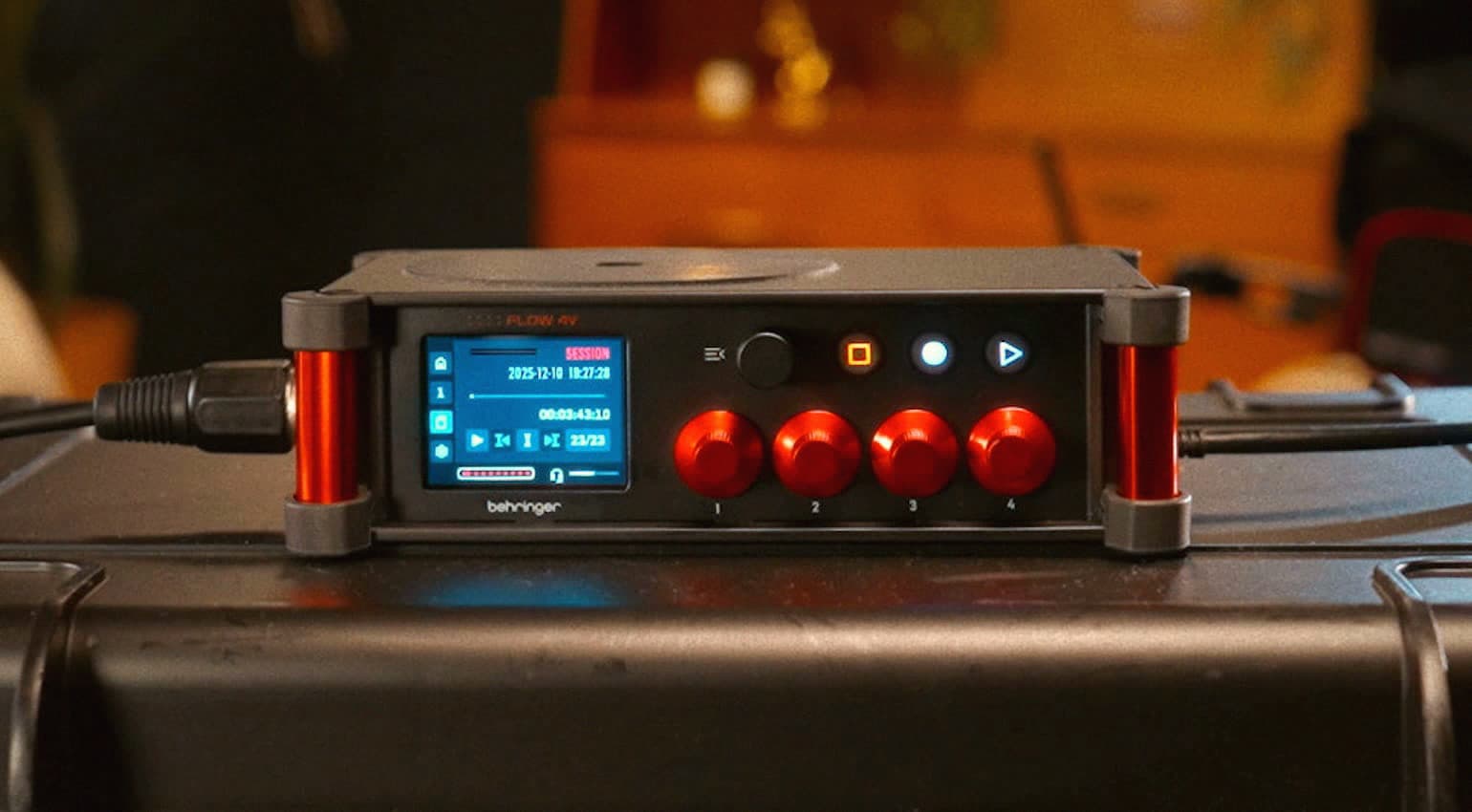
Multitrack field recorders that don't clip have been a pro-only expense for years. A Zoom F8n Pro runs about $600. Sound Devices gear starts well north of that and climbs past $3,000. Behringer's answer, the FLOW 4V, undercuts all of it at $299 (€269), and it's shipping now after a January 2026 NAMM reveal, per Synth Anatomy and Synthtopia.
What does $299 actually buy?
Ten tracks, recorded in real 32-bit float or 24-bit fixed, straight to SD or USB, with automatic backup to a second USB drive so a failed card doesn't cost you the recording. The dual-stage A/D conversion behind the four onboard MIDAS mic preamps pushes dynamic range to 138dB, which is the whole pitch of 32-bit float: you stop worrying about gain-staging a live signal in the moment and just fix it after, because the input effectively can't clip. There's an 8-channel mixer onboard with EQ, dynamics and automixing, SMPTE timecode for syncing to camera, HDMI start/stop control, Bluetooth audio and an app for iOS and Android. None of that is new as a feature set. What's new is the price it arrives at.
Why does StageConnect matter for a club booth?
The more interesting piece for a working engineer isn't the recorder, it's StageConnect. Behringer built the protocol to send up to 32 channels of uncompressed digital audio over a single cable that runs on standard XLR (up to 5 meters) or DMX cable (up to 40 meters), with sub-millisecond latency, replacing what would otherwise be a thick, heavy multicore snake between a stage box and a booth or a mixing position. For a promoter running a temporary rig, a mobile engineer, or a club doing a one-off multitrack capture of a live set, that's the difference between hauling a multicore and running one cable. Behringer also sells a FLOW 4VIO expander that adds four more preamp inputs over StageConnect, so a single FLOW 4V can grow into an 8-input system without extra external power beyond the main unit.
Who is this really for?
Not a headliner's front-of-house rig, at least not yet, that's still Sound Devices and Zoom territory for people who need bulletproof redundancy on a festival stage. But for the tier just below that, the promoter who wants to multitrack a b2b set for a future release, the mobile DJ recording their own gigs properly, the small club or streaming setup that wants camera-synced multitrack audio without renting gear, $299 changes the math entirely. It's the kind of price that turns "we should really record this properly" from a line item into an impulse buy.
The whole pitch of 32-bit float has always been that you stop babysitting your gain staging. Behringer just made that argument at a third of the usual price.