What exactly did Bitwig rebuild in the Sampler?
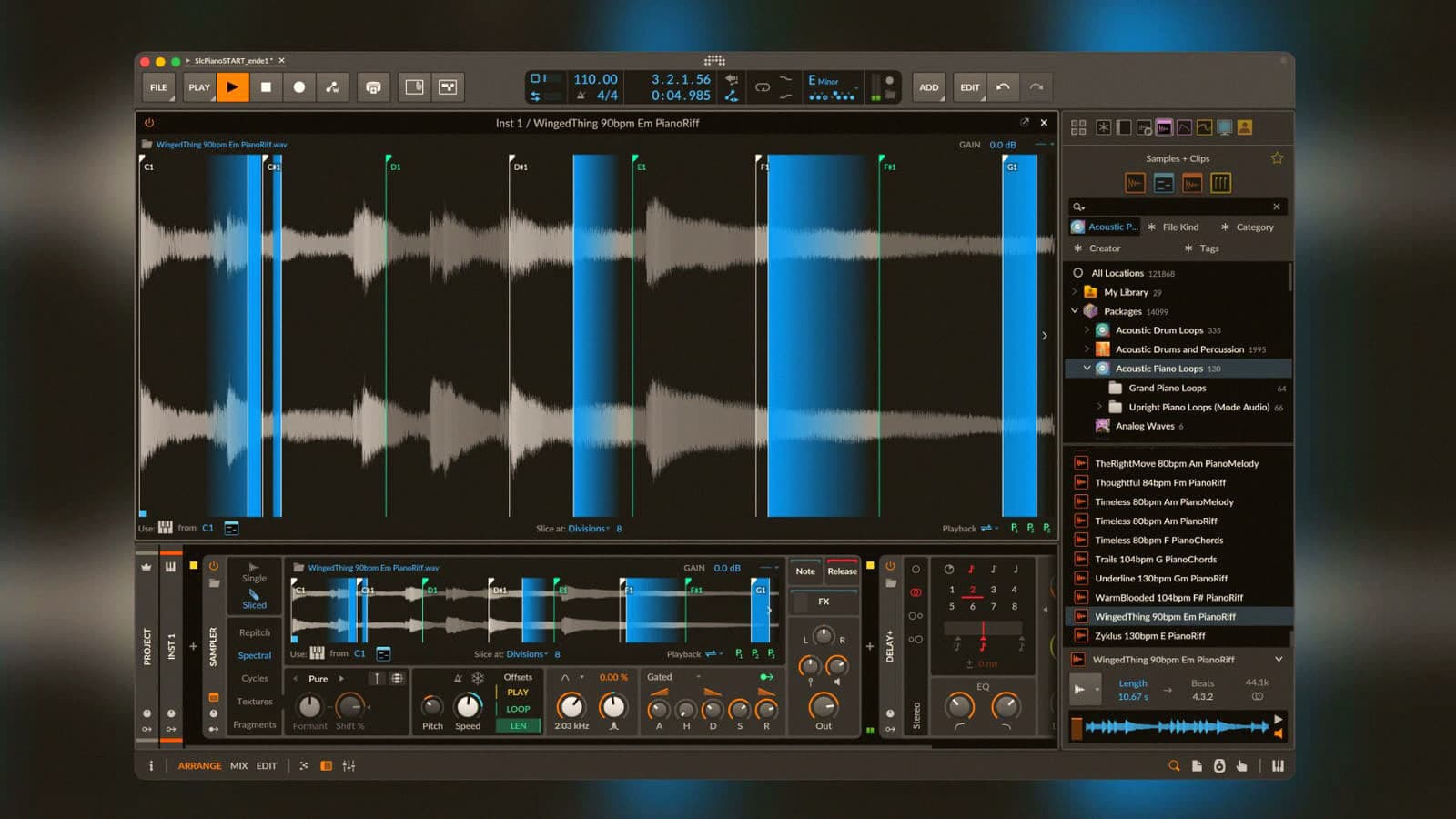
Pretty much everything. The Bitwig Sampler in 6.1 is not a refresh with a couple of new buttons. It is a ground-up redesign that touches every play mode and adds a slicing engine that works across all of them. One-click slicing now works directly from the arranger or the clip launcher, and you pick from five methods: beat divisions, automatic onset detection, pitch changes, equal distribution, or beat intervals. Once you have your slices, each one carries its own loop setting and its own per-slice modulation, meaning every sampler parameter behaves independently per slice. Add dynamic pitch analysis (the DAW identifies the root key automatically) and automatic tempo detection, and you have a sampler that removes the prep work producers usually dread.
The improved playhead visualizations and the new Bell filter for quick tone shaping are smaller touches, but they add up. Multisample drag-and-drop creation is now integrated directly, which is a practical improvement anyone building velocity-layered instruments will appreciate.
What are Spectral Mode and Fragments Mode?
These are the two new play modes in the full Bitwig Studio edition, and they are genuinely different capabilities rather than rebranded existing features.
Spectral Mode uses FFT-based time-stretching with transient preservation and formant processing. Bitwig describes it as the cleanest time-stretching available regardless of speed, and FFT approaches at this level are typically expensive plugins sold separately, not built into a DAW's native sampler.
Fragments Mode is granular playback with up to 256 independent grains per voice. Each grain has its own playback rate, direction, position, and size. For producers working in ambient, experimental, or textural techno, this is the kind of control that changes what a single sample can become. Grain triggering is also accessible in The Grid via signal input and drum onset triggering, which means modular-style patching of the granular engine is on the table.
What changed in Repitch Mode and Cycles?
Repitch Mode now splits into two characters. Analog mode adds tape flavour and juicy saturation for anything that needs warmth. Digital mode goes the other direction, emulating 90s samplers or enabling extreme mangling. Both are applied polyphonically across voices, which matters when you are running melodic content through the sampler.
The Cycles device gets three new characters covering pulse width adjustment, phase modulation, and harmonic rebalancing. A Freeze function converts samples into oscillators, and a new Duophonic option lets you crossfade between two engines. Cycles was already one of Bitwig's most distinctive synthesis tools; this update deepens the unified sampling and synthesis angle the DAW has always pushed.
"Up to 256 independent grains per voice" is not a marketing line. That is the kind of grain density that opens genuinely new sonic territory inside a DAW sampler.
Who gets what, and when?
The public beta is live right now for users with an active Upgrade Plan. The Spectral and Fragments play modes are Bitwig Studio edition only. The new Tuner device, which uses the same pitch detection algorithm as the dynamic pitch analysis in the Sampler, is free to all Bitwig editions including the cheaper tiers. Full release is planned for summer 2026.