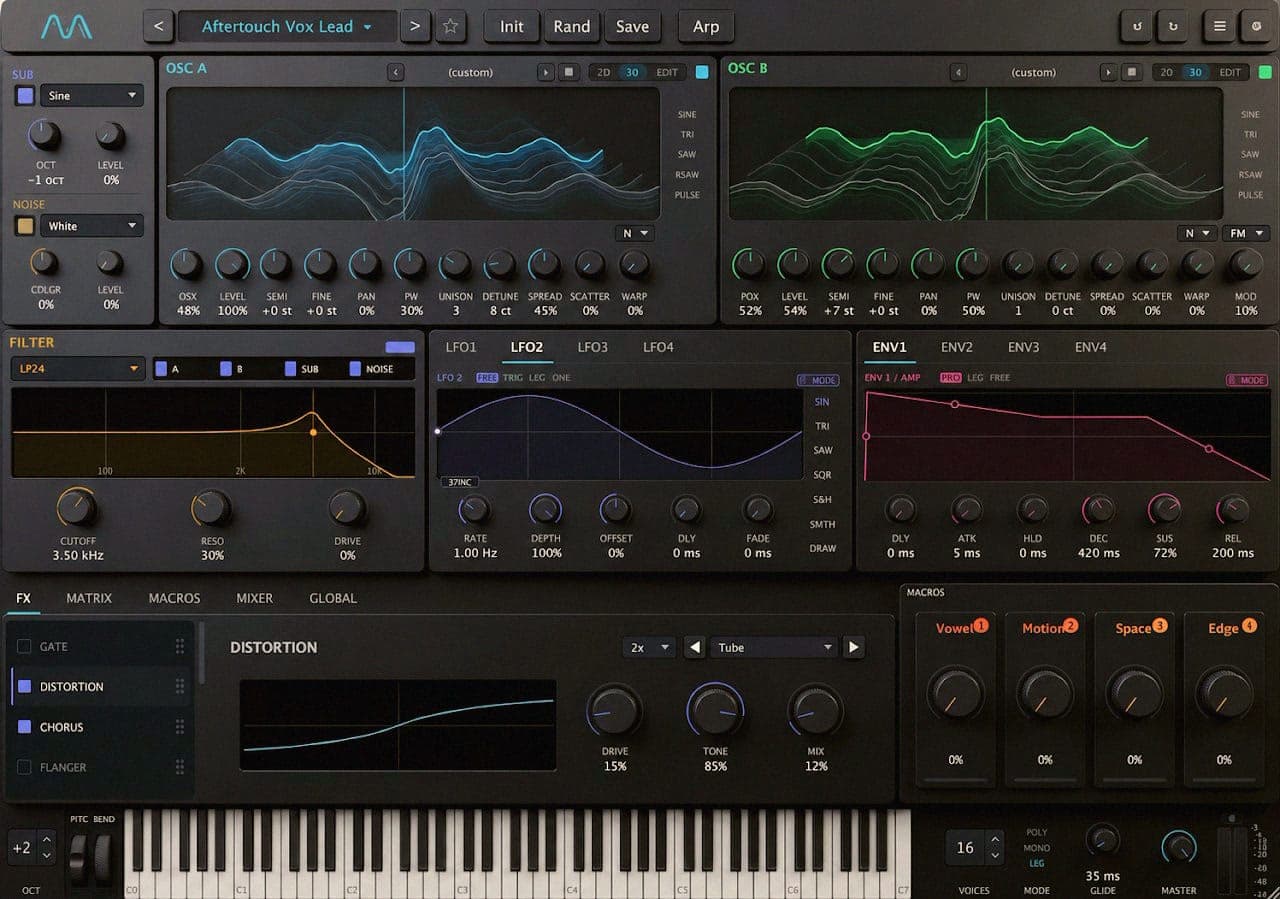
Butterlamp Audio isn't a name that shows up on many producer shortlists yet, but Tilichu, its new $99 wavetable synthesizer, is built with the kind of depth that usually comes from a much older company. Two morphing wavetable oscillators, a granular and spectral resynthesis engine, a 32-slot modulation matrix and twelve effects sit under the hood, and the plugin ships in VST3, AU and a macOS standalone (Windows is coming), with a 14-day free trial before the $99 buy-in.
What's actually under the hood?
The two oscillators morph across 256-frame wavetables with unison, warp and phase scatter, plus a live 2D/3D display for watching the shape change. The second engine is where it gets more interesting for sound designers: load any sample and play it back as a grain cloud or a frozen spectral snapshot, with formant shifting and real-time harmonic reshaping. Four LFOs, four envelopes and four macros feed a 32-slot modulation matrix with bipolar depth, so almost any parameter can be patched to almost any source. Twelve effects round it out. None of this is beginner-toy territory: it reads like a plugin aimed at people who already own Serum or Vital and want a deeper synthesis engine, not a simpler one.
How does the AI patch generator actually work, and should sound designers trust it?
Type a description, plain language, and Tilichu builds a full patch from it rather than a single preset tweak. Treat it as a sketch generator, not a replacement for sound design skill: an AI-written starting patch still needs the same ear and the same modulation matrix to turn into something that actually sits in a mix. The more useful comparison is a preset browser that responds to language instead of a genre tag, which matters most when you're chasing a texture you can describe but haven't built before. Butterlamp frames it that way too, pairing the line “a hands-on wavetable synth for classic, knob-by-knob sound design” with the AI feature rather than positioning the AI as the headline.
Every stage is built for modulation and made to be played. Start from a wavetable, reshape it spectrally, scatter it into grains, then route anything to anything.
Why does importing Serum 2 and Vital patches matter?
Because most working producers already have years of presets built in one or both of those synths, and a new plugin that can't touch that library is a hard sell no matter how deep its engine is. Tilichu's direct import means a house or techno producer can bring existing wavetable and modulation work over and immediately push it further through the granular and spectral engines, rather than starting from zero. For a scene that runs on hardware and software people already trust, that compatibility is arguably the more consequential decision than the AI generator, even if it gets less attention.