What makes Bad Mood different from the original Mood?
Chase Bliss built its reputation on pedals that behave more like generative instruments than static effects, and the 2023 Chase Bliss Mood, later followed by the stereo Mood MKII, became a fixture in ambient and experimental rigs for exactly that reason: a micro-looper that reassembled audio into something unrecognizable, in a good way. Bad Mood keeps the same chassis and core parameter set as its predecessor, but every algorithm underneath is new, built to sound rougher, glitchier and more unstable than the original's lush wash.
How does the dual-channel design actually work?
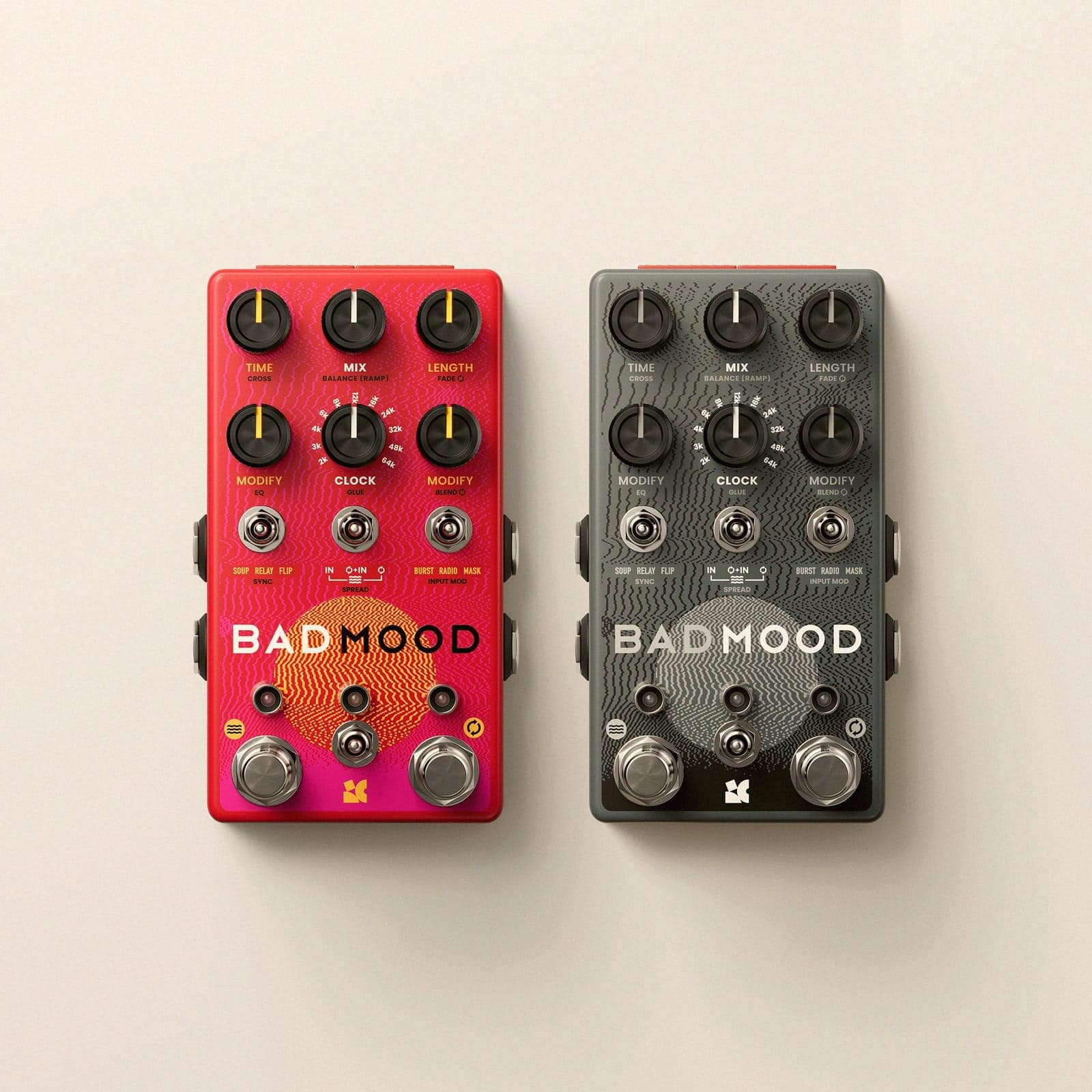
The pedal splits into two interacting sections. The right side houses a micro-looper that fragments incoming audio and stitches it back together in ways the player doesn't fully control, while the left side runs a wet channel combining delay, reverb and a harmonizer. A global "Glue" section, a saturator and destroyer, sits over both and binds the chaos together. Delay comes in relay, flip and soup modes, reverb in burst, radio and mask, and Radio mode is the standout: it routes loops through five simulated stations, tape, ambient, orchestral, shoegaze and dance, each one reassembling the material with its own glitches and interruptions. A Clock knob shifts the sample rate of both channels in harmonized steps, and a Dynamic knob makes the whole engine react to how hard you play.
Who is this pedal for, and how do you get one?
Bad Mood is built for the ambient, experimental and modular-adjacent performers who already treat effects as compositional tools rather than sweeteners, and full MIDI control (the entire engine, both channels and the Glue section) means it can lock into a DAW or hardware sequencer for a live set instead of staying a stompbox afterthought. It ships as a Small Batch release, meaning a limited production run rather than a permanent catalog item, priced at €469 in Europe (about $399 in the US) in two colorways. Pre-orders close August 31, 2026.