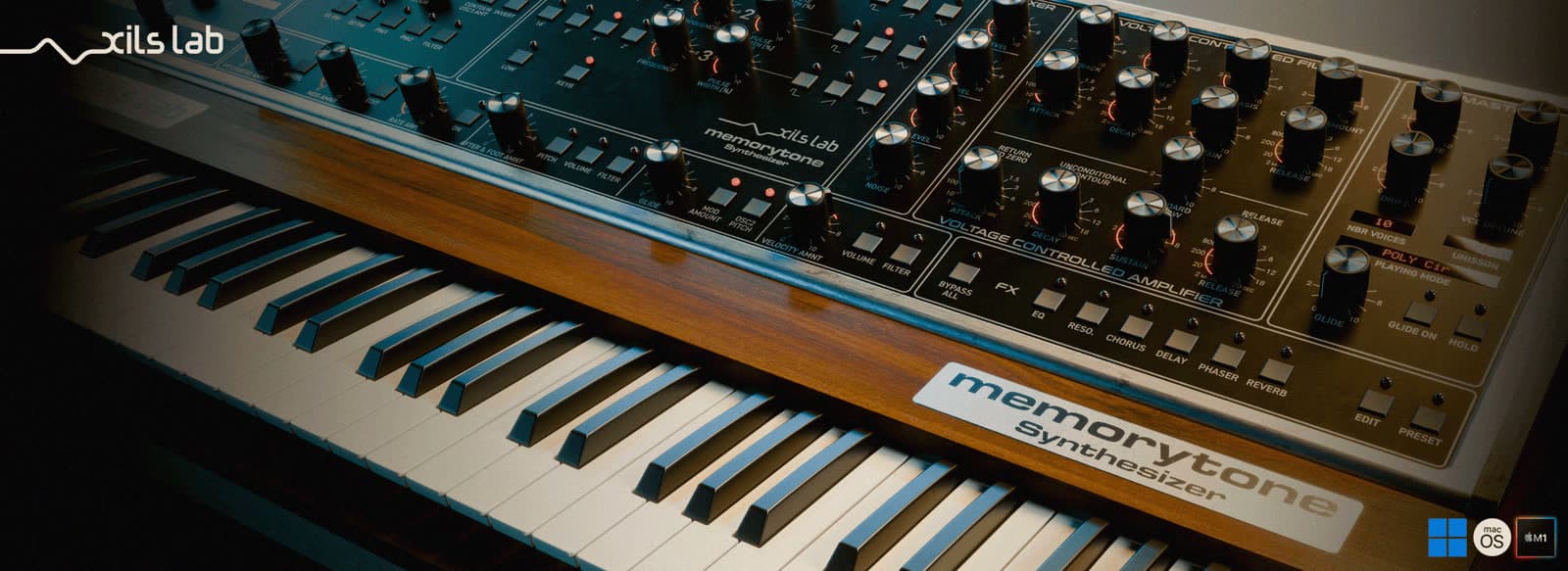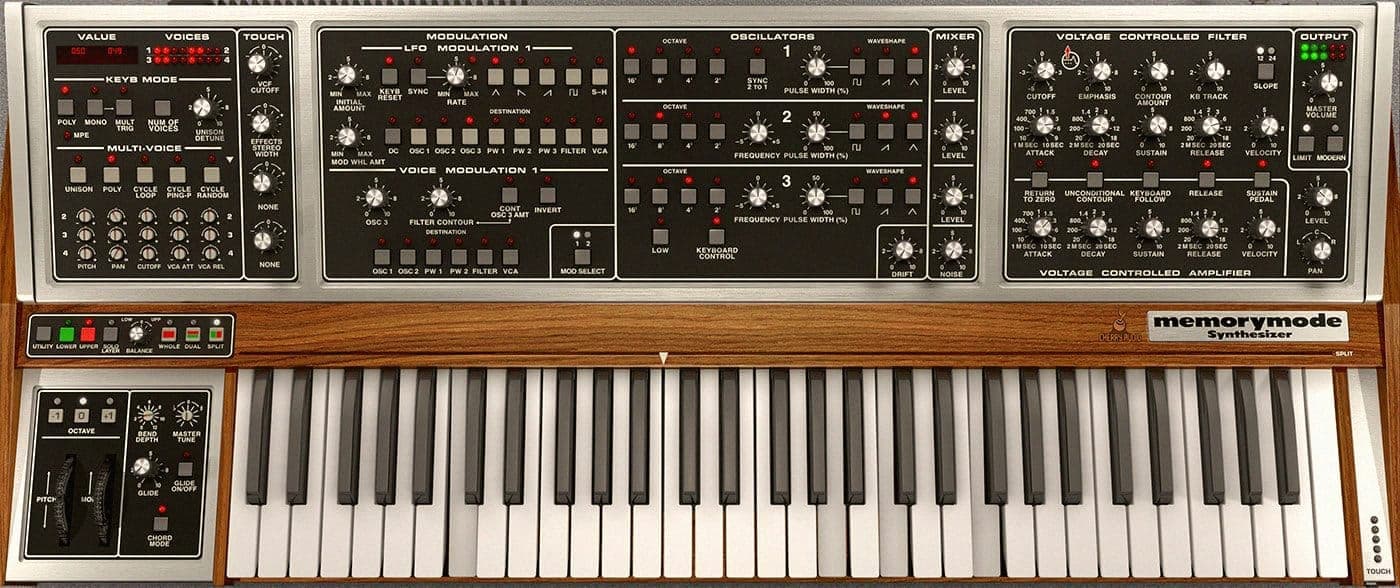
The Memorymoog, built by Moog Music from 1982 to 1985, was a six-voice analog polysynth and nothing more: one engine, one patch, one voice at a time per key. Cherry Audio's original Memorymode plugin, released in 2021, respected that limit. Memorymode 2, out now, does not.
The new version splits the emulation into two complete 16-voice layers that can run as splits, stacks or independent patches inside a single preset, with unison stacking pushing each layer up to 48 voices. That is a structural change, not a preset pack: it turns a faithful recreation of a specific vintage machine into an instrument that can do things the Memorymoog physically could not, while keeping the original's sound as the reference point. Cherry Audio also reworked the analog modeling underneath it, adding drift control for the wobble of real vintage oscillators, resonance compensation on the filter, and a choice between the original 24dB ladder slope and a new 12dB option, alongside a Modern mode for cleaner lows and highs.
What does dual-layer actually buy a performer?
Each layer gets its own three-oscillator engine, its own 16-step by 4-pattern polyphonic sequencer, its own arpeggiator and its own touch-modulation lanes. In practice that means a player can hold a pad on one layer and sequence a bassline on the other from a single instance, or set up a keyboard split without reaching for a second plugin. The effects section backs that up with three independent chains totaling 22 effects (reverbs, delays, BBD flanger, chorus and phasers), plus two effects new to this release: a wide phaser and a rotary speaker simulation, useful for the kind of Leslie-adjacent motion the Memorymoog never had onboard.
All proceeds from sales in August 2026 will benefit the Bob Moog Foundation, now celebrating its 20th anniversary.
Where does the preset money actually go?
Cherry Audio didn't just cite Moog's legacy, it wrote a check into the product page. The $9.99 Foundation Preset Pack, 275 patches built by sound designers James Dyson, Scott McAuley and Ger Hughes specifically to show off the new layering, sequencing and touch-animation features, sends its August 2026 proceeds to the Bob Moog Foundation, the nonprofit that runs the Moogseum and Bob Moog's archives. It is a modest tie-in financially, but it lands during the foundation's 20th anniversary and gives a plugin update a reason to matter beyond spec-sheet bragging rights.
On the archival side, Memorymode 2 still ships the 100 original Memorymoog factory patches, recreated from a cassette tape backup of the hardware, alongside all of Memorymode 1's presets and the new 275-patch Foundation pack, for a library north of 800 sounds. It runs standalone and as VST, VST3, AU and AAX on macOS and Windows.