What exactly did Chip E. put out?
The Jacking Machine is a new instrument that packages the swing, shuffle and low-end pulse of house music, the feel Chip E. helped codify four decades ago, into something you can actually play. It arrived without a splashy trade-press rollout: he simply debuted it on August 29, 2026, the day he also played the main stage at the Chicago House Music Festival & Conference in Millennium Park. An iOS version is out now as a public TestFlight beta under the name "Chip's Jacking Machine." Desktop versions in VST3 and Audio Unit formats, the plugin standards every major DAW on Mac and Windows supports, are planned but not yet released. The app is also live on the App Store as Chip's Jack Machine, priced at an introductory $0.99 through September 12, 2026 before rising to $4.99 (download here); Chip E. played a live set that same day at 4 p.m. on the Jay Pritzker Pavilion stage.
Why does Chip E. get to build the "house" instrument?
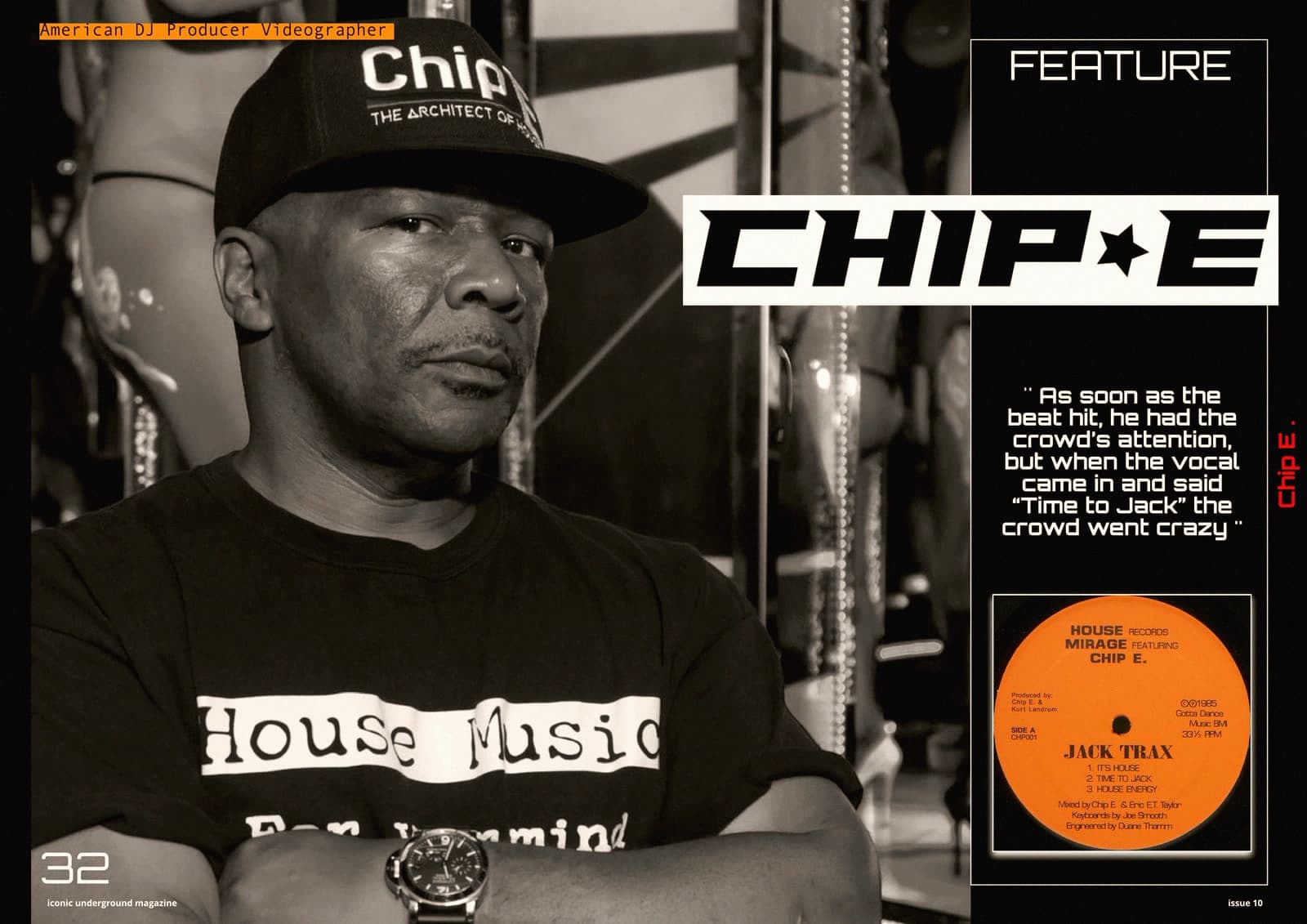
Because he's one of the people who named the genre in the first place. Born Irwin Larry Eberhart II in Chicago, Chip E. self-released the Jack Trax EP in 1984, a record built on a Boss Dr. Rhythm drum machine and, by his own account, a toy keyboard.
"I had a Boss Dr. Rhythm drum machine and a Casio VL-Tone keyboard, not even a professional one, it was a little toy for kids." That's how Chip E. has described the gear behind Jack Trax.
Jack Trax's two tracks, "It's House" and "Time to Jack," are among the first records to use the words "house" and "jack" the way the genre still uses them today; the dance move "jacking" traces straight back to that title. Street Mix magazine put him on its cover in 1986 and called him the "Godfather of House Music," and he co-produced Frankie Knuckles's debut single, "You Can't Hide." For years Chip E. has described himself not as the inventor of house, but as its architect, the person who saw the commercial and musical potential in a sound already brewing in Chicago's warehouse parties and gave it a name and a template.
What's next for the Architect Series?
The Jacking Machine is billed as the first entry in a planned "Architect Series" of instruments, a direct callback to that self-given title. More instruments are said to be in the pipeline alongside the VST3 and Audio Unit builds. The timing isn't a coincidence: the same month, Still Music starts reissuing Chip E.'s 1984-88 catalog as a three-volume vinyl series titled The Architect of House, with Volume 1 due September 11, 2026 and liner notes from former Chicago Reader editor Jake Malooley. Between the instrument and the reissues, 2026 is shaping up as the year Chip E. moves to formally own and monetize the sound he helped build, instead of watching other people's plugins and sample packs do it for him.
Why it matters
A lot of "vintage house groove" plugins and sample packs on the market today were built by mining old Chicago and New York records without ever crediting, let alone paying, the people who made them. A foundational figure shipping his own instrument, under his own name, on his own terms, is a rare case of a genre's original architect getting in front of that economy instead of behind it.
What we think
Software built to fake a pioneer's feel is everywhere; software built by the pioneer himself is not. That alone makes the Jacking Machine worth watching, even at the modest scale of an iOS TestFlight beta. The real test is whether the VST3 and Audio Unit versions actually ship on a real timeline, because "planned" is exactly the word where a lot of gear announcements quietly go to die.