What is the RND, and what does it refuse to do?
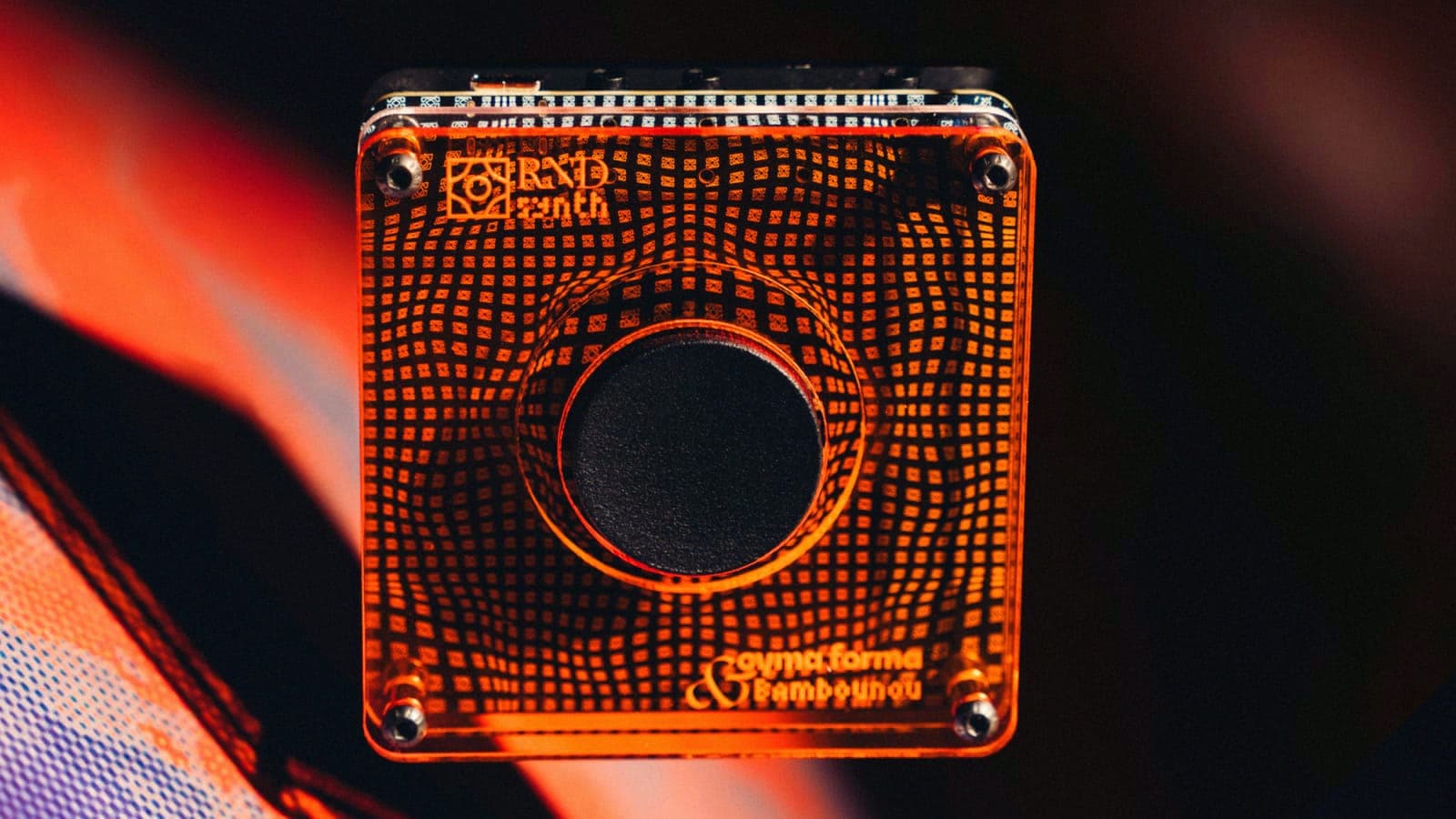
Cyma Forma has built the most contrarian little box at this year's Superbooth. The RND has no screen, no knobs, no faders. It has one button. Press it and the machine hands you an entirely new idea: a four-layer patch pulled from eight synthesis engines (subtractive, FM, acid, noise, speech, Karplus-Strong, supersaw and additive), shaped as a sequence, a one-shot or a drone, in one of 20 scales through one of five filters. The maker claims over four billion possible results. The catch, and the whole point, is that none of them can be saved or recalled. You capture the sound while it is playing or you lose it forever. Their tagline says it plainly: stop playing, start listening.
Why build a synth you can't control?
Because control is exactly what it is trading away. Made with the French producer Bambounou, the RND is a deliberate shove against a studio culture obsessed with total recall, endless presets and the safety of undo. In a year when you can prompt a finished track out of a text box, a machine that forces you to react to chance, and to commit, reads less like a gimmick and more like an argument. It will annoy anyone who wants to dial in a precise patch. That is the audience it is not for.
Does it actually fit a real setup?
Yes, which is the surprise. Behind the toy looks sits proper connectivity: USB-C carrying both audio and MIDI, four independent pre-reverb tracks over that same cable, four MIDI channels in and out with nine modes, MIDI clock in and out, analogue sync on mini jacks and a stereo mix output. So the RND can sit inside a DAW session, lock to a modular rig or trigger other hardware, all for 125 euros plus VAT, with shipping starting in late June. At that price it is cheaper than most boutique pedals, which makes the no-save provocation easy to gamble on.
A synth that won't let you save a sound is the most honest comment on 2026 studio habits anyone has shipped this year.