What did Deezer actually find?
Deezer's own detection system flags up to 85% of the streams on AI-generated tracks as fraudulent, and the platform now strips those plays out of its royalty maths entirely. AI tracks are also pulled from algorithmic recommendations and editorial playlists, and Deezer no longer bothers storing hi-res versions of them. The volume is staggering: roughly 75,000 AI tracks land every day, about 44% of all new uploads, more than two million a month. Deezer tagged 13.4 million AI tracks in 2025 alone. And yet, by Deezer's own count, AI music is still only 1 to 3% of what people actually stream.
"AI-generated music is now far from a marginal phenomenon," says Deezer CEO Alexis Lanternier, "and as daily deliveries keep increasing, we hope the whole music ecosystem will join us in taking action to help safeguard artists' rights."
So who is making money on tracks nobody hears?
This is where the anger lives. If almost nobody is streaming AI tracks legitimately, why upload millions of them a day? Because the money was never in listeners. Streaming services pay out of a shared pot, split by each track's share of total plays. Flood that pot with cheap, mass-produced tracks and point a bot farm at them, and you siphon real money away from the artists people are actually listening to.
AI-generated music is now far from a marginal phenomenon.
It is not a hypothetical. In 2024 the US Justice Department charged Michael Smith with wire fraud and money laundering over a scheme that allegedly used AI-generated tracks and armies of bots to collect around 10 million dollars in royalties over several years. The 85% figure is what that business model looks like at platform scale.
Why does the upload fee matter so much?
Because the distributor layer is paid on volume, not on quality or honesty. Services like DistroKid and TuneCore take their upload or subscription fee up front, whether the track is a masterpiece, machine spam, or something no human will ever press play on. They have no real incentive to slow the firehose, because the firehose is their revenue. And when Deezer, Spotify and others now bill a penalty for flagrant fake streams, that charge gets passed back down to the uploader, so even the crackdown becomes another fee line rather than a refund.
Is anyone actually fixing this?
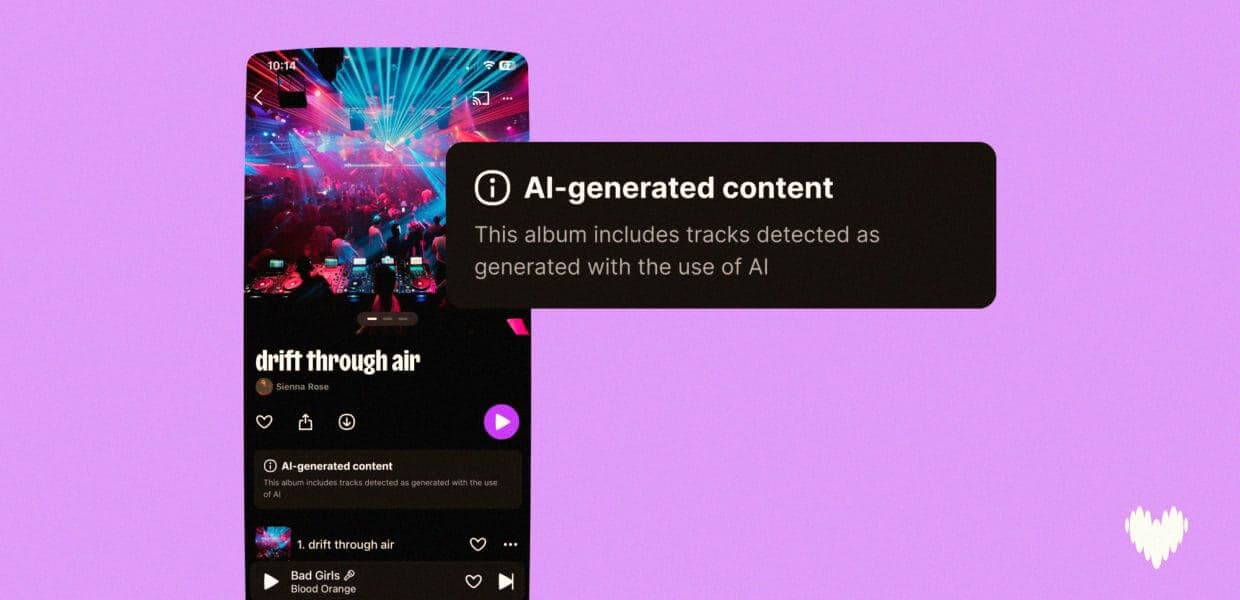
Deezer is doing more than most: it was the first platform to tag AI music outright, and it is now licensing its detection tool to the rest of the industry. Its own survey of 9,000 listeners found 97% could not tell AI from human music in a blind test, 80% wanted AI tracks clearly labelled, and 52% did not want them charting alongside human-made music. Rights bodies estimate AI could put a quarter of creators' income, some 4 billion euros, at risk by 2028. But tagging on one platform does not touch the incentive underneath: as long as it stays free money to upload junk and farm it, the spam keeps coming, and the pool everyone shares keeps getting thinner.