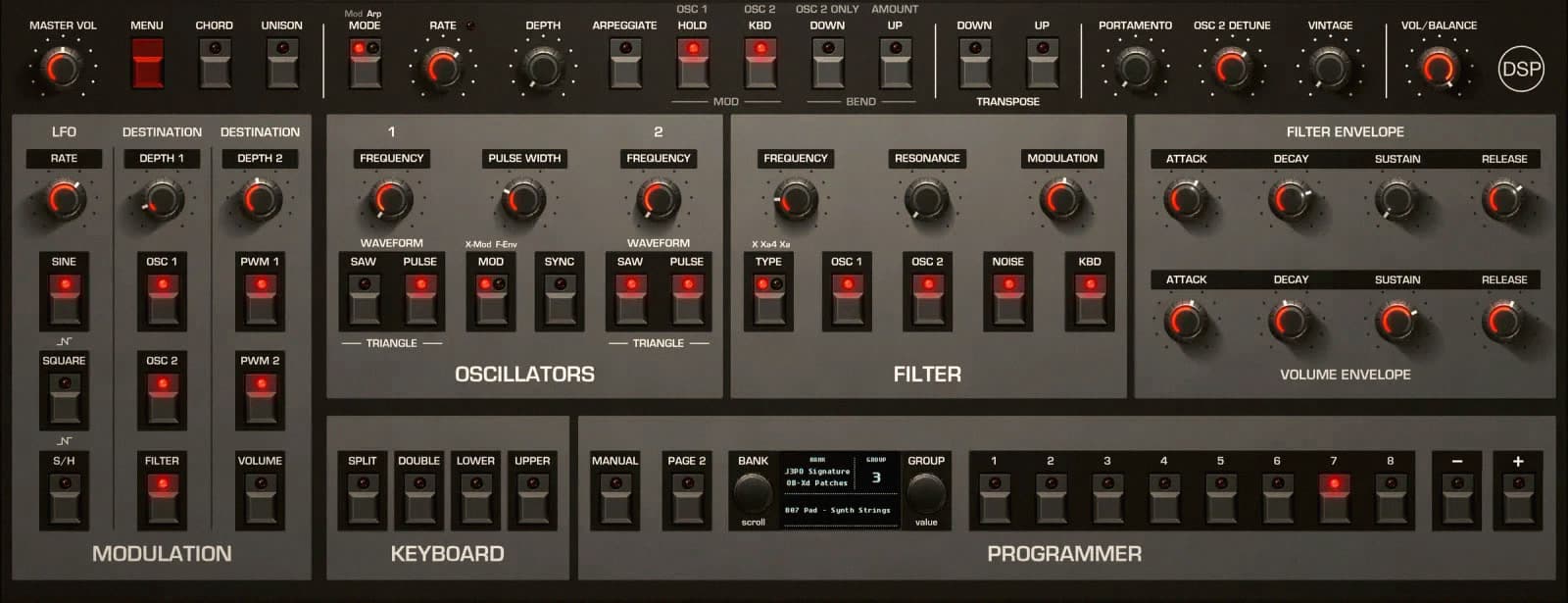
discoDSP's OB-Xd has spent over a decade as the plugin producers reach for when they want the sound of an Oberheim eight-voice without paying real Oberheim money. The current OB-X8 module alone lists at $3,599, the keyboard version well over $5,000. OB-Xd has always undercut that by a wide margin, and version 4 closes even more of the distance between emulation and hardware, partly by letting the plugin reach into the hardware directly.
What actually changed under the hood?
discoDSP rebuilt OB-Xd's filter engine against measurements taken from a physical OB-X8, matching the OB-X, OB-Xa and SEM circuits sample by sample rather than approximating their behavior mathematically. The envelopes, LFOs, portamento, voice allocation and arpeggiator timing now follow the OB-X8's own firmware logic, and the plugin keeps the Split, Double and Binaural layering modes the hardware uses to combine patches across its eight voices. That's the difference between a plugin that sounds Oberheim-ish and one tuned against the actual unit it's modeling.
Why would a $99 plugin need to talk to a $3,599 synth?
Because for producers who already own the hardware, OB-Xd 4 now doubles as its control surface. A built-in USB librarian handles two-way editing, program changes, bank transfers, backups, restores and OS updates on a real OB-X8 straight from the plugin, no separate editor software required. Pair that with a new tempo-synced arpeggiator, chord memory, MPE support and MIDI Learn, and the update reads less like a sound refresh and more like discoDSP positioning OB-Xd as the software front end Oberheim never shipped for its own machine.
"An engine matched to measurements of a real unit, captured in extensive sessions at professional audio specifications," is how discoDSP describes the new filter modeling on its own product page.
What's new in Retromulator 2.4?
Retromulator, discoDSP's separate multi-synth emulator, picks up two new cores in this release. Nordic 2 recreates the Clavia Nord Lead 2 without any firmware or ROM data, running 64 voices against the hardware's 16 and reading original Nord Lead 2 and N2X banks directly. MiniD adds a three-oscillator analog monosynth built on hardware measurements, with a transistor ladder filter and polyphonic, unison and double-voice modes. Retromulator can now also stack up to 8 of its instrument cores inside a single instance, each with its own mixing, MIDI channel and key or velocity split, turning one plugin window into a small rack of vintage synths running side by side.
OB-Xd 4 and Retromulator 2.4 are both available now for macOS, Windows and Linux, priced at $99 through December 31, 2026 before rising to $199; discoDSP is also offering discounted upgrade tiers for owners of its earlier synths.