Doepfer isn't a company that chases trends. Dieter Doepfer built the A-100 system in 1995, and that decision is the reason "Eurorack" means anything today: the 3U, 84 HP format he settled on became the default grid every other manufacturer builds against. So when Doepfer finally ships its first 1U modules, almost a decade after Intellijel and Pulp Logic turned the slim, half-height format into modular's go-to way of packing utilities into a case, it's worth asking why it took this long.
What did Doepfer actually release?
Six modules, all confirmed on October 14 by Synth Anatomy: the Doepfer A-130-3 is a dual linear/exponential VCA with manual gain and per-channel voltage control, priced at 100 euros (105 in black). The A-142-5 packs two envelope generators that double as A/D-style LFOs via a toggle switch. The A-138-6 is a monophonic six-input mixer with routing and hard-panning options. The A-142-6 is a looping attack-decay envelope with a trigger input, the A-155-3 is an eight-step CV/gate sequencer with ratcheting, and the A-190-7 handles MIDI-to-CV/gate conversion through a 3.5mm MIDI input. Prices run from 65 to 220 euros depending on the module, and most come in standard or black finish.
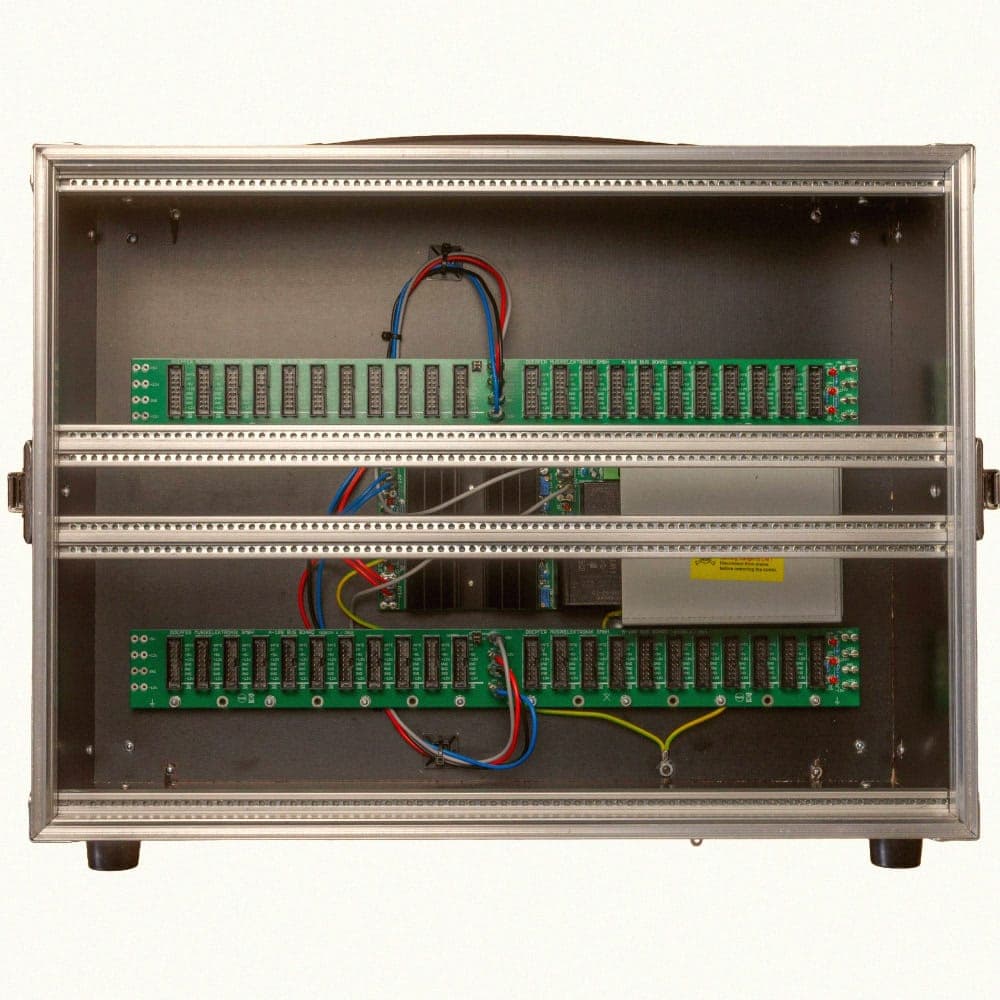
Alongside them sits the A-100P7, a reworked version of Doepfer's existing P6 flightcase. Instead of two stacked 84 HP rows, the P7 slots a dedicated 1U row (built to the Intellijel standard most manufacturers already use) between two full-size rows, so builders can finally mix Doepfer's utility modules with their main patch without bolting on a separate rail. It ships for 719 euros with a 2 to 3 week lead time.
Why did it take Doepfer this long?
Eurorack's own inventor just became the last major brand to ship something in the format it helped turn into a standard.
There's no PR spin here, and Doepfer hasn't offered one. The company has spent three decades iterating almost exclusively on its original 3U grid, from the base A-100 system to the Monster cases and low-cost housings. 1U emerged around 2016 as a way to park clock dividers, attenuators, and small utilities without eating premium 3U space, and Intellijel's 1U Palette series effectively wrote the spec everyone else now builds to. Doepfer sat that out while Pulp Logic, 2hp, and dozens of smaller builders filled the category. Catching up now, with a case and a half-dozen modules in one drop rather than a token single product, suggests the company wanted to do it properly or not at all.
Why it matters
Doepfer's name still carries weight with builders who started on the A-100, so a full 1U lineup from the format's originator gives the category a kind of retroactive legitimacy, and it also means those builders no longer need a third-party case or rail to use 1U gear inside an all-Doepfer rig.
What we think
It's a genuinely good drop (a six-input mixer and an eight-step sequencer in 1U are useful, not filler) but the real story is the timing. Doepfer didn't need to validate 1U. 1U validated itself years ago. This is a founder admitting the rest of the room was right.