What does Instrument X actually replace?
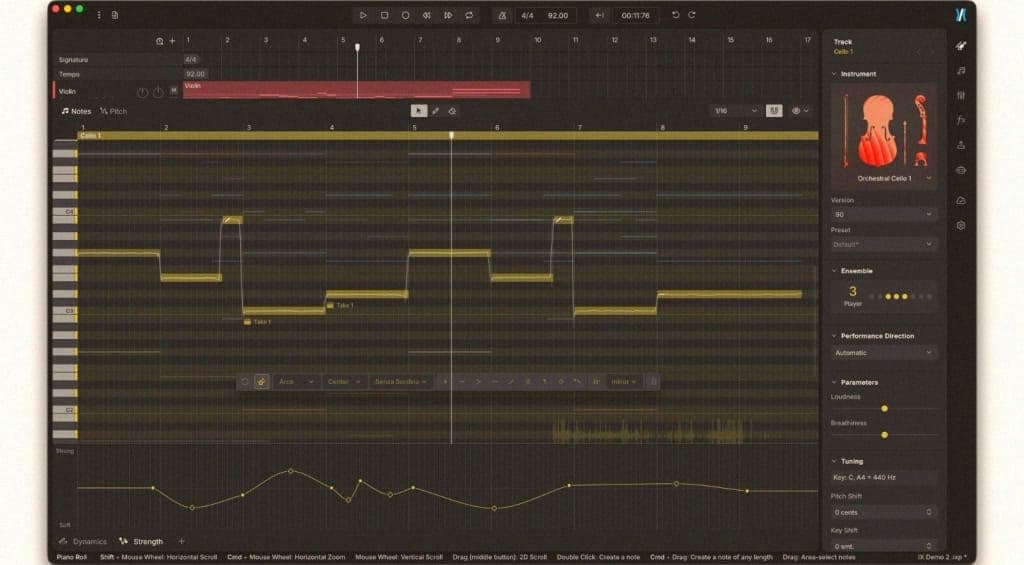
Dreamtonics, the Tokyo studio best known for its vocal-synthesis engine Synthesizer V, launched Instrument X on August 26, 2026: its first attempt to bring neural synthesis to a full orchestra. Instead of triggering pre-recorded samples the way virtually every string, brass or woodwind library has worked since the 2000s, Instrument X generates the sound directly from notation, using what the company calls physics-augmented neural networks. Those networks were trained using a custom dodecahedral speaker array that mapped the acoustic geometry of a real studio, so the engine can separate a dry instrument's tone from the room's own behaviour and reconstruct both on demand. It runs entirely on a local machine, no GPU or internet connection required, and models up to 11 simultaneous microphone perspectives, from tight close mics to a Decca tree array to room ambience.
The launch lineup covers 15 instrument expansions across orchestral strings, woodwinds, brass and a jazz saxophone collection, priced individually at $99 and up, with curated bundles running $158 to $279. The core editor is free once you own at least one expansion. Founder Kanru Hua frames it as the third leg of the company's catalogue, alongside Synthesizer V Studio 2 Pro and the voice-conversion tool Vocoflex: "rather than overloading a single workspace, Instrument X should stand as a distinct, dedicated platform, completing our trilogy."
Why should house and techno producers care?
Orchestral strings and horns don't show up much in a straight four-on-the-floor loop, but they show up constantly in the moments that make a house or techno record memorable: the string swell under an afro house breakdown, the brass stab sampled off a 1970s soundtrack record for an organic house intro, the cinematic pad that turns a deep house closer into a festival moment. Getting those textures right has traditionally meant one of two paths: paying for a multi-gigabyte sample library built for film scoring, or digging through vinyl for the right old recording to chop, which is its own skill and part of house music's sampling culture. Instrument X collapses both into a plugin that fits on a laptop and responds to a MIDI line in real time, which matters a lot to a producer working in a bedroom studio without the storage or budget for a full orchestral template.
"You could pay a lot more for just the library storage of a WAV-heavy orchestra."
That's a real cost Instrument X is targeting directly, and it's the argument in its favour: cheaper, faster, smaller access to sounds that used to require either deep pockets or a record crate.
Is this a shortcut or a threat to the craft?
The other side of that argument is what's actually being debated in production forums right now: if the string section in your track is generated rather than sourced, does it still carry the specific, imperfect character that made sampling an art form in house music in the first place? A neural network trained to reconstruct a "coherent" studio sound is, by design, smoothing toward an average. Crate-digging never optimizes for coherence, it optimizes for the one weird, cracked, mono recording that makes a loop sound like nothing else on the dancefloor. Dreamtonics isn't claiming to replace that instinct, and Instrument X is a tool for people scoring and arranging real instrumental parts, not a sample-flip machine. But the same efficiency argument that makes it attractive to a producer on a deadline is exactly what worries anyone who thinks the grain and history baked into an old sample is the point, not a limitation to engineer away.