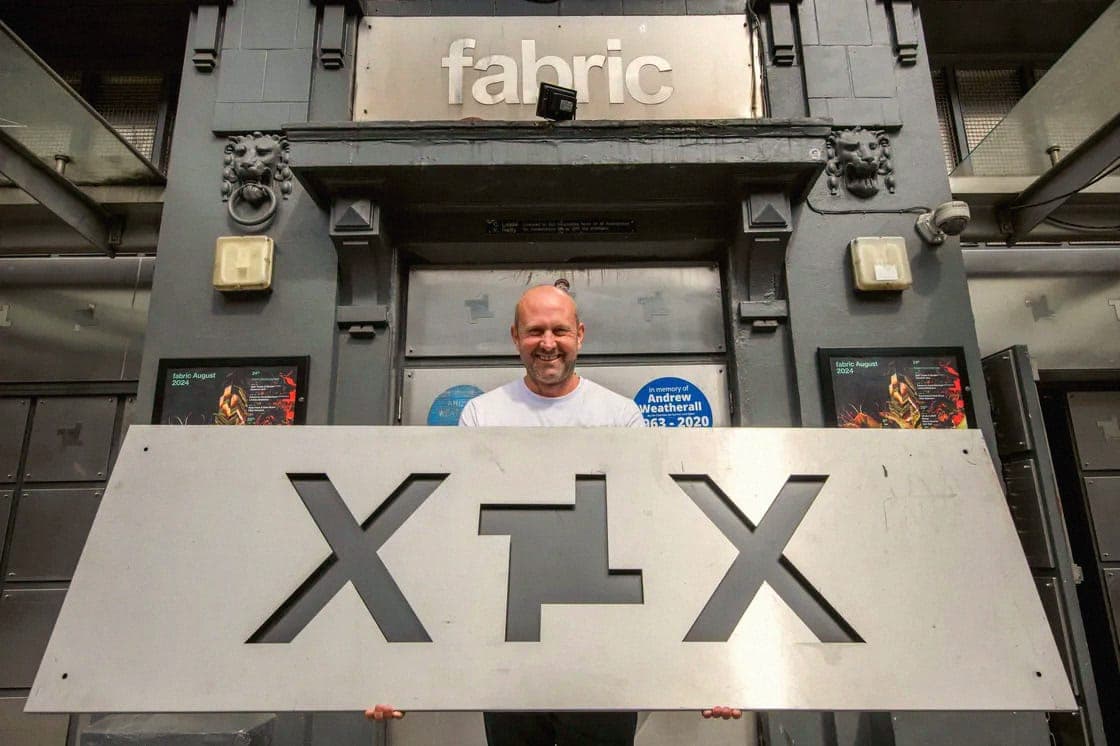
Ten years ago the story around fabric was a council hearing, a revoked license and a real fear the club would never reopen. Now a piece of its exterior is being catalogued, conserved and mounted behind glass in a national museum, a few hundred metres from where the club actually stands.
London Museum says fabric is donating the metal sign that hung outside the Farringdon venue in 2019 to mark its 20th anniversary. The sign will go into 'Hanging Out,' a permanent installation the museum describes as a celebration of the meeting spots that bring London's communities together, according to the museum's press office. It opens alongside the rest of London Museum on November 28, 2026, when the institution moves into the restored General Market building at West Smithfield, timed to the museum's own 50th anniversary, per the museum.
Why is a museum collecting nightclub signage?
Because London Museum went looking for it. The museum has been running a public call-out for signage from the last 80 years, specifically anything at least 50x50cm, and says it is still trying to track down more pieces for the same display, per curator Beatrice Behlen, who called fabric "truly at the heart of Smithfield's creative pulse." fabric's sign isn't a one-off nod either: the club and the museum have been formal neighbours-in-waiting since 2022, when fabric was named the world's first nightclub-in-residence at a museum, per London Museum's press office. That relationship keeps building. Co-founder Cameron Leslie said the club is "excited to welcome London Museum as our soon-to-be neighbours" and called it "great to see the club recognised for the community we have built," per the museum.
What does fabric actually get out of this?
More than wall space. Per the museum, fabric and London Museum will run a monthly 'House Party' social gathering starting February 2027, sitting inside a broader day-to-night programme that also includes a Tuesday Tea Club, a monthly Dinner Club, family Playdates and Shared Late Nights built around DJ sets. The museum itself is organised around three permanent galleries, Real Time, Our Time and Past Time, with Our Time working as the central hub, per London Museum.
"fabric is truly at the heart of Smithfield's creative pulse.", Beatrice Behlen, Senior Curator, London Museum
What makes this land, rather than read as a routine acquisition, is the distance fabric has actually travelled. This is a club that spent years fighting simply to keep its licence and its doors open, in a period when London lost venue after venue to the same pressures. A museum choosing to preserve its signage as civic heritage, not as a footnote, is the establishment conceding the point clubbing culture has been making for decades: that a dancefloor is as much a part of a city's fabric, no pun intended, as any market hall or town square.
Why it matters
A sign in a state collection is a small object with a large signal: London's official cultural record now includes nightlife as heritage, not just as controversy, which matters for how every embattled club argues its own civic value going forward.
What we think
This is the right kind of institutional recognition, not a sanitised one. Housing fabric's sign a short walk from Smithfield Market says the city finally treats a surviving underground venue with the same seriousness as its historic markets, and the ongoing 'House Party' partnership means it's a living relationship, not a glass case.
Sources: London Museum press releases, 2026-08-29 and 2026-06-18.