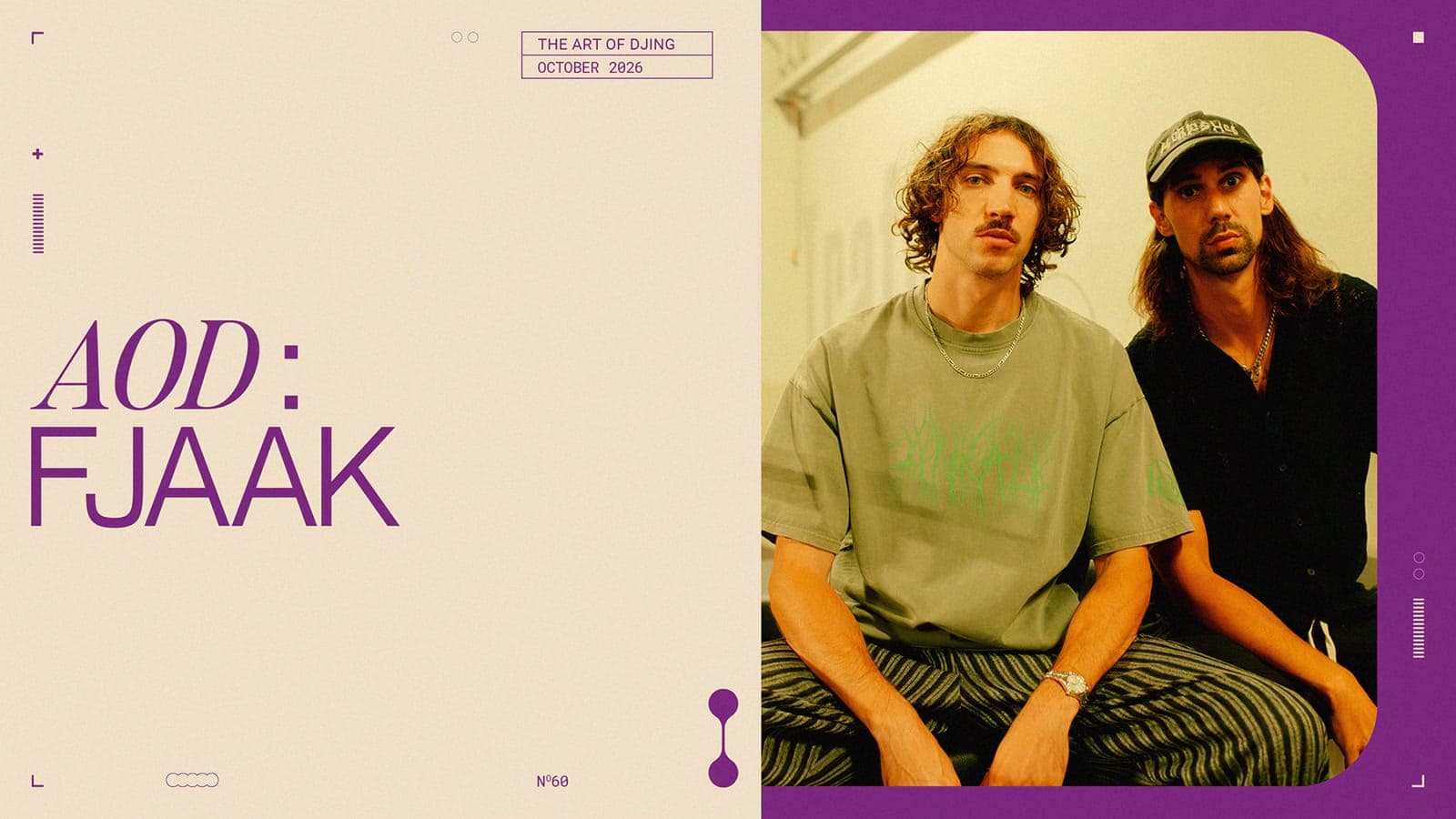
Twenty years is a long time to keep saying no to a laptop. FJAAK, the Berlin duo of Felix Wagner and Aaron Röbig, are the subject of Resident Advisor's latest "Art of DJing" feature, published October 6, 2026, written by Sophie McNulty with photography by Kasia Kim-Zacharko and film by Mario Bergmann. The piece calls them, almost two decades into the project, still restless enough to build a new hybrid techno show, one that folds their hardware-driven live performance and their vinyl crate digging into a single set, with groove, not genre or gear, as the actual obsession underneath it.
What's actually different about FJAAK's show?
Most touring techno acts in 2026 run a USB stick and a laptop. FJAAK have spent their career doing the opposite: a live rig built from drum machines and analogue synths, and DJ sets pulled from records rather than a hard drive. Per RA, their new show pushes that further, blending the two formats rather than keeping them as separate bookings. It's a real distinction in a scene where "DJ set" has quietly come to mean a controller and a folder, and it's the reason a profile about them runs in a series literally called The Art of DJing rather than a release feature.
Why build a whole act around refusing the laptop?
The hardware obsession isn't new branding. FJAAK's rig has long run through Roland 909s and 808s, Moog and Elektron boxes, a Korg synth, and a battered Akai MPC so prone to deleting tracks that the pair started keeping notebooks just to not lose ideas. Felix Wagner has been blunt about the one piece he won't let go of: "We fucking love acid," he's said of the Roland TB-303, of which they own both an original and a modified clone. Aaron Röbig has described the whole approach in simpler terms: "We just try to reproduce the best energy we have." That's a harder thing to fake live than clicking play on a pre-rendered set, and it's exactly the kind of risk that gets you booked by a series built around the craft of DJing rather than the fact of it.
"We fucking love acid."
Who are Felix Wagner and Aaron Röbig, and why does it matter now?
FJAAK started in the late 2000s as a four-piece among friends from Spandau in west Berlin, including Wagner's brother Johannes and producer Kevin Kozicki. Johannes left first; Kozicki departed in 2019, after the Havel album, leaving Wagner and Röbig to run the project alone. They release through two labels of their own, FJAAK and Spandau20, the latter named for their old postal code, alongside 2017's self-titled debut LP on Monkeytown Records, 2018's Havel, the club-support Support Your Scene EP series, and 2024's FJAAK THE SYSTEM. Wagner has made no secret of why that structure suits them: "This isn't gonna be the album of ours that gets 30 million streams. The industry is so boring, everything has to be five months in advance." Röbig put the bigger picture even more plainly: "Man, we're just musicians."
Why it matters
The laptop-and-USB generation runs most of the techno circuit now, which makes FJAAK's hardware-and-vinyl hybrid show a live argument for a different standard: that DJing and performing live are still skills, not settings, and a scene that forgets that loses something real.
What we think
The "is it DJing or a band" debate is a distraction. What actually matters is that FJAAK built a rig that forces real decisions in the room, the kind that can go wrong, which is exactly why it also goes right in a way a synced playlist never will. That's worth more respect than another festival headliner syncing a USB stick and calling it a set.