Why does decoupling the sequencer from the drums actually matter?
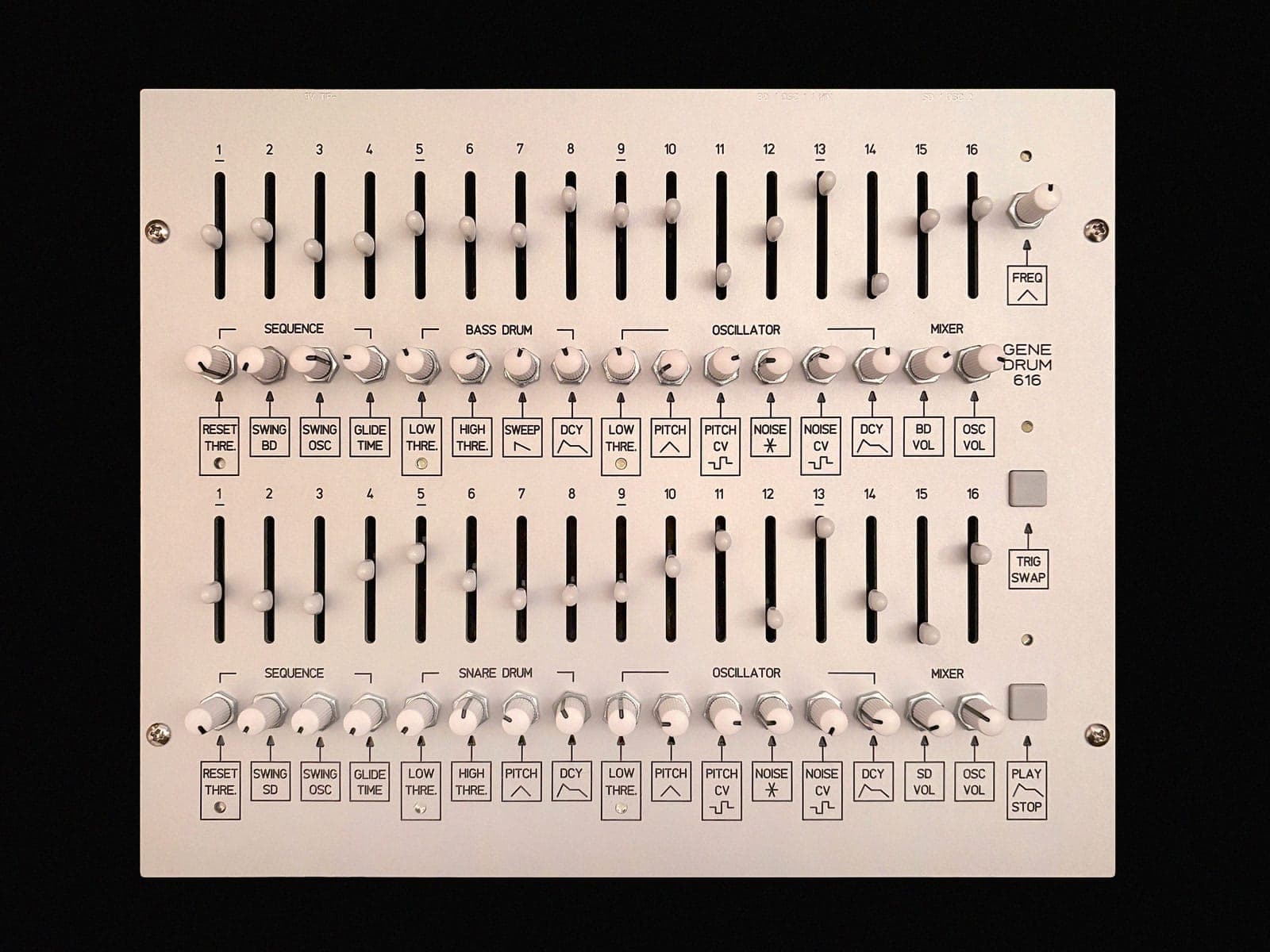
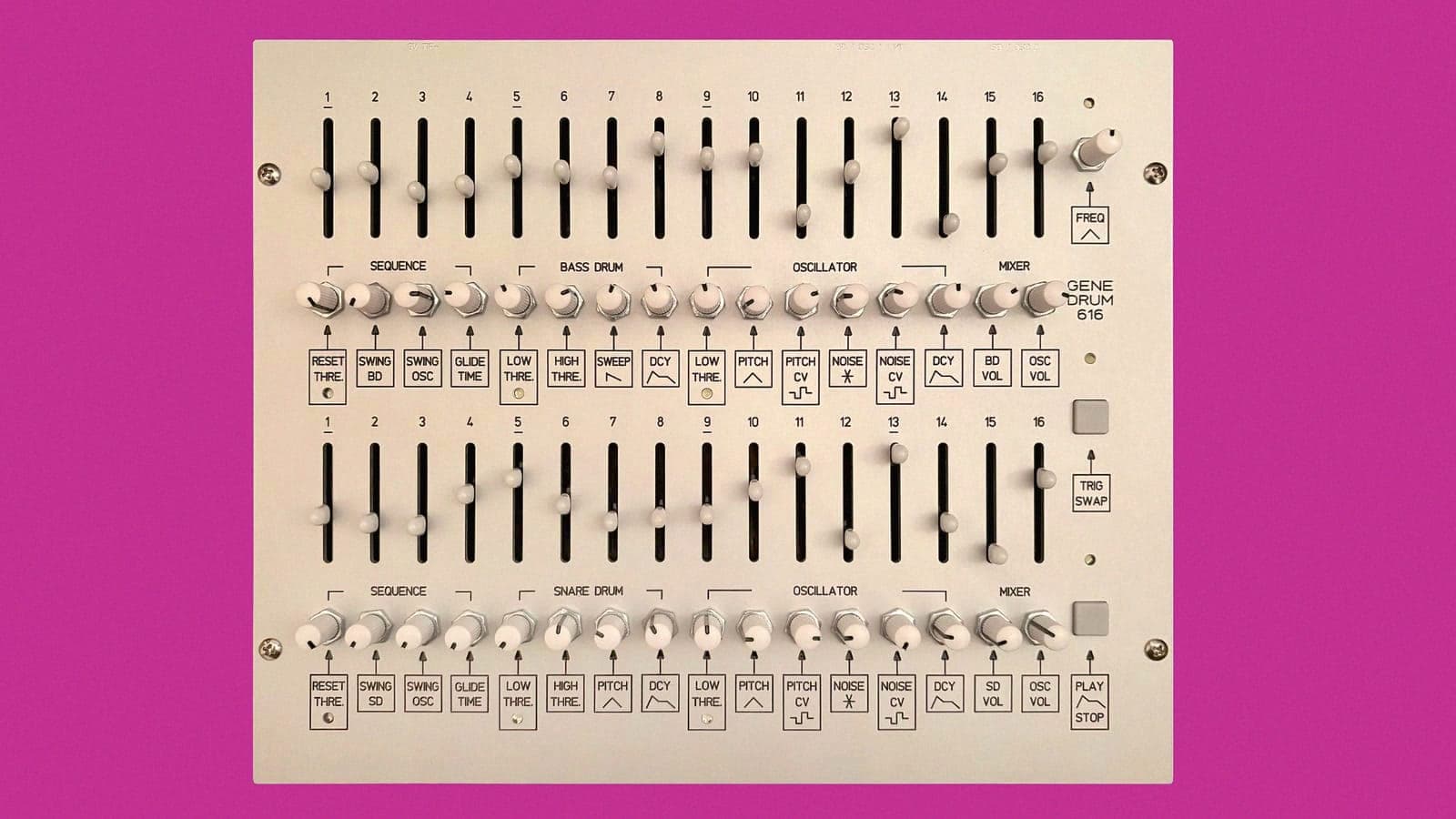
On almost every drum machine ever built, step 1 of the sequence fires voice 1, step 2 fires voice 1 again or voice 2, and so on in lockstep. The sequencer and the sound source are welded together. Gene Synths built the GENE 616 around breaking that weld. Its two 16-step sequencers generate CV and trigger streams that are routed to the four drum generators independently of each other, so a sequencer can run its own length, its own glide time and its own swing while the drum voice it's feeding reacts on its own terms. Patch it the obvious way and you get a normal four-voice drum machine. Patch it the other way and the CV sequence becomes a melodic line riding on top of percussion hits that no longer have to land where the steps say they should.
The mechanism that makes this useful rather than just chaotic is the threshold control on each generator. Every drum voice has a low and a high threshold, and only CV values that fall inside that window trigger a hit. Feed the same 16-step CV sequence into two generators with different threshold windows and you get two different rhythms out of one pattern, shifting from a dense fill to a sparse polyrhythm by turning a knob rather than reprogramming a step sequence. That is the real difference from a standard drum machine: the pattern isn't fixed data, it's a continuous signal that each voice reads selectively.
What's actually in the box?
Four voices make the sound: a bass drum generator with pitch sweep and decay, a transistor-circuit snare with its own pitch and decay, and two further multi-waveform oscillators that can behave as drum voices or as tonal elements depending on how they're triggered. Germanium diode overdrive circuits are switchable per voice for grit. A Trigger Swap function lets you cross the two sequencers' triggers between generators on the fly, and quantized swing is available across all four voices independently rather than as one global setting. CV and clock inputs and outputs are available for patching into a wider modular rig, and the whole thing ships in a hand-made wood case rather than a stamped metal shell, priced at $2,424 USD, £1,799 GBP or €2,199.88 EUR including tax.
Decoupled CV/trigger sequencing lets the pattern become a signal a voice reads, not a script it has to follow.
Who is this actually for?
Gene Synths is explicit that the GENE 616 draws on experimental drum machines and modular systems going back to the 1960s, the lineage of gear built by people who treated rhythm as a voltage problem rather than a pattern-grid problem. That puts it closer to a Serge or Buchla-style percussion patch than to a TR-808 clone, and it's priced and built (hand-made wood case, no screen, no quantized step grid in the conventional sense) for someone already comfortable thinking in CV, not someone shopping for their first drum machine. For industrial techno, EBM and modular-leaning producers who have been building this kind of decoupled rhythm by patching a sequencer into a handful of separate modules, the GENE 616 packages that exact workflow into one box.