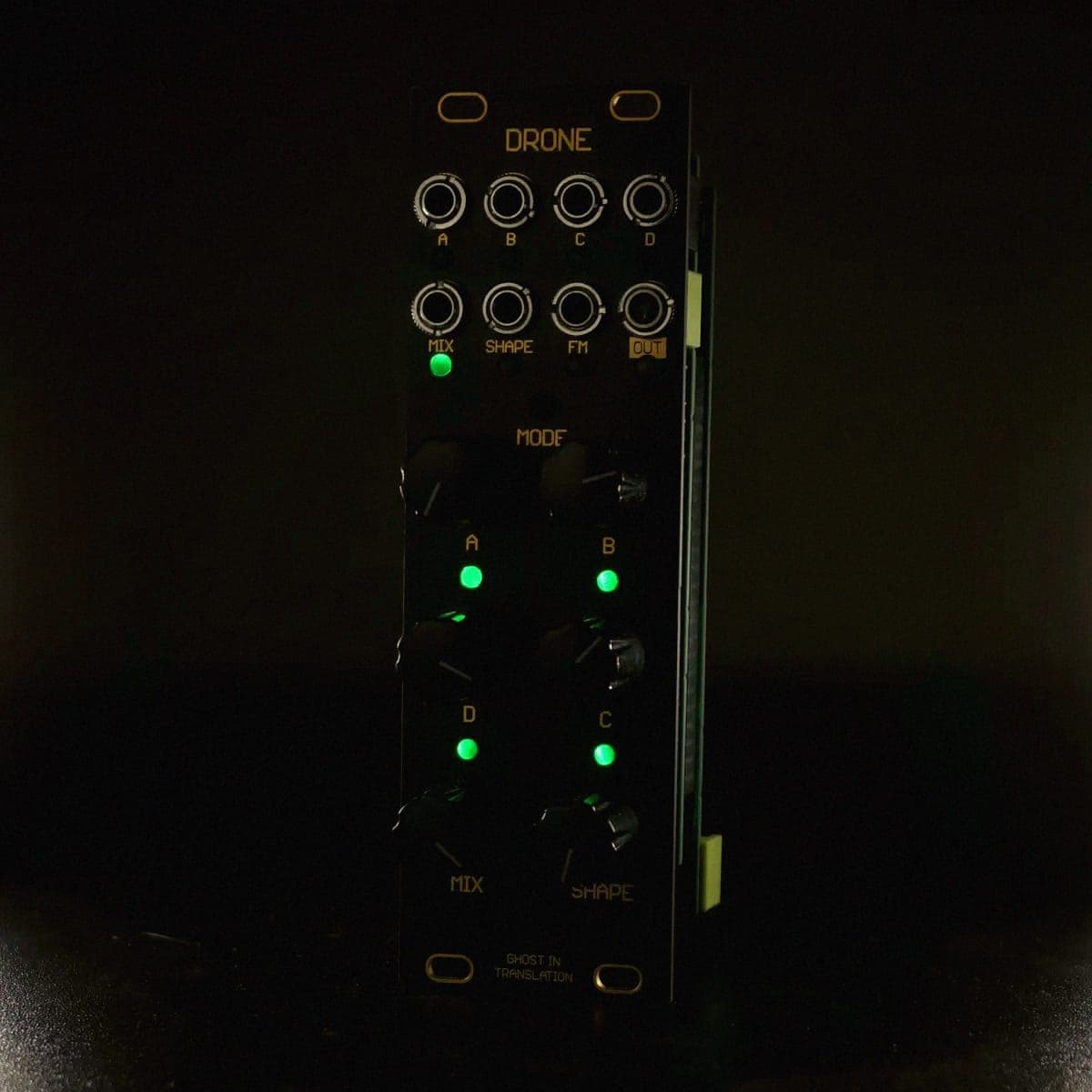
Most drone modules in Eurorack are sealed boxes. You turn the knobs, you get a sound, and the DSP doing the work stays proprietary, whatever chip and code the maker chose to hide behind the panel. Ghost In Translation's new module, Drone, breaks that pattern in the one place that matters most to anyone who actually builds and hacks their own systems: the code.
Drone is an 8HP stereo module built around four fully independent voices, each running through a 32-bit float DSP engine. That engine, the actual synthesis code shaping every drone the module makes, is published in full on GitHub rather than compiled into a locked firmware blob. Ghost In Translation has built its whole catalog this way since its earlier Teensy-based modules like Synth and DS9, and Drone continues that stance rather than starting it.
What can you actually do with it?
Sixteen algorithms are onboard, covering a wide spread of drone and texture behavior: Sine-Resonant Noise, Resonant Noise, Sine-Phaser-Ring, Sine-FM, Saw-Comparator, Slink Filter, plain FM and a wavefolder among them. Each of the four voices runs one of these independently, so a single 8HP module can layer four distinct textures into a stereo field rather than one voice panned wide. A built-in looper records knob movement, up to a minute freely or 32 bars locked to MIDI clock, which is what turns a static drone into something that evolves across a set without a modulation source patched in from elsewhere in the case.
Open sourcing the DSP means anyone with a Teensy and a soldering iron can study, fork or extend the exact synthesis engine running inside a commercial module, not just its panel.
Why does open DSP actually matter here?
For most listeners, a locked chip and an open repository sound identical on the first patch. The difference shows up later: when a bug needs fixing five years after the maker moves on, when someone wants to port an algorithm to a DIY build, or when a sound designer wants to understand exactly what "Slink Filter" is doing mathematically rather than take a marketing name on faith. Eurorack has a real DIY culture built on shared schematics and open firmware, from Mutable Instruments' influence onward, and Drone's GitHub repository puts it in that lineage rather than the sealed-box side of the market.
What's the actual cost and timeline?
Ghost In Translation is running an early-bird batch at EUR 199, rising to a EUR 279 standard price once that batch sells out. The maker's own product page lists the early-bird units shipping from August 21, 2026.