HARMONICO dsp isn't a name most producers know yet. That changed on August 19, when the Paris outfit put out four plugins at once, each one built around a physical phenomenon rather than a hardware emulation. Founder Nicolas Barreau is a sound engineer and acoustician, and it shows: none of these tools pretend to be a vintage compressor or a classic delay unit. They're named after the physics they simulate.
Why build a reverb around bird flocking?
Murmuration, the reverb, takes its modulation from a real-time flock simulation, the kind of algorithm normally used to animate starling murmurations or fish schools, feeding a 64-line feedback delay network. Most reverb plugins modulate their delay lines with LFOs or simple noise generators; a flocking algorithm produces correlated, organic movement between lines instead of independent randomness, which is the whole pitch: a tail that shifts the way a crowd of birds banks together rather than the way a machine wobbles. It ships with seven voicings and external sidechain ducking, and costs 59 euros at launch (79 euros regular).
What makes the free plugin actually worth having?
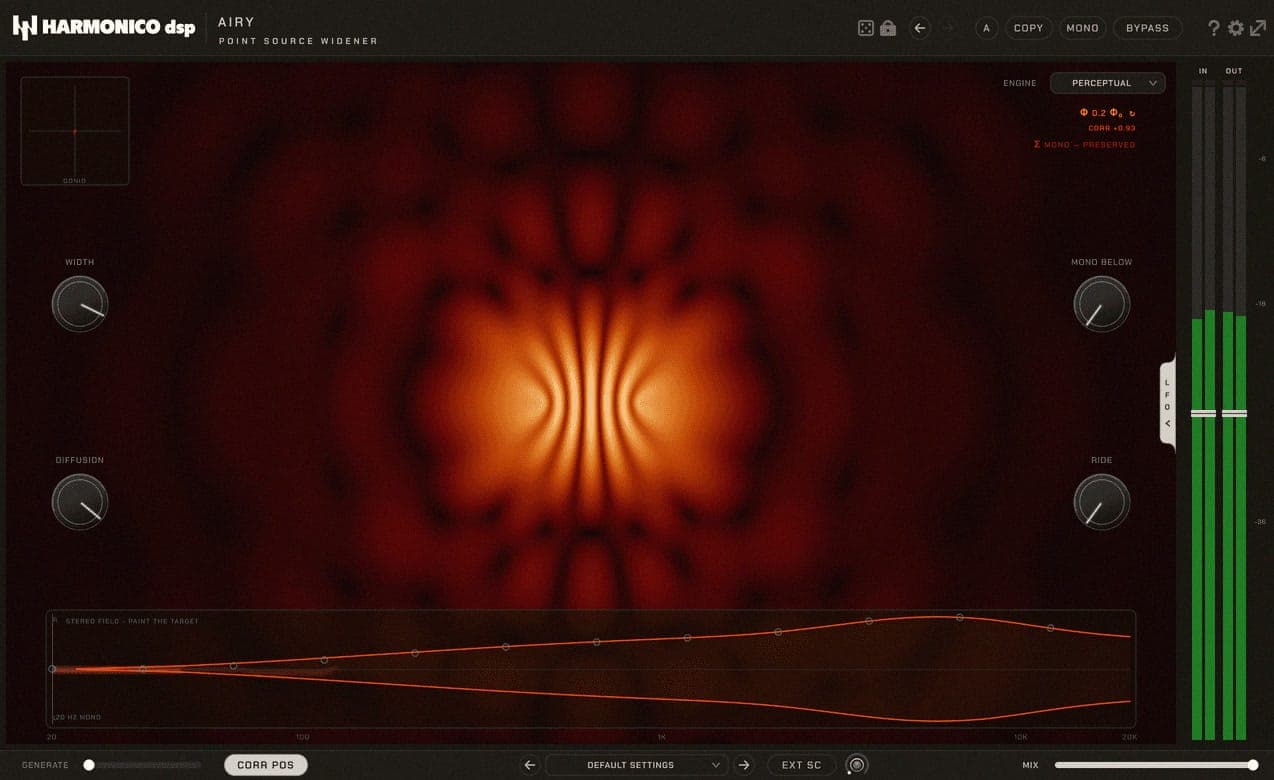
Airy, the free stereo widener, is the one worth grabbing even if you ignore the rest of the catalogue. Cheap wideners fake width by shifting phase between channels, which sounds big in stereo and collapses or thins out the moment a mix is summed to mono, a real problem on club systems and phone speakers alike. Airy instead measures inter-channel coherence band by band and synthesizes only the width that's actually missing, keeping the side channel additive rather than phase-shifted. HARMONICO dsp names it after the Airy diffraction pattern, the rings of light that appear around a point source seen through a lens, as the inspiration for treating width as something added around a solid mono core rather than smeared across it. No account or activation required, just an email for the download link.
The other two releases round out a producer's signal chain: Spectral Mass Rebalance is a multiband EQ that tilts spectral energy around a pivot tracked from the incoming material rather than a fixed frequency curve, and Earthquake Distortion Device is a 24-band saturator where a simulated clay terrain fractures under the signal, with distortion character that accumulates and heals per band over time. Both run 14-day full trials, and the whole three-plugin bundle is 149 euros through September 12.
None of these four plugins emulate a piece of studio hardware. They simulate diffraction, tectonics and flocking, then let a mix engineer turn the knob.
Why should deep-tech producers care?
For anyone mixing in the deep-tech and minimal space, where low-end control and a controlled stereo image matter more than genre-defining color, a mono-safe widener that costs nothing and a physically-modeled saturator that isn't another 1176 clone are both genuinely useful additions to a small studio's toolkit.