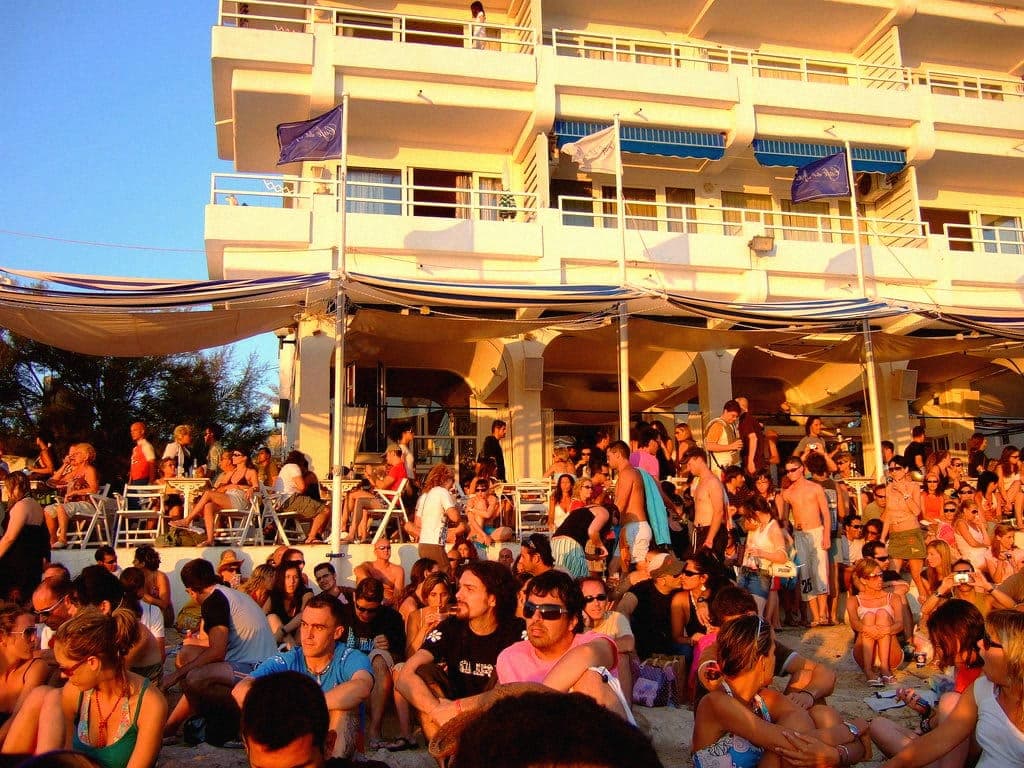
Ibiza's illegal-party scene isn't hiding in a field with a generator and a prayer anymore. It's running shuttle buses.
On June 10, 2026, Local Police and the Civil Guard broke up a party for roughly 1,000 people at a villa off Camí Vell de Sant Mateu, on protected rural land in the Es Amunts area near Sant Antoni de Portmany, a zone where building is restricted for fire risk. What they found wasn't a rogue house party that got out of hand. Per Periódico de Ibiza and a companion report from Noudiari.es, the site had multiple distinct music areas, a portable carousel, a medical tent staffed with an ambulance crew, paid staff directing parking, a shuttle service ferrying guests in from pickup points, portable toilets, generators, and wristbands to control entry. That is not a party plan. That is an events-company production sheet.
How does a 300,000-euro fine become 180,000?
Sant Antoni's council opened the file with a proposed sanction of 300,000 euros, treating the breach as a very serious violation under Balearic Law 7/2013, the framework governing activity licensing on the islands. The promoters' first move was to deny the facts. Then, per Periódico de Ibiza's July 28 report, they reversed course: they admitted responsibility and waived their right to appeal, which under the standard administrative process earns a 40 percent reduction for early acceptance. Final bill: 180,000 euros, paid in advance to close the case.
Run the math on 1,000 attendees and that's around 180 euros a head, a line item a promoter can quietly build into a budget rather than a number designed to make anyone think twice. The municipal resolution didn't see it that way: it stressed the "special gravity" of the breach for environmental protection, public safety and the tranquility of neighbors on land that isn't supposed to hold a party at all, let alone one this size.
Why does a single Sant Antoni case matter beyond Sant Antoni?
Because the infrastructure is the story, not the fine. A carousel and a staffed medical tent mean someone budgeted for this the way a festival budgets for a main stage, banking on the fact that even a worst-case sanction, discounted for good behavior, still pencils out against 1,000 tickets sold off the books. Ibiza's licensed club economy already runs on eye-watering door and bottle prices that draw plenty of resentment on their own; an unlicensed shadow circuit operating at the same scale, on protected land, with a known and negotiable price for getting caught, is the same economics with the safety net and the tax bill removed.
The municipal resolution cited the "special gravity" of the breach for environmental protection, public safety and neighborhood tranquility.
No promoters or DJs were named in either outlet's coverage, and the case is now closed. What's left on record is the template: rural villa, protected land, four-figure crowd, and a fine that reads less like a deterrent than a cost of doing business.
Why it matters
When a settled fine works out to roughly 180 euros a head against an initial sanction that was itself discounted 40 percent for cooperating, the economics stop discouraging the next villa rave and start pricing it. That's a policy failure dressed up as an enforcement win.
What we think
A 40 percent knockdown for admitting what Local Police and the Civil Guard already documented on-site isn't leniency for good faith, it's a built-in discount that promoters can price into the business plan before the first shuttle bus even leaves the pickup point. If Ibiza wants this economy to actually shrink instead of just getting a little more expensive to run, the number attached to getting caught needs to hurt more than the ticket revenue it interrupts.