Kieran Foster spent two decades making producers destroy their own tracks on purpose, and got them to love it. The British developer, known across forums as illformed, dblue and MaDHaTTeR, has died at 47. Within days, the friends who kept his code alive turned his signature plugin into a free download, adding the modern plugin format it always lacked.
What made Glitch different?
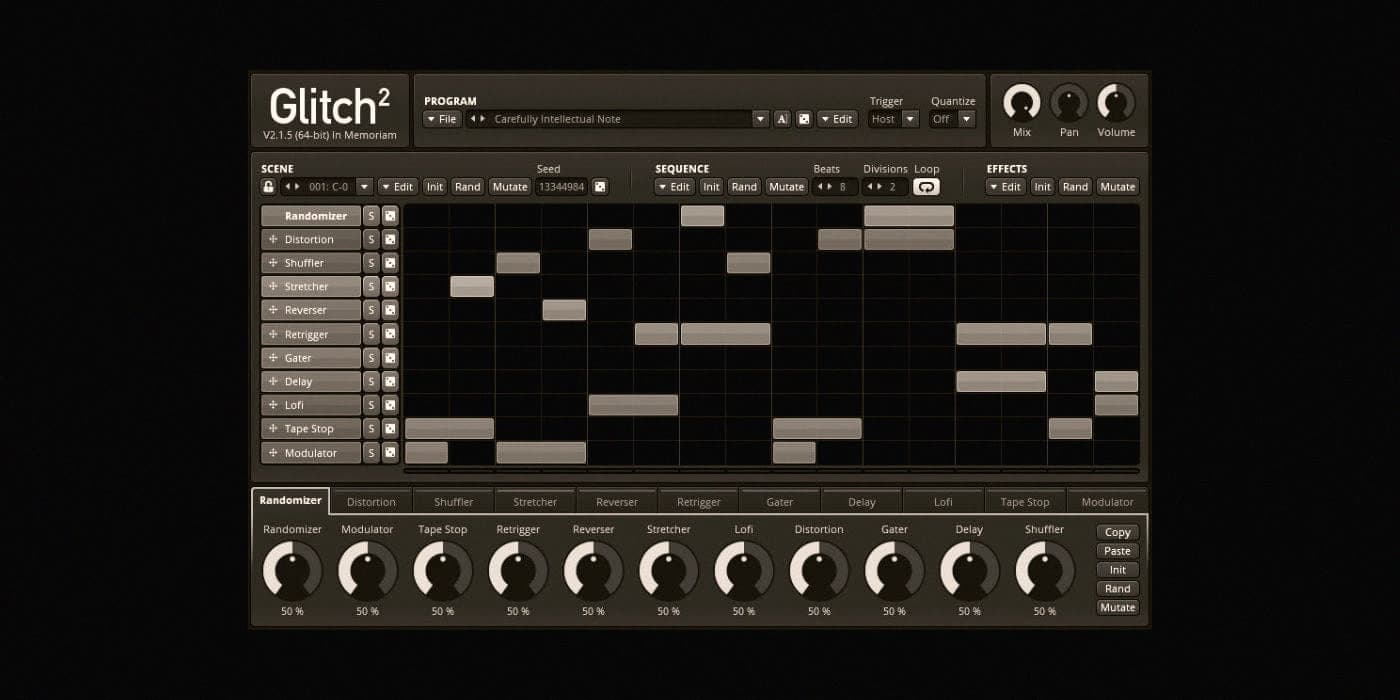
Foster released the original Glitch in 2005, at a moment when most effects plugins were still trying to sound clean. Glitch did the opposite: it let producers program stutters, reverses, retriggers and tape-stops onto a tempo-synced step sequencer, turning a static loop into something that lurched, skipped and rebuilt itself in real time. For a generation who came up on tracker software and early home-DAW forums like Renoise's, it was one of the first tools that made computer music feel genuinely experimental rather than a copy of a hardware studio. Foster was a longtime fixture of the Renoise community, where his coding chops shaped how that scene approached tracker-based production.
Glitch² followed in 2013, expanding the idea into a full multi-effects rack: distortion, shuffler, stretcher, reverser, retrigger, gater, delay, lo-fi and a modulator, each triggered step by step rather than played as notes. The approach was influential enough that Sugar Bytes has pointed to Glitch as a direct inspiration for its own Effectrix plugin, released in 2008.
What happens to Glitch² now?
After Foster's death, a developer friend went into the plugin's code, added VST3 support (the format Glitch² had never officially shipped in) and released the whole thing as freeware. It now runs as VST, VST3 and AU on both Apple Silicon and Intel Mac, and on Windows, meaning the tool that shaped a decade of glitch and IDM production is now available to any producer with a modern DAW at zero cost.
"His plugin is one of the most fun FX plugins ever developed. And when version 1 came out, it was one of the most innovative."
Bedroom Producers Blog's Tomislav Zlatic put it plainly, recalling that the original dblue Glitch was one of the first plugins he ever used, back around 2008: it "was chaotic and fun, and it opened doors I did not even know existed yet."
Why does this matter beyond nostalgia?
Foster's tools weren't a house or techno plugin specifically, but the vocabulary he built (stutter edits, glitch retriggers, tempo-locked chaos) has been absorbed into deep-tech, minimal and experimental house production for years, wherever producers reach for rhythmic destruction instead of a clean transition. Losing the person who built that vocabulary, and gaining free, modern access to the tool that carries it, is a rare moment where a community mourns and gets handed something useful at the same time.