Infinite is the kind of tool that usually takes a team and a pricing page. It's a node-based workstation where modular synthesis, real-time GPU video, 3D rendering and plugin hosting all live on the same canvas, and it's free, open source, and built by one developer: Naman Soni, who goes by n1m21n on GitHub. On October 31 it crossed into version 1.0, and the update list reads like the thing finally caught up to what people were already trying to do with it.
What actually shipped in version 1.0?
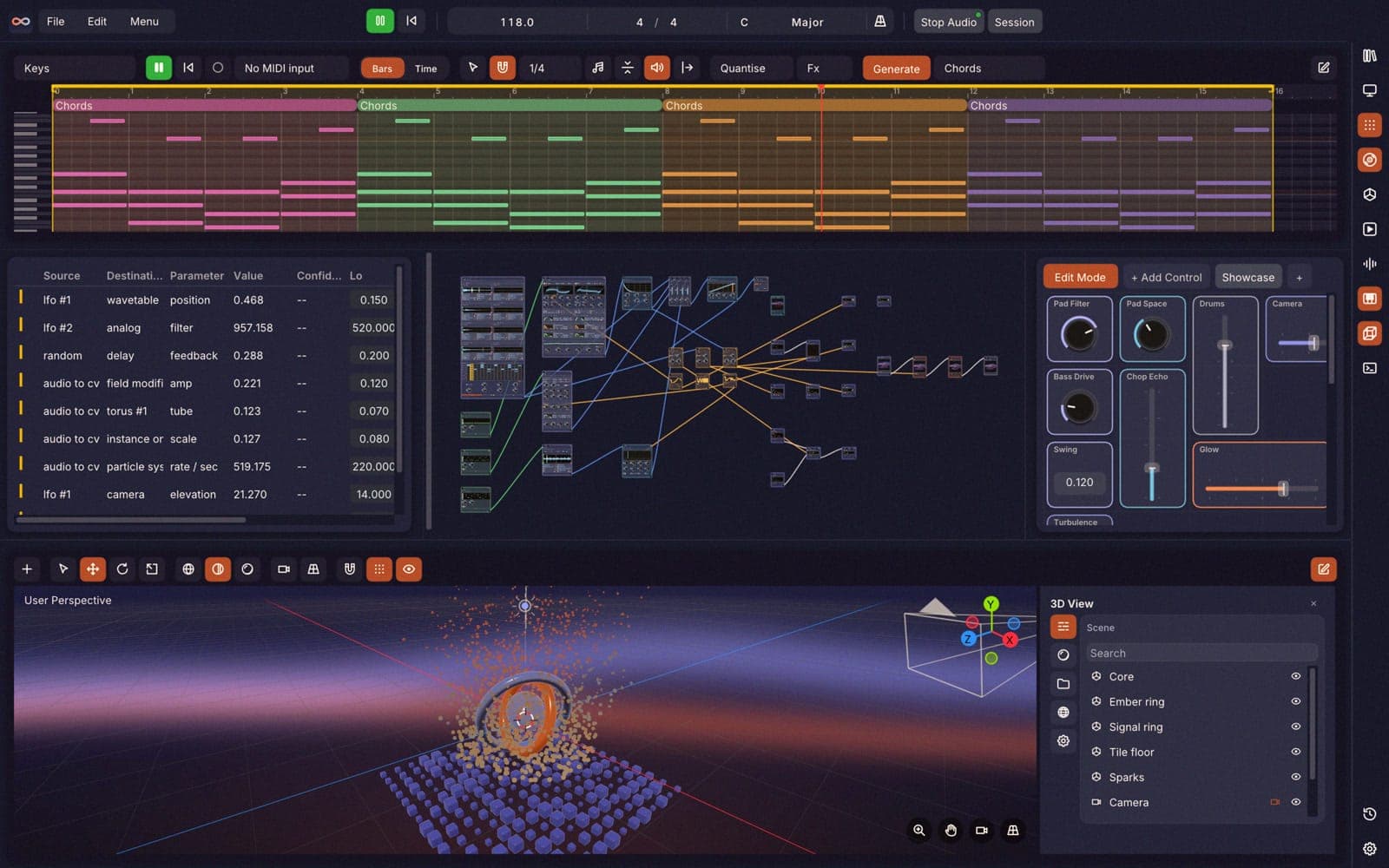
The headline additions are a Piano Roll (MIDI lanes, clips, scale-snap colors, direct .mid import), a Sample Studio for waveform editing and slicing with tempo follow and loop generation, and a Terminal panel that runs real commands against the engine, down to a Windows ConPTY host and settings for headless operation. There's also a 3D View: right-click any node and push its output into a camera-rendered scene with lighting, reflections and glass highlights, then convert it back into nodes if you want to keep patching. Three new physically modeled instruments round it out: a piano with Rhodes and Wurlitzer character, a wind node covering clarinet, sax, flute and brass, and a string node for guitar, harp, violin and cello with pick and bow controls.
Why does one node canvas matter here?
A working VJ rig, a modular synth voice and a plugin chain are normally three different pieces of software, three different workflows, and often three different machines. Infinite puts all of it on one patch: more than 140 node types spanning synthesis, GPU compositing, modulation, analysis and output, plus third-party VST3 and AU hosting that you can modulate with the same LFOs and envelope followers driving your visuals. Need a node that doesn't exist yet? Field, Infinite's built-in language, lets you write a short kernel instead of waiting on a fixed node, and the engine figures out on its own whether that kernel should run as a GPU shader, a geometry processor or audio DSP.
The engine runs headless, with a CLI mode that can render or validate a patch from a terminal, a script or a CI job, no window required.
That headless mode matters more than it sounds: it means a patch can be treated like code, tested and rendered automatically rather than babysat by hand, which is exactly how a one-person open-source project scales past its own developer.
Who is this actually for?
For anyone building live visuals for house or techno sets, or running a modular rig alongside a laptop full of plugins, Infinite collapses the budget and the rig count into one free download for macOS, Windows and Linux, with projects that stay portable and shareable between machines. It won't replace a dedicated mixing console or a battle-tested VJ suite overnight, but a tool with this much range, costing nothing, is exactly the kind of thing that quietly becomes a scene staple.