What is Latent Terrain, actually?
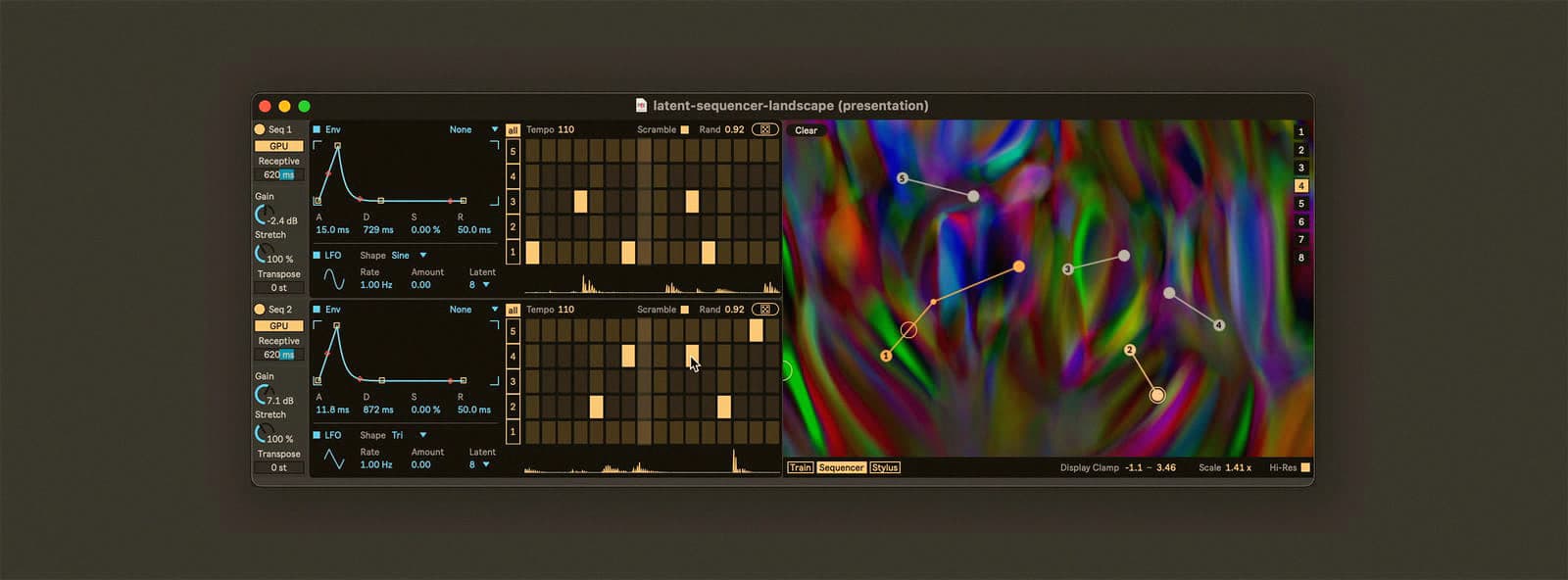
Think of a neural audio model as a giant invisible space where every point is a sound. A "terrain" is a map you draw across that space: you place a few coordinates, and the tool reads out a stream of latent vectors in real time, which the model turns back into audio. Move across the map with an XY pad, a tablet stylus, a gestural controller or a sensor, and the texture morphs under your fingers.
The tool is an open-source Max external called nn_terrain, built by Jasper Zheng, a PhD researcher at Queen Mary University of London. It works hand in hand with nn~, the Max object that runs neural models, and supports pre-trained autoencoders including RAVE (from IRCAM's ACIDS group), Music2Latent and the Stable Audio Open autoencoder. You can even train small networks inside Max to map your own timbres onto the surface.
How is this different from Suno or a prompt box?
A generative service takes a line of text and hands you a finished track out of a black box trained on everybody else's music. Latent Terrain does the opposite. It takes the sounds you feed it, runs entirely on your machine, and lets you crawl through the model's insides by hand. No account, no upload, no waiting for a render.
I'm not particularly interested in typing prompts to make stuff, I'm interested in breaking them and dissecting them.
That single line is the whole philosophy. Where the big AI tools sell predictability and a clean output, Latent Terrain treats unpredictability as the point: a place to get lost, find a sound nobody asked for, and play it.
Why would a producer care?
Because it is an instrument, not a vending machine. It is free, it is tactile, it runs offline, and it keeps your raw material yours. People are already pushing it into strange corners: Keigo Yoshida has driven it from EEG brain data, and Jiatong Liu built "nn/mémoire," a soundscape archive of Beijing's Hutong neighborhoods, on top of it. For a club producer chasing texture rather than autopilot, that is a far more interesting promise than another prompt window.