Why did it take thirteen years?
The KP3+ dropped in 2013 and became a fixture on DJ riders and live-act backlines for years. Then nothing. Soft synths got good, DAWs got powerful, and the case for carrying a dedicated hardware effects box got harder to make. Korg watched the market shift and, apparently, waited it out. The Kaoss Pad V is their answer to the question of whether hardware effects still matter in an era where every laptop can run Ableton.
The honest answer, based on what the KP-V actually does: yes, if the hardware is this capable. The question is whether Korg gave it enough to justify the wait.
What does dual-touch actually change for a performer?
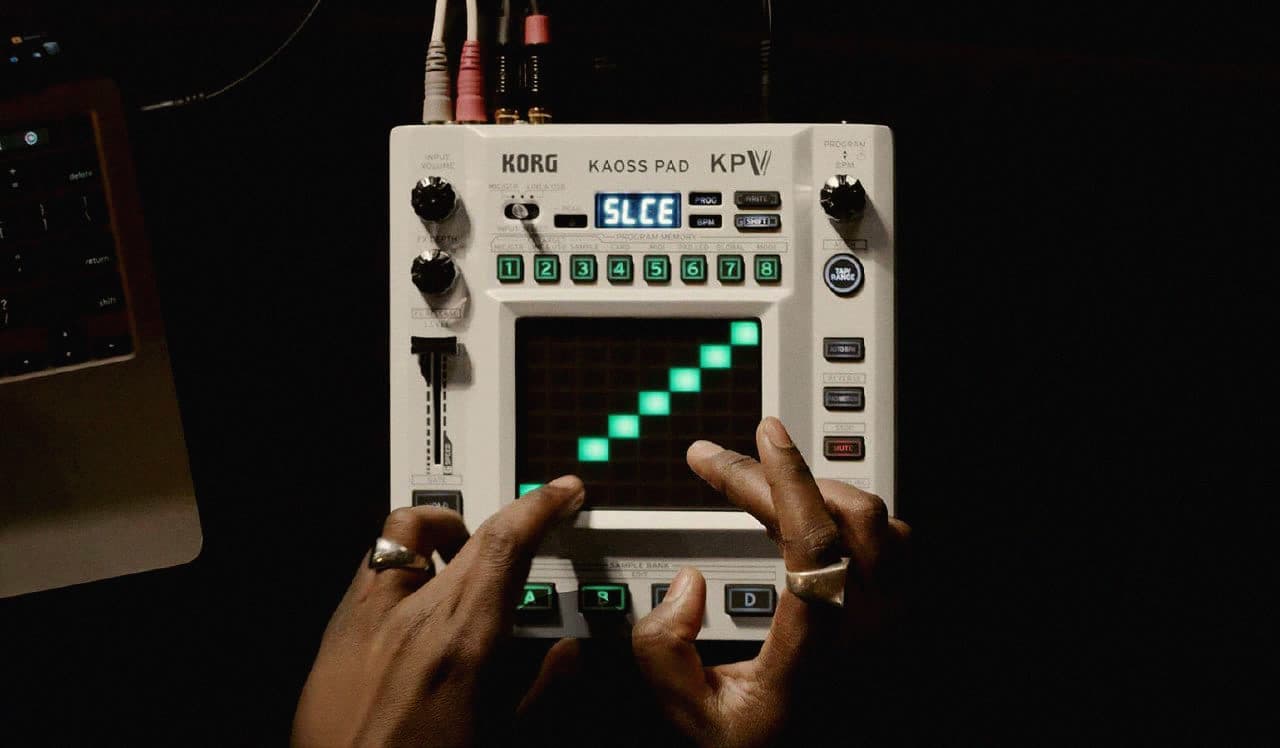
Every Kaoss Pad since the original has been single-touch: one finger, one X position, one Y position, one effect. The KP-V breaks that constraint. Two fingers on the pad simultaneously means two independent effect vectors at once, drag one corner while pinching through the centre, sweep low-pass in one axis while you modulate reverb depth in the other. For live performance, that is a genuine upgrade. It is not a gimmick; it changes the vocabulary of what you can do with your hands on the instrument.
The new Voice FX engine is the other real story here. Pitch-shifting and harmonizing are expected, but voice-controlled MIDI is more interesting: the performer's voice becomes a controller, mapping pitch or dynamics to parameters elsewhere in the chain. For vocalists doubling as live producers, or for anyone running vocals through a DJ set, this is a meaningful addition. The balanced microphone preamp input, combined with simultaneous line-level and USB audio inputs and internal blending, means the KP-V can sit at the centre of a live rig rather than at its edge.
Sampling holds up too: up to 8 bars with BPM sync, slicing, and Step Hold for rhythmic stutters. The 300 patches (200 factory, 100 user) give you a working library from day one without forcing you to start from zero.
The dual-touch pad is the upgrade live performers have wanted since 2013. The connectors are the compromise they will have to live with.
Is $649 the right price for what you get?
At 210mm × 226mm × 49mm and around 1.3kg, this is compact enough for a gig bag and sturdy enough to trust in a live setup. The Hi-Z guitar and bass input removes the need for a separate DI box. The built-in USB audio interface means one less item on the desk. For a piece of hardware that genuinely consolidates several roles (effects processor, voice processor, sampler, audio interface), the price lands in a reasonable range for working performers.
The connectors are where Korg loses the argument. USB-B in 2026 is a choice that requires carrying a specific cable you will forget. RCA outputs in 2026 put the KP-V at odds with the infrastructure most modern DJ setups are built around. These are not legacy holdovers from an old design; this is a brand-new product shipped with connectors that were already dated at announcement. Korg knows better. It reads as a cost-saving decision dressed up as a nod to tradition, and the people who actually use this gear in clubs will notice.