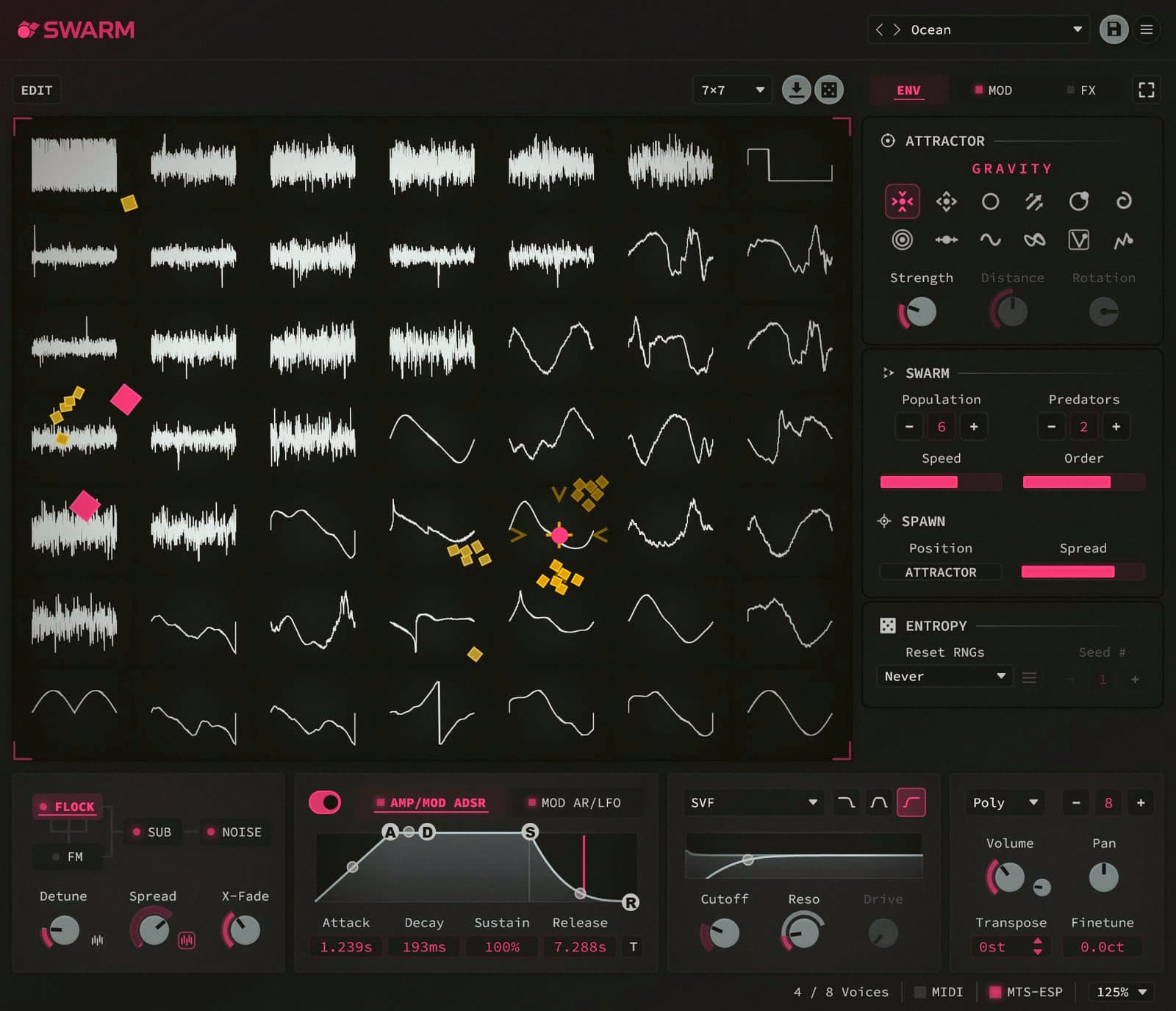
Wavetable synthesis has run on the same basic trick since the Prophet VS and Waldorf Microwave: pick a scan position, move it over time, get morphing timbre. Morpheral Machines just threw that control model out. The Swarm, released November 5, 2026, replaces the scan line with a flock.
Morpheral Machines is the studio of Eduard Muller, the developer best known for building Renoise, the long-running tracker beloved by chiptune and demoscene producers for giving its users total, sample-accurate control over every event in a track. The Swarm is almost a rebuttal to that philosophy on its own terms, built by the same person.
How does the flocking actually drive the sound?
Each voice can carry up to 24 band-limited oscillators, every one of them capable of its own FM, scattered across a 2D grid that holds anywhere from 9 to 169 single-cycle waveforms (a 3x3 up to a 13x13 layout). Instead of a single scan position sliding through that grid, each oscillator is its own "boid" that moves independently, reacting to the position and velocity of its neighbours, pulled by 12 selectable attractor types, and occasionally knocked off course by up to 9 "predators" that perturb the flock. Twelve-voice polyphony means a chord can host more than 280 of these moving points at once.
Morpheral Machines is explicit that this is not generative AI. Flocking algorithms, usually called boid simulations, are a deterministic computer-graphics technique that has been used to animate crowds and bird flocks since the 1980s; here the same math decides which cell of the wavetable grid each oscillator samples next. There is no model, no training data, no inference. Users who want a result they can recall simply lock a seed value, which freezes the exact trajectory every boid will take; leave it unseeded and the patch keeps drifting.
"Trackers give you the power to decide every detail of your music. With Morpheral Machines, I want to explore ideas that complement this: sound that's alive. Sound that has a mind of its own, yet stays within boundaries and rules you set."
The rest of the signal path is conventional by comparison: five filter models, a waveshaper combining wavefolding with a pitch-locked crusher, a tap-cloud delay running 8 independent taps per voice, and a modulation matrix with 32 routings per voice drawn from 17 sources into 28 destinations. The plugin imports WAV, FLAC or WT wavetables, or builds its own grid directly from an audio sample, and supports MPE and MTS-ESP microtuning for anyone running expressive controllers or alternate tuning systems. Around 50 factory presets ship in the box.
What's Desense, and why give it away free?
Morpheral Machines released a second instrument alongside The Swarm: Desense, a free plugin that emulates four flavours of electronic interference, GSM, mains hum, data noise and radio static. It's a smaller, single-purpose tool rather than a stripped-down demo of the main synth, and it gives producers who have no interest in flocking oscillators a reason to still download something from the studio's first release week.
Why it matters
Most "generative" synth marketing in 2026 means a machine-learning model trained on samples. The Swarm is a reminder that there's still unexplored ground in decades-old deterministic algorithms applied somewhere new, and that a seed value can give an evolving patch the same reproducibility a preset has always promised.
What we think
Boid flocking has animated screensavers and crowd simulations for forty years; nobody had wired it directly into a wavetable oscillator bank and called it an instrument. That's the kind of lateral move that's more interesting than another filter model, and coming from the person who built Renoise, a tool that is the opposite of "let the algorithm decide," makes the swing toward controlled unpredictability a genuinely personal statement rather than a trend chase.
The Swarm is available now as a demo and full purchase directly from Morpheral Machines, with the $59/€59 introductory price running through November 30, 2026 before it settles at $79/€79.