What exactly did Neve build?
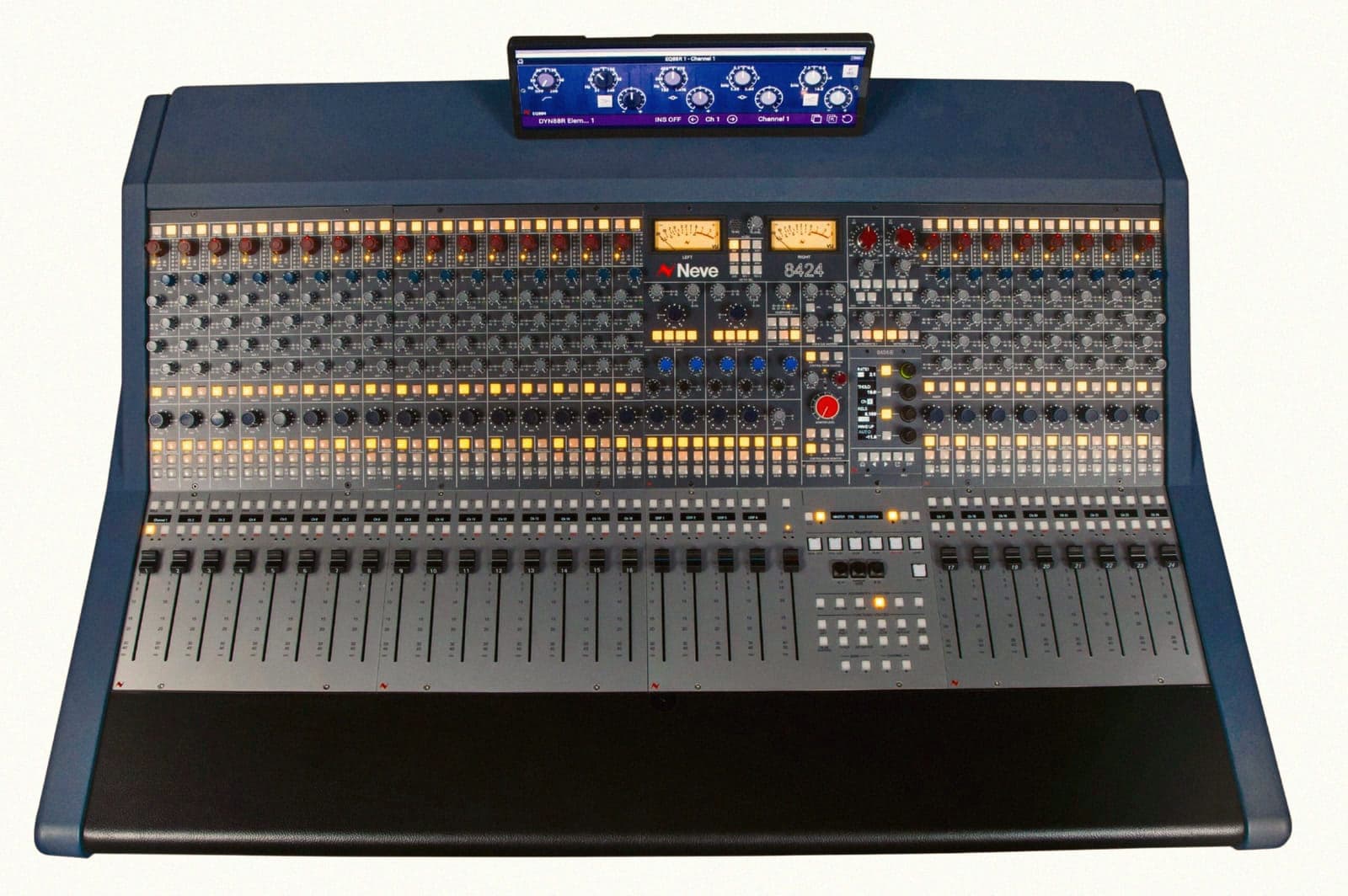
Neve used to make one kind of product: a hand-wired analogue console you could not update, patch into a laptop, or recall from memory. The 8424E breaks that rule. Per Sound On Sound (October 30, 2026), the 24-channel desk keeps the Marinair transformer-coupled mix bus pulled from Neve's 80-series consoles, the same analogue mix architecture studios have chased for decades, but bolts a 2400x720 horizontal touchscreen and four touch-sensitive encoders onto the control surface. At mixdown it handles up to 48 inputs across those 24 physical channels, plus four mono groups, and it ships with a dual mono/stereo 500-series VCA compressor built in. List price is $37,950 / £26,995, with shipping expected in Q1 2027 and orders open now.
The desk's real trick sits in the new Elements range: three separate 2U rack units, eight channels apiece, each one a "digitally controlled analogue processor." The 88R EQ ($4,895) carries the four-band EQ from Neve's 88R console. The 88R Dynamics ($5,595) packages compressor, limiter, gate and expander circuitry from the same desk. The 1084 EQ ($6,295) is the inductor-based three-band EQ Neve built for the Sound City 8028 console, repackaged standalone. Every unit talks to the 8424E through Neve's E-Controller over an Ethernet-based architecture, and every setting lives inside a 64-step undo history with full snapshot recall, DAW-side through VST3, AU and AAX plug-ins.
Why does a hybrid Neve matter for studio culture?
Neve circuitry has been the reference point for "real" analogue warmth since the 1970s: 1073 preamps, 88 consoles, desks that never forget a knob position because nobody touched the knobs between sessions. Recall, automation, instant plugin-style control, those were historically the DAW's advantages over a Neve desk, the tradeoff engineers accepted for the sound. The 8424E erases that tradeoff on paper. A studio can now run genuine Neve analogue circuitry on a session, save the exact settings as a snapshot, undo sixty-four steps back if a mix goes wrong, and recall the whole thing instantly for a client who booked a follow-up session three months later, the single biggest practical argument hybrid studios have made for going all-digital.
The 8424E erases the oldest tradeoff in studio design: recall used to cost you the analogue sound, now it doesn't.
What do engineers actually gain, and what do they give up?
The upgrade path tells you who this is really for: an existing 8424 owner adds an E-Controller and a set of Elements units rather than buying an entirely new console, which reads less like a flagship launch and more like Neve admitting its installed base wanted this years ago. What engineers gain is obvious: total recall on circuitry that used to demand a notebook and a steady hand to document, plus a plugin-equivalent workflow for gear that previously only lived in a rack. What they arguably give up is harder to pin down. There is no touchscreen on a vintage 8078, and part of the console's mystique always rested on exactly that kind of friction, the idea that you earned the sound by committing to it. Neve is betting that modern studios will trade a little of that mystique for a Marinair mix bus you can actually run a session on twice.