What does FDTD actually simulate?
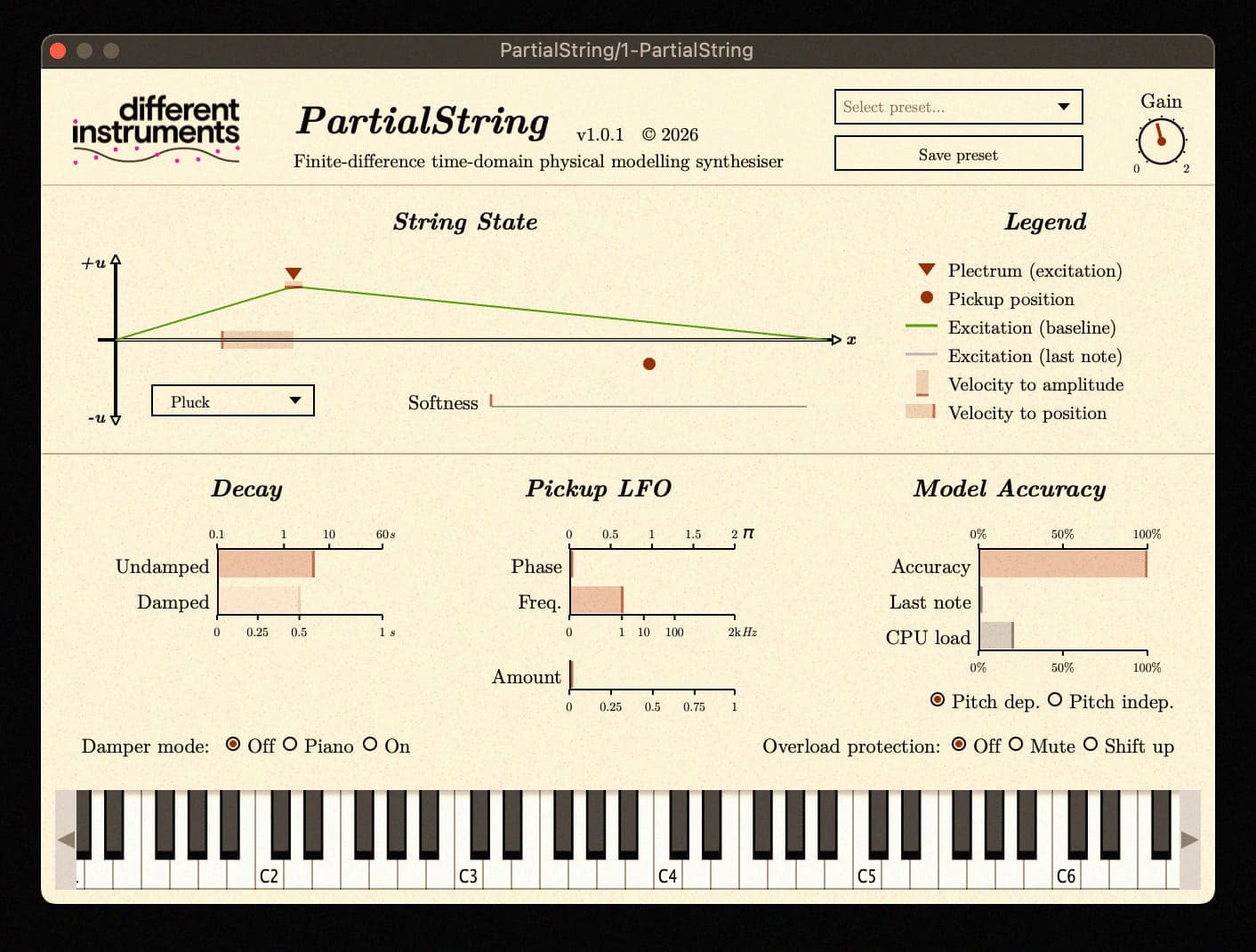
Finite-difference time-domain modeling isn't a preset or a sample library, it's a numerical method that solves the physics directly. PartialString represents a string as a chain of displacement points in memory, more points for lower notes because a longer string needs more of them, and calculates how a disturbance at any point propagates along that chain in real time. Pluck it, and the plugin runs the wave equation, sample by sample, to work out how the whole string moves. A virtual pickup reads the displacement at a chosen spot and that becomes the audio signal. It's the same category of technique used in acoustics research and in commercial modeling instruments like Modartt's Pianoteq or Applied Acoustics Systems' String Studio, both of which charge for the privilege.
Who builds a synth like this for free?
Different Instruments is a one-person operation: developer Christian Baker, who picked the problem back up after finishing a University of Edinburgh MSc in 2009 that modeled musical instruments with finite-difference methods under acoustics researcher Stefan Bilbao. Baker's day job is biomedical engineering, ultrasonics, optics, photoacoustics, work that lives in the same mathematical neighborhood as string physics. PartialString descends from GoString Synth, an open-source proof of concept he put on GitHub in 2022. "This is an attempt to revive that work now that personal computers have suitable computational ability," Baker wrote announcing the plugin.
"It's not supposed to be realistic. Just a different way of thinking about sound design."
That's Baker explaining why PartialString lets you break the physics on purpose, not just model it faithfully.
What can producers actually do with it?
The excitation section lets you choose a pluck or a hammer, velocity-sensitive, and set exactly where along the string it strikes. Decay time is adjustable, with an optional damper model for piano-like mutes. Reduce the simulation's accuracy and the string disperses its overtones unevenly, which reads as metallic, bell-like inharmonicity, useful for anyone chasing organic-but-off textures rather than a clean acoustic guitar patch. The pickup position can be swept by an LFO fast enough to hit audio rate, generating AM-style sidebands no real guitar pickup could produce. For minimal, deep and organic house producers who want acoustic-adjacent texture without renting a session guitarist or buying a 200-dollar modeling instrument, that's a genuinely useful toolbox, not a novelty.