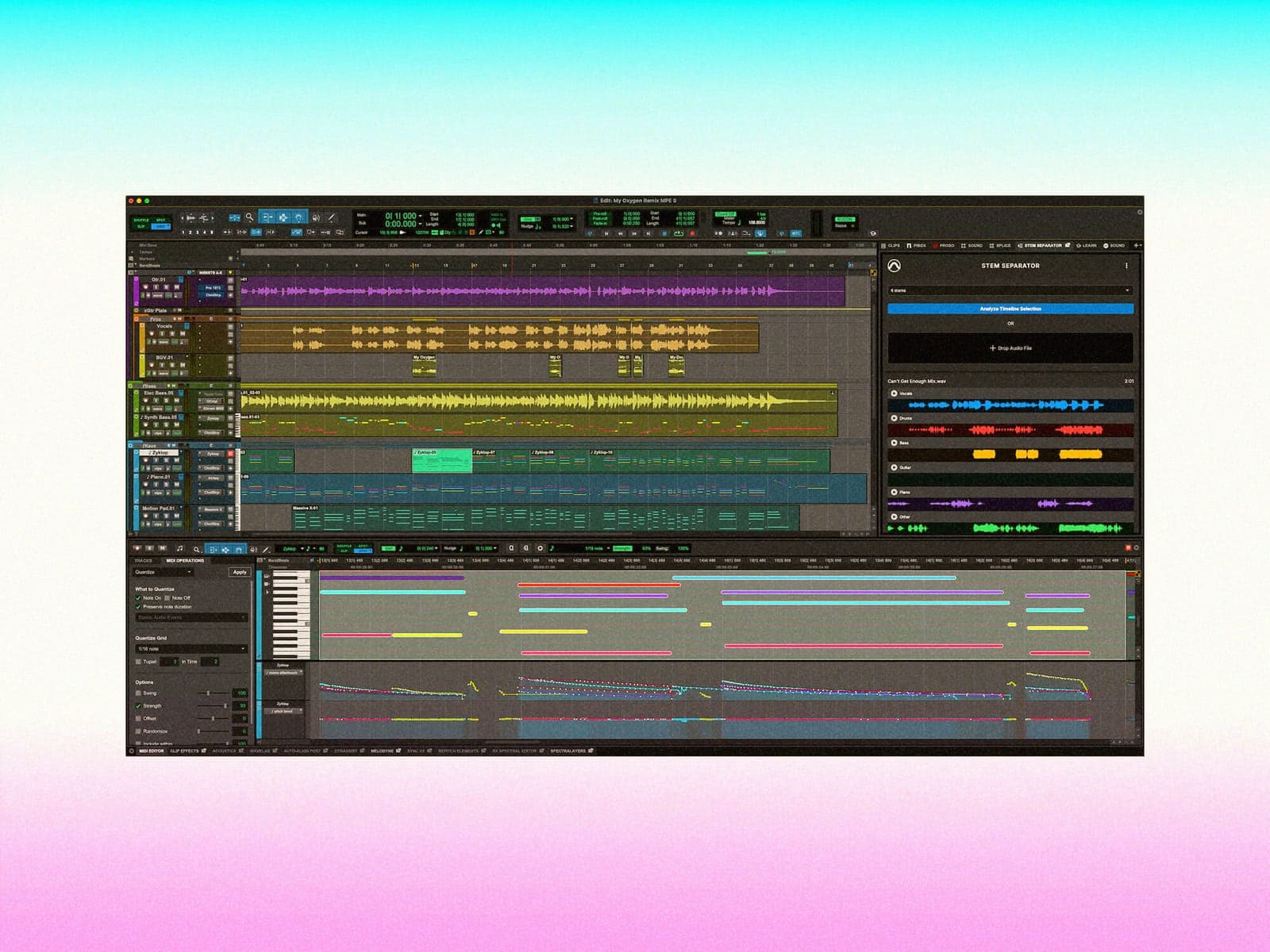
For as long as Pro Tools has run AAX plug-ins, roughly since 2011, those plug-ins have answered to one rule: they live on a single track and do not see past it. That rule is why so many producer workflows in Pro Tools still mean bouncing stems, hopping between apps, or leaning on third-party scripting tools like SoundFlow just to get a sound library or a batch process to behave like it belongs inside the session. Avid's Pro Tools 2026.11 update tears that rule up with a new format called Extensions.
What was actually broken about Pro Tools plug-ins?
An AAX plug-in only ever sees the track it is inserted on. A reverb, an EQ, a saturator: all scoped to one channel, by design. Extensions do not work that way. Avid built the format to operate "across multiple tracks or entire sessions," and an Extensions menu sits in Pro Tools independent of any plug-in slot, accessible even with no session open at all. That is a structural change, not a cosmetic one: it means a tool can watch an entire session, move audio in and out of it, or run while you are still deciding what to open.
Who gets in first, and what can they do?
Avid's first Extensions partners are Pro Sound Effects, Soundly, Forte and Pibox, covering sound-library browsing and collaboration tools that previously had to live outside Pro Tools or bolt on through custom scripting. Splice and SoundFlow, both of which had already found unofficial ways to work close to Pro Tools since 2025, are migrating their existing integrations over to the sanctioned format. That is the real tell here: Avid is not just adding a feature, it is formalizing a door that developers were already trying to pick.
What else shipped in the same update?
Pro Tools 2026.11 also adds MPE (MIDI Polyphonic Expression), so individual notes inside a chord or a performance can respond independently to pitch, pressure and timbral expression, recorded, edited and automated on dedicated expression lanes. That matters for anyone programming with an MPE controller rather than a flat MIDI keyboard. On the production side, the release adds Windows High-DPI scaling and per-monitor support for 2K, 4K and 8K displays, plus a refined dark theme. Avid also folded in a proprietary Stem Separator Extension, splitting a track into vocals, drums, bass, guitar, keys and other, locally, with no cloud upload required. The update is live now for Artist, Studio and Ultimate subscribers, and for perpetual-license holders with an active Upgrade Plan.
Extensions formalize what developers were already trying to build around AAX's single-track wall.
Why it matters
AAX's single-track scope has shaped how every third-party tool approaches Pro Tools for over a decade; anything that needed session-wide awareness had to live outside the plug-in chain entirely. Opening that up changes what a sound library, a collaboration tool or an automation script is allowed to do inside the DAW itself, and it puts pressure on Logic, Ableton and Studio One to match the same kind of session-level access.
What we think
This is the most consequential Pro Tools architecture change in years, not the AI stem separator getting most of the headlines. Stem separation is a feature; a plug-in format that can finally see an entire session is infrastructure, and infrastructure is what third-party developers actually build businesses on. Watch which companies jump on Extensions in the next twelve months, that list will tell you more about where Pro Tools is headed than any single update note.