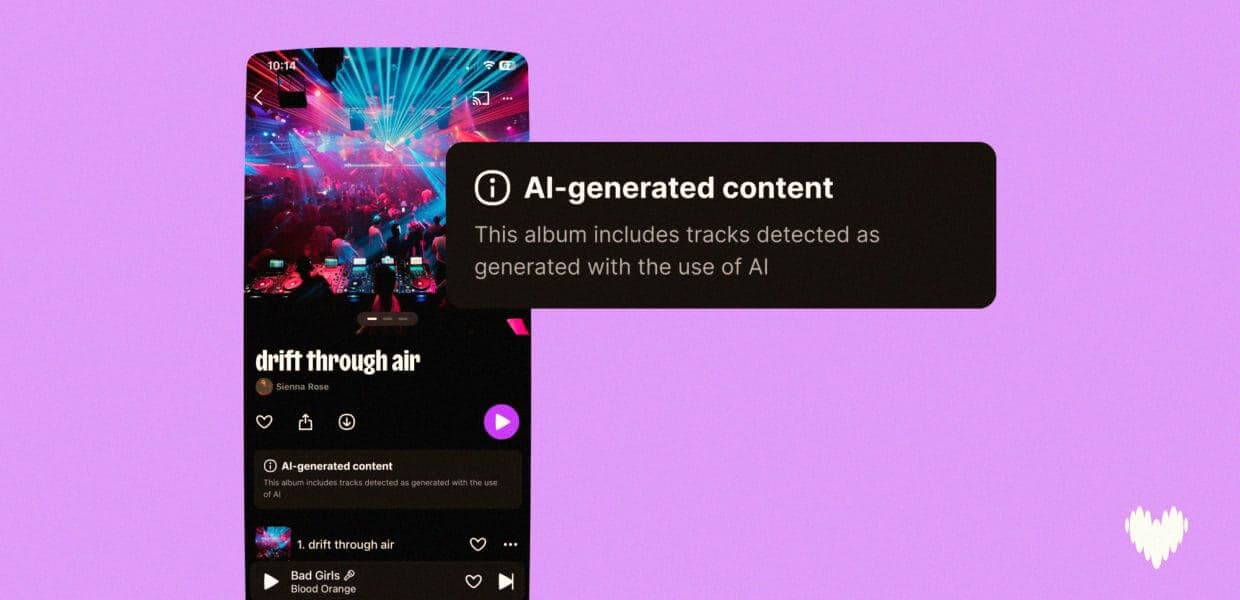
The flood is real. Deezer's own numbers show roughly 90,000 fully AI-generated tracks made up more than half of its peak daily uploads in June 2026. What's less discussed is that those tracks barely register with listeners: just 1 to 3% of total streams. Deezer has also found that up to 85% of streams on fully AI-generated tracks in 2025 were fraudulent, stream-farm and bot activity rather than anyone actually pressing play.
So the platforms have a spam and fraud problem more than a listening problem. But producers aren't waiting for platforms to sort it out. A parallel, informal policing effort has sprung up in DJ and producer circles, and it runs almost entirely on ear and instinct.
Who's doing the policing, and how?
Italian turntablist-turned-producer Nihil Young has spent months posting his suspicions on Threads, listening for what he describes as the telltale "sound of Suno" and arguing good headphones are enough to catch a fully generated track. US producer Max "H4RRIS" Harris runs recurring video segments flagging suspected AI cuts, pointing to recurring vocal patterns, a particular sharp hiss, vocal and melodic stuttering happening at the same time, and even unnatural details in promo images: unstable-looking fingers, an overly glossy sheen.
Both are working from genuine expertise. Neither has a tool that actually proves anything.
Nihil Young says the backlash to his callouts has included harassment and suspected hacking attempts against him.
That's the cost side of this. Nihil Young has said music production is his main income, and that he's already lost clients since generative tools arrived, which is exactly the pressure that pushes someone toward public callouts in the first place. The instinct to defend the craft is legitimate. The methods available to do it are not.
Why doesn't the detection actually work?
Peer-reviewed research cited alongside these callouts found that AI-audio detectors fail after pitch changes, added noise, or simply re-encoding the file through an unfamiliar codec, meaning a track can dodge detection with production steps producers already do routinely for entirely unrelated reasons. There is no shared, reliable detector the scene has agreed on. What exists instead is trained ears, pattern recognition and gut calls, run in public, about someone else's livelihood.
The Josh Fawaz case shows exactly how that goes wrong. He faced questions from listeners and fellow producers over his "Like a Prayer" cover, and it turned out to be more complicated than a clean yes or no: Fawaz disclosed using AI as a tool, and Spotify's own credits for the track subsequently listed generative-AI vocals and AI drums. Not a hoax, not an outright denial, just a blurry, partial use that got caught in the same binary accusation cycle as a fully synthetic track.
Even Spotify has admitted its own disclosure system can't be trusted as proof either way. The platform has said publicly that an absent AI-disclosure credit does not mean AI was not used, which means the one official paper trail producers might lean on isn't reliable ground truth.
What's actually at stake here?
Deezer's numbers say the fraud, not the music, is the real problem: fully AI tracks are a rounding error in real listening but a magnet for bot streams. Producers trying to protect the culture from a flood of undisclosed synthetic music are reacting to something genuine. But without a shared, working detector, the policing falls on individual ears making public calls, and the collateral damage lands on real musicians like Josh Fawaz who used the tools partially, disclosed, and got dragged through the same accusation as someone hiding a fully generated track.