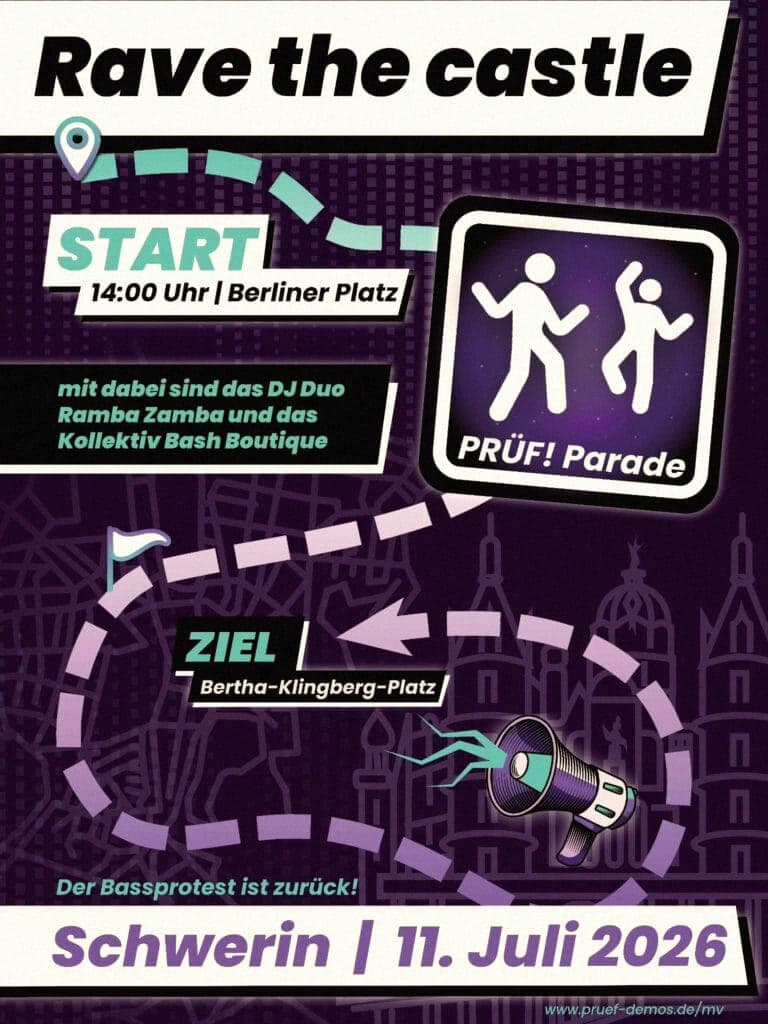
No podium, no PA stack for speeches. Just two flatbed trucks rigged with sound systems, pulling a crowd of hundreds through the middle of a German state capital for seven straight hours. That was Rave the Castle, and it happened in Schwerin, the capital of Mecklenburg-Vorpommern, on July 11.
The route ran from Berliner Platz down Hamburger Allee and Ludwigsluster Chaussee, past Schwerin Castle itself, along Obotritenring to Bertha-Klingberg-Platz. Doors, or rather departure, at 2pm; the trucks were still rolling toward the finish around 9pm. Free entry. Local police logged one-sided road closures starting at Hamburger Strasse and full closures from Graf-Schack-Allee onward, the kind of traffic footprint a city usually reserves for a real festival, not a political demo.
What was actually playing?
Techno and hardtech carried most of the route, with bigroom and EDM in the mix too, the two trucks trading sets as they crawled through the city. That's not incidental. A speech holds a crowd for the length of the speech. A DJ set holds a crowd for the length of the route, through traffic, through a seven-hour march past a castle, in a city center that would otherwise empty out on a Saturday afternoon. The organizers, a coalition called PRUEF MV, understood exactly what a rave format does that a rally podium can't: it makes staying worth it.
Who is behind PRUEF MV, and what do they actually want?
PRUEF MV is the regional Mecklenburg-Vorpommern arm of Pruef, a nationwide campaign the satirist Nico Semsrott launched in November 2025. The name is a pun: "pruef" means "check" or "examine." The demand is specific and legally grounded, not a vague anti-far-right slogan: a review, by the Federal Constitutional Court, of political parties that Germany's domestic intelligence service, the Verfassungsschutz, has already classified as suspected or confirmed right-wing extremist. The campaign doesn't need to name the AfD directly, because the Verfassungsschutz classification already does the naming for them in several German states.
Schwerin wasn't a one-off. PRUEF MV runs a demonstration in the city roughly monthly, the previous one on June 13 at the city harbor with speeches, music and a drum workshop. Rave the Castle was the loudest and largest version of that recurring format so far, and it landed on a weekend when sister PRUEF chapters also held demonstrations in Munich, Stuttgart, Hannover and other German cities, part of a wider wave of demonstrations against right-wing extremism across the country that same weekend.
Organizers told parents attending with children to bring hearing protection, standard advice for any event built around a proper sound system, not a PA rented for speeches.
Why put a rave in the middle of a constitutional argument?
Because techno has always traveled with a political spine when the moment called for it, from the Berlin Wall-adjacent warehouse scenes of the early 90s to the free-party and sound-system culture that grew up defying licensing laws and municipal control on principle. PRUEF MV drew explicitly on that lineage, citing both the DGB youth union's "Jobparade" and Berlin's own Rave the Planet as reference points. A truck with a rig and two DJs is cheap, mobile and legally a demonstration, not a ticketed event, which means it can hold a public street for seven hours in a way a fixed-stage rally can't.