Raving already has the structure of ritual: preparation, leaving normal life behind, hours of music and collective movement, altered states, and eventually returning home. Psychedelics can intensify that experience, making music feel deeper, time feel different and the dancefloor feel less like a night out and more like a shared journey.
The Essentials
01. A 2025 study of rave attendees who use psychedelics, MDMA and other psychoactive drugs suggests the rave follows the structure of a modern rite of passage: preparation, the dancefloor, and the days that follow. Some participants said rave culture influenced major life decisions, including becoming DJs, producers or musicians, while others felt more sociable and connected afterward.
02. Psychedelics can make the ritual side of raving much more obvious. Music can feel deeper, time can stretch, emotions intensify and an extended DJ set can start to feel like a journey. Instead of simply hearing the music, you can feel completely inside the experience with the crowd around you.
03. With psychedelics, set and setting are crucial. Your mood, mindset, friends, crowd, music and environment can completely change the experience. An uplifting outdoor festival with trusted friends can feel like a beautiful ritual, whereas a packed, aggressive club surrounded by heavily intoxicated strangers can turn into a bad trip.
04. Different drugs can create very different dancefloors. MDMA can boost energy, openness and social connection, while ketamine can slow people down and impact the energy of the dancefloor. Psychedelics, in the right setting, can combine connection, music and altered perception in a way that makes the rave feel closer to ritual.
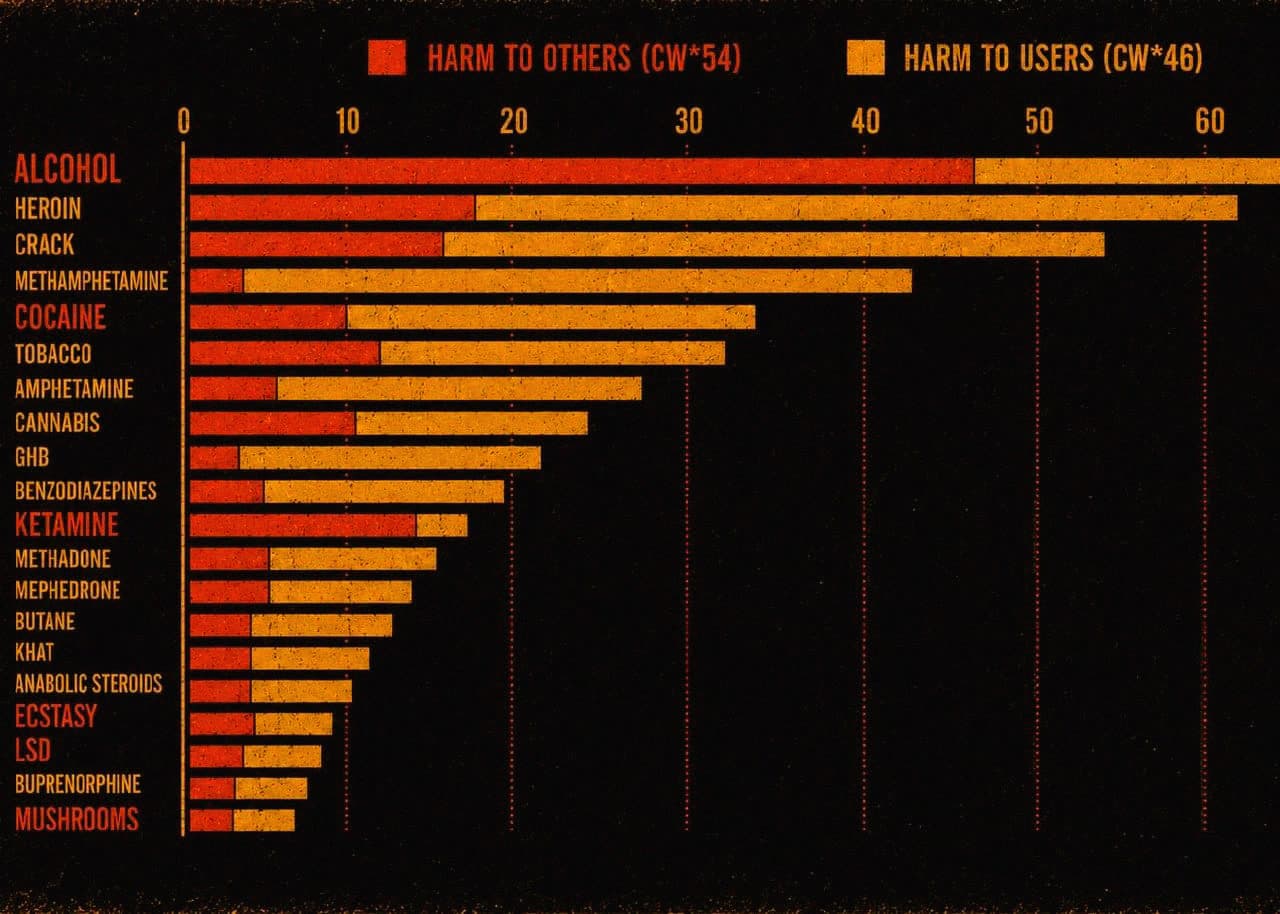
05. What nightlife treats as normal is not always safer. In David Nutt and colleagues' famous drug-harm ranking, alcohol came out highest overall. Cocaine also ranked far above ketamine, while MDMA and psychedelics were close to the bottom.
06. Purity and quantity matter. With unregulated drugs, what you think you are taking may not be what you get. And more is not better. Too much of almost anything can stop you dancing, disconnect you from the music or turn the night into managing the drug instead of experiencing the rave.
07. A dancefloor is a feedback loop. The DJ affects the crowd, the crowd affects the DJ, and dancers affect one another. When people share similar altered states, that chemistry can shape the entire room. The drug changes the person, the people change the crowd, and the crowd changes the rave.
08. The real question is not whether drugs belong to rave culture. They have been there for decades. It is what kind of altered state we want our dancefloors built around. Music provides the pulse, the crowd makes it collective, and psychedelics can turn that shared experience into something that feels much closer to a modern ritual.
The Rave Already Looks a Lot Like a Ritual
A proper rave rarely starts when you walk through the door. The experience begins earlier, when the group chat wakes up, you start listening to the artists you are going to see, work out who is coming, where you are meeting, how you are getting home and what kind of night you are preparing for.
Then you leave normal life behind. You enter a warehouse, club, forest, beach or festival where everyday routines start disappearing, individual tracks dissolve into a continuous set, and hundreds or thousands of people begin moving around the same repetitive beat.
Eventually morning comes, the music stops and you return to normal life. That basic pattern is exactly what researchers Yula Milshteyn and Moshe Bensimon found when they studied rave attendees who use LSD, MDMA and other psychoactive drugs.
Their 2025 study looked not only at what happened on the dancefloor, but at what happened before and afterward. People described preparing physically, getting into the right mindset, bonding with friends, organizing food, clothes and water, and feeling anticipation build before the rave. Afterward, they described physical, emotional and social changes. (sciencedirect.com)
The researchers compared this pattern to a rite of passage. In simple terms, you prepare to leave normal life, enter a temporary world where the usual rules feel different, then return from it carrying whatever happened there back into everyday life.
Some participants said rave culture had influenced major decisions, including becoming DJs, producers or musicians. Others described becoming more sociable or feeling closer to people afterward. (jsatjournal.com)
That makes the rave more interesting than simply “going out.” The preparation matters, the experience itself matters, and what happens when you come home matters too.
Why Psychedelics Fit the Ritual So Well
Psychedelics are where this idea becomes especially interesting.
LSD and psilocybin can change perception, emotion, time and the feeling of meaning itself. Music can become more immersive, small changes in sound can feel huge, and something as simple as a sunrise or a long transition between two tracks can suddenly feel deeply significant.
Electronic music is almost perfectly built for this kind of experience because a great DJ set already has a journey inside it. The DJ gradually changes mood, builds tension, releases it, takes the room darker, brings warmth back and connects hours of music into one continuous arc.
On psychedelics, that structure can feel much more powerful. A transition can feel like moving somewhere new. A breakdown can feel emotionally enormous. A bassline can become an environment rather than simply a sound.
Instead of thinking, “this is a great set,” you can start feeling like you are moving through it.
Research has also found that psychedelics can increase feelings of connection, meaning and emotional response to music, although the experience depends heavily on the person and environment. (sciencedirect.com)
That is where the rave can start feeling less like entertainment and more like ritual.
The beat becomes the pulse, the venue becomes a temporary world, the crowd becomes part of the experience, and the DJ becomes the person shaping the journey through sound.
But Psychedelics Do Not Automatically Create a Good Rave
There is a danger in romanticizing this.
Psychedelics can make beautiful music, nature and social connection feel incredibly powerful, but they can also amplify anxiety, discomfort, paranoia or a feeling that the environment around you is wrong.
That is why set and setting are crucial.
Set is what you bring into the experience internally: your mood, mindset, expectations, fears and emotional state. Setting is everything around you: the people, music, crowd, venue, lighting and whether you feel safe in the environment.
Psychedelic research has treated these factors as important parts of the experience for decades. (pmc.ncbi.nlm.nih.gov)
For a rave, the difference can be huge.
Imagine being at an outdoor festival in nature, with enough space to move, uplifting music, trusted friends and a crowd that feels relaxed and connected. If things become too intense, you can move away, sit down somewhere quiet or reconnect with people you trust.
Now imagine a packed indoor club where you already feel anxious, strangers are pushing past you, people around you are heavily intoxicated on alcohol and cocaine, the atmosphere feels aggressive and you cannot find somewhere calmer to go.
The substance might be exactly the same, but the experience may be completely different.
Psychedelics do not magically make the second setting spiritual. They can make every uncomfortable part of it feel stronger.
That is why the environment is not just the background to the psychedelic experience. It becomes part of the experience itself.
Your Friends Are Part of the Setting
The people you are with can make as much difference as the venue.
Trusted friends create familiarity in an altered state. If something feels strange or overwhelming, you are surrounded by people who know you, understand how you normally behave and can help you feel grounded.
The wider crowd matters too.
A room where people feel focused on the music, respectful and socially connected can produce a very different experience from one where people are extremely drunk, aggressive or constantly pushing through the crowd.
This is why psychedelics are often more naturally associated with outdoor festivals, nature and scenes where people are sharing a similar atmosphere.
It is not because nature automatically makes drug use safe. It is because having space, trusted people and the ability to step away from intensity can make a major difference when perception and emotion are already amplified.
The DJ Becomes Part of the Setting Too
The DJ also becomes part of that environment.
They are obviously not responsible for anybody's drug experience, and they have no idea what individual people in the crowd have taken. But they control one of the strongest forces in the room: the music.
Music has been studied as an important part of psychedelic settings, with researchers looking at how it can shape emotional experience and the movement of a psychedelic journey. (pmc.ncbi.nlm.nih.gov)
On a dancefloor, this makes the craft of DJing even more interesting. A DJ who understands pacing, tension, release and emotional movement is doing much more than selecting good records.
They are taking the room somewhere.
For a sober dancer, that is great DJing. For someone on psychedelics, those same changes can feel massive.
The DJ does not control the trip, but the music is undeniably part of the setting.
MDMA Makes the Ritual More Social
Psychedelics are the core of the ritual argument, but other drugs show how strongly substances can change the character of a dancefloor.
MDMA is the clearest example.
It can combine stimulation with feelings of warmth, sociability and connection, which fits almost perfectly with the basic idea of a rave: people moving together around the same music.
Research on MDMA has repeatedly found stronger feelings of social connection and closeness. (pubmed.ncbi.nlm.nih.gov)
On a dancefloor, those effects can become collective. People move more, strangers feel less strange, eye contact becomes easier and the crowd can feel unusually connected.
The energy goes outward.
The DJ feels the response and pushes further. The crowd reacts again. That feedback loop is one reason MDMA and ecstasy became so closely tied to rave history.
If psychedelics can turn the set into a journey, MDMA can make the journey feel deeply shared.
Other Drugs Can Pull the Floor Inward
Ketamine offers a useful contrast because it can create a very different relationship with the room.
As a dissociative, it can make someone feel more detached from their body or surroundings. At stronger levels, movement and coordination can become harder, which means the experience can become more internal and less connected to the collective energy of the dancefloor.
That does not make ketamine inherently bad, and some people find music deeply immersive under its effects. But an interesting individual experience is not automatically the same thing as a strong collective dancefloor.
If enough people become less physically engaged and more inward, there is less energy circulating through the room.
The BPM may be exactly the same, but the consciousness of the crowd has changed.
This is why the drug matters not only to the person taking it, but to the atmosphere everyone else is dancing inside.
Too Much of Anything Will Sit Your Ass Down
There is also a point where the romantic language about altered states needs to meet basic reality.
More is not necessarily better.
Too much alcohol and coordination disappears. Too much ketamine and standing can become difficult. Too much MDMA can become physically dangerous. Too much psychedelic intensity can turn music, lighting and the crowd from immersive into overwhelming.
Cocaine has its own version of the problem. A night that began around music can slowly become centered on returning to the bathroom, taking another line and maintaining the stimulation.
At some point, too much of almost anything will sit your ass down, physically or mentally.
That is the irony of chasing the strongest possible high. You can end up so intoxicated that you are no longer participating in the thing you came to experience.
The music becomes secondary, dancing stops, and managing the substance becomes the night.
The strongest altered state is not necessarily the best rave state.
Purity and Quantity Can Decide the Night
Quantity is only part of the problem. Purity matters too.
With an illegal and unregulated supply, something sold as MDMA, ketamine or another drug may not contain exactly what someone expects, and strength can vary dramatically.
That changes both the experience and the risk.
This is one reason drug checking has become an important harm-reduction measure at some festivals and nightlife events. The 2025 rave study itself points toward drug checking as one way to reduce some of the negative consequences around drug use. (sciencedirect.com)
This is not separate from protecting rave culture. A dancefloor dealing with unexpected reactions and medical emergencies is not a better dancefloor.
If drugs are going to exist in nightlife, knowing what is actually circulating matters.
The Drugs We Normalized Aren't Necessarily the Safest
The conversation becomes even more interesting when we look at which drugs society treats as normal.
Professor David Nutt and colleagues published one of the most famous comparisons of drug harms in The Lancet in 2010, looking at harm to users and harm to other people.
Alcohol came out highest overall. Cocaine also ranked far above ketamine, MDMA, LSD and psychedelic mushrooms, while MDMA and classic psychedelics were toward the lower end of the ranking. (imperial.ac.uk)
That does not mean the substances lower on the list are harmless. Dose, purity, mixing, health and setting all change risk.
But it does challenge a basic cultural assumption.
Someone drinking heavily in a nightclub fits perfectly inside society's image of normal nightlife. Cocaine is deeply embedded in certain scenes too. Psychedelics remain far more taboo.
Yet alcohol came out at the very top of Nutt's comparison of overall harm.
Legal and familiar do not automatically mean safer.
Alcohol and Cocaine Create Their Own Ritual
Alcohol and cocaine are not outside this idea of ritual. They can shape the rhythm of a night just as strongly, although often in a very different direction from psychedelics or MDMA.
A night can gradually become a cycle of drinking, talking, going to the bathroom, taking another line, smoking, getting another drink and returning to the dancefloor before starting again. Over time, maintaining intoxication can become the main activity while the music moves into the background.
That does not mean everyone drinking becomes aggressive or everyone on cocaine becomes self-centered. Just as not everyone taking MDMA becomes loving and not everyone on psychedelics has a profound experience.
People, doses and environments are more complicated than that.
The point is simply that different substances push attention and behavior in different directions, and when enough people share the same space, those shifts become part of the culture of the room.
The Rave Is the Container
This is what makes the 2025 study so useful for understanding dance culture.
It does not treat drug use as something separate from the rave. It places it inside a larger experience involving preparation, anticipation, friendship, music, environment and what happens afterward. (sciencedirect.com)
That is also what makes the idea of ritual useful.
A ritual is not created by one ingredient.
The venue creates the space. The soundsystem makes the music physical. The DJ shapes the journey. The crowd makes it collective. Each person brings their own mood and expectations.
Then the substance changes how all of those things are experienced.
With psychedelics especially, set and setting connect everything. Your mindset changes how you experience the environment, the environment changes how you experience the drug, and the drug changes how you experience the music and people around you.
That is why psychedelics sit at the center of this conversation.
They make it almost impossible to separate the drug from the ritual around it.
Then You Have to Come Back
Every ritual eventually ends.
The lights come on, people find their friends, everyone gets home and normal life begins again.
The 2025 study found that the effects of the rave did not necessarily stop at the exit. Participants described difficult physical and emotional after-effects, but also happiness, increased confidence, stronger social connection and greater sociability.
Some said rave culture had influenced their decision to become DJs, producers or musicians. (jsatjournal.com)
That may be the most interesting part of the ritual.
A rave is not necessarily meaningful because you escaped normal life for eight hours. It can become meaningful because something comes back with you.
A friendship, a memory, a new relationship with music, a stronger sense of community or even a different direction for your life.
The venue creates the container, the soundsystem provides the pulse, the DJ shapes the journey and the crowd makes it collective.
What Kind of Ritual Are We Creating?
Drugs have been part of rave culture for decades. Pretending otherwise will not create safer or better dancefloors.
The more interesting conversation is what different substances actually do to the spaces we love.
MDMA can make the rave more energetic, social and collective. Ketamine can pull attention inward and, at higher doses, work against the movement that makes a dancefloor feel alive. Alcohol and cocaine create their own patterns while also ranking much higher on measures of overall harm.
But psychedelics raise the most interesting question.
In the right set and setting, they can deepen the relationship between music, people, environment and time until the rave feels less like entertainment and more like a journey shared with everyone around you.
In the wrong setting, they can amplify anxiety, discomfort and chaos just as easily.
That is why the substance is never the whole story. Your mindset matters, your friends matter, the crowd matters, the music matters, the venue matters, purity matters and quantity matters.
Psychedelics can make us feel the ritual more deeply, but set and setting decide what kind of ritual we actually enter.