ZAK Sound founder Ben D'urso frames RocketVerb around a single design question: what happens if the behavior of space audio becomes part of the reverb itself, not the sound of it. "The original recordings are not played back," he says. "Their spectral movement, density and texture are translated into profiles that shape a new algorithmic tail in real time."
That distinction matters for producers who've heard a hundred plugins claim to use field recordings or found sound. RocketVerb isn't sampling a radio-telescope feed and dropping it into an impulse-response convolution engine. It analyzed public space audio, planetary recordings and astronomical data sonifications for their behavioral fingerprints, how energy moves, how dense the texture gets, how it decays, how rough or smooth it reads, and encoded those fingerprints into 38 internal source profiles. The reverb tail you actually hear is synthesized algorithmically, in real time, guided by those profiles. No convolution, no fixed IR.
Why would a house producer care about this?
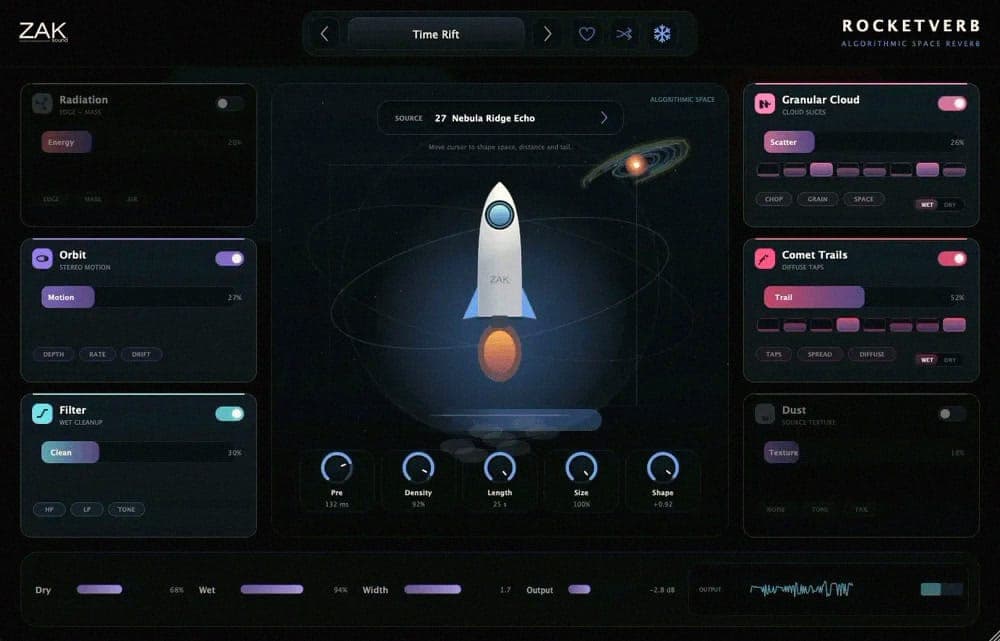
Ambient, deep house and organic house all live or die on texture that doesn't sound like the same three reverb plugins everyone already owns. A profile derived from planetary or astronomical sonification data isn't going to behave like a plate, a hall or a cathedral IR, which is exactly the point: it gives a producer chasing an unfamiliar spatial signature (something between a granular texture and a decaying wash) a genuinely different starting material rather than another emulation of a room that already exists. The six effect blocks push further into that territory: Granular Cloud breaks the signal into rhythmic, atmospheric fragments, Comet Trails builds diffuse evolving delay repeats, Dust folds source-derived texture back into the tail, and Orbit and Radiation add their own pattern-based motion on an 8-step modulation grid. Freeze holds any of it indefinitely, useful for building a pad or a drone straight out of the reverb itself rather than a separate synth.
The interface leans on a two-dimensional Galaxy cursor sitting alongside the five core controls, Predelay, Density, Length, Size and Shape, so a producer can sweep multiple internal dimensions with one gesture instead of stacking knob moves.
What's the actual catch on "free"?
There isn't one hidden in the fine print, but the window is real and short. ZAK Sound is giving away perpetual licenses, not trials or time-limited demos, to anyone who claims RocketVerb between July 22 and August 22, 2026. Claim it in that window and it's yours with no subscription, forever. Miss it and the price reverts to $39 (37 euros). That's the entire mechanic: a hard deadline, not a bait-and-switch.
"RocketVerb began with a simple question: what happens if the behavior of space audio becomes part of the reverb itself.", Ben D'urso, ZAK Sound
RocketVerb runs as AU, VST3, AAX and Standalone on macOS (Apple Silicon and Intel), VST3 and AAX on Windows, and VST3 on Linux, a rare full cross-platform spread for a plugin this specialized.