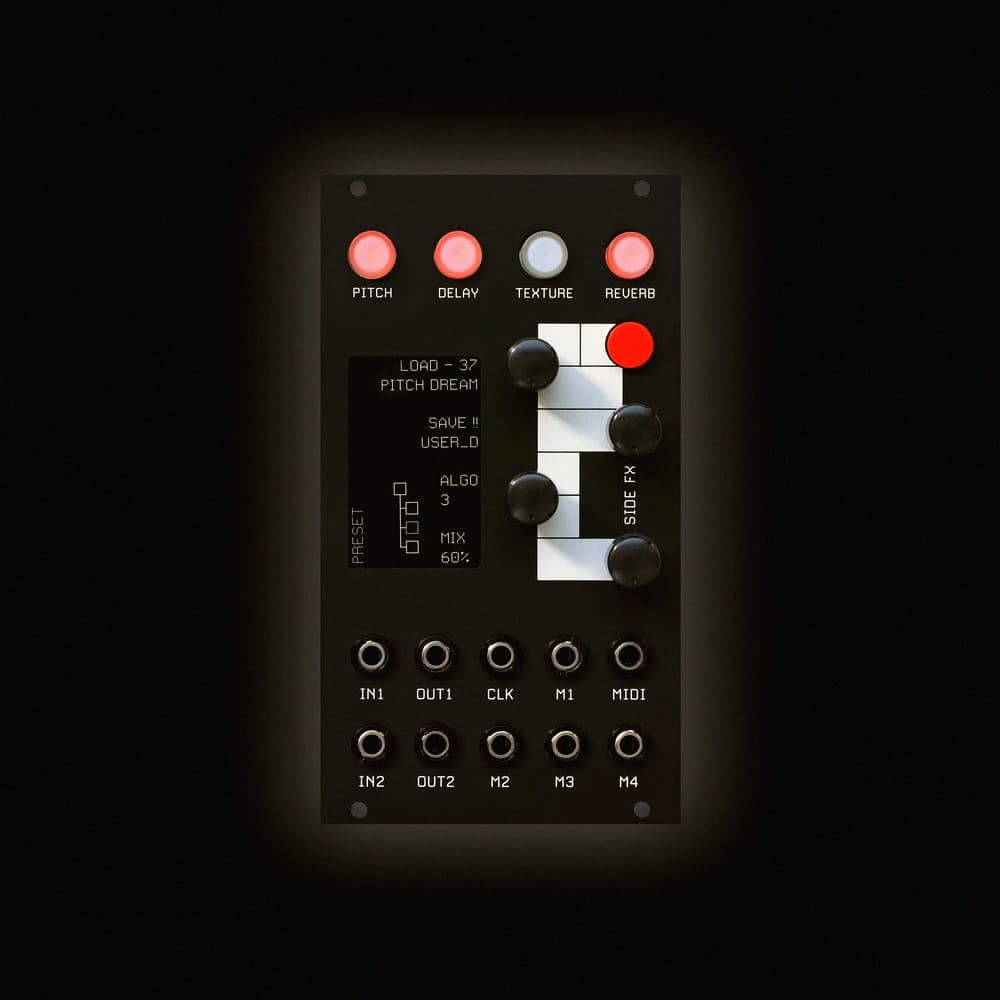
Rack space is the one resource every modular performer runs out of first. RYK Modular just made a direct play at that problem: the new Side FX squeezes four separate, simultaneously running effects engines into a single 14HP module.
That is the headline spec, but the real story is what you can do with four engines once you have them. A single reverb or delay module eats HP and gives you one process. Side FX gives you four, and lets you decide how they talk to each other.
How do you route four effects in one module?
Side FX ships with 16 effect types on tap: pitch shift-delay, a granulator, reverbs, glitch processing, tape simulation and wave shapers among them. Rather than hard-wiring them, RYK Modular built 7 chain algorithms covering serial routing, parallel routing and dual-mono setups where the four blocks split into two fully independent stereo-adjacent chains. That last mode matters for anyone running two voices, or a voice and a return bus, through the same module without one effect bleeding into the other.
Effect sends can be triggered manually or driven by CV, which is where Side FX stops being a glorified pedal and starts behaving like a proper modular citizen. Four assignable CV inputs, MIDI and clock connectivity tie the module into whatever sequencing or performance control you already run.
Why does the internal modulation matter?
The module doesn't just accept outside CV, it generates its own. Built-in LFOs, a random source and an envelope follower mean Side FX can modulate its own effect parameters without borrowing a utility module to do it. For a compact live rig where every slot is already fought over, that is the difference between patching three extra modules just to get movement on your delay time, and getting it for free inside the FX unit itself.
Four engines, seven routing modes, and the modulation to drive them, all in 14HP: that is the pitch, and for once the spec sheet backs it up.
Presets live on an SD card, so a chain you build at home travels to the gig without re-patching. At £330 including VAT, Side FX launched October 15 and is available now.
Who is this actually for?
Anyone building a case-based or travel rig where HP is the real currency. A four-engine multi-FX unit this compact is aimed squarely at live performers who need reverb, delay, granular texture and glitch on tap without devoting a quarter of their case to effects alone, and at studio modular heads who want dual-mono flexibility without buying two separate FX modules.