What exactly do you get for free?
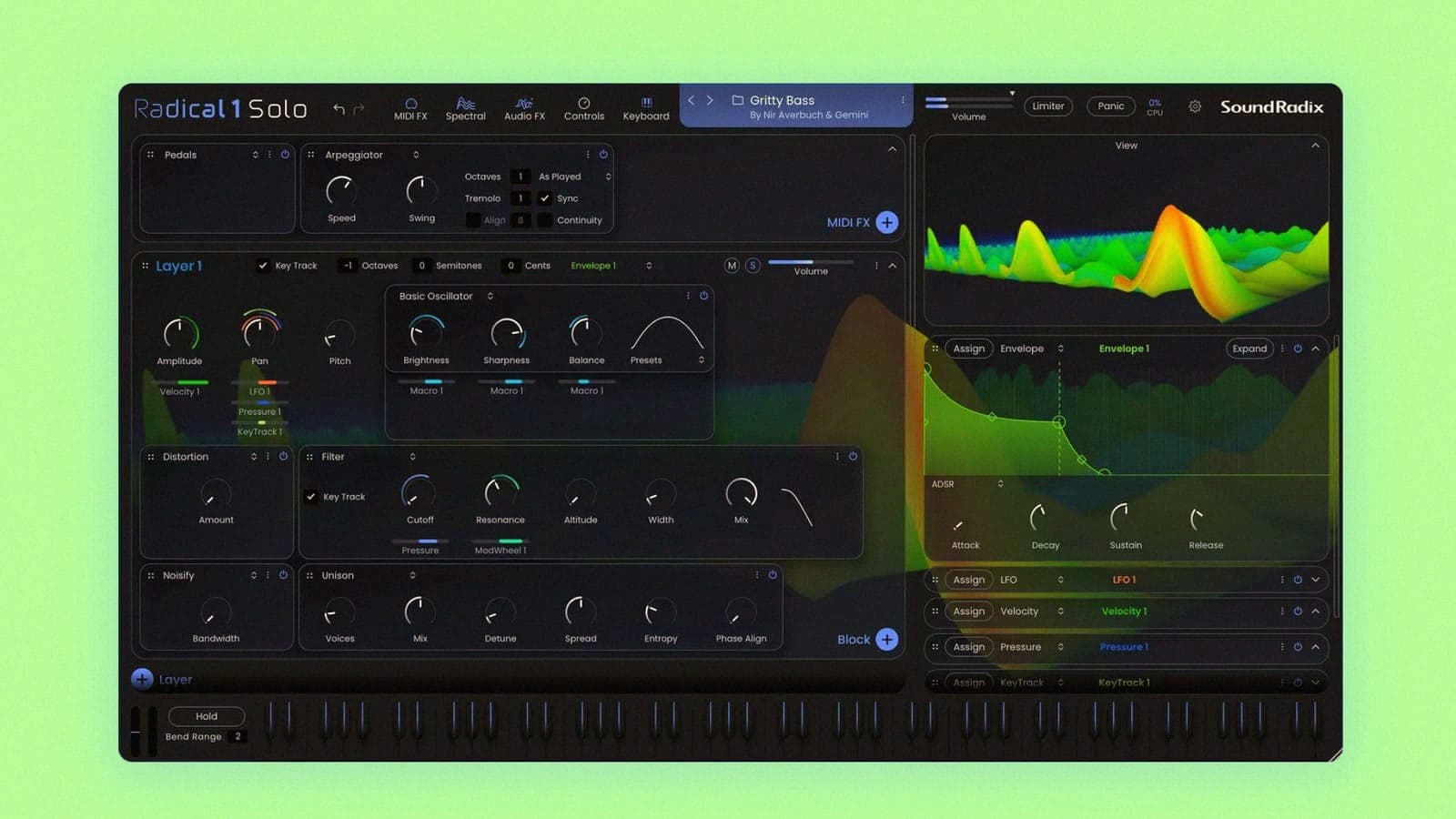
Sound Radix isn't cutting corners on the engine with Sound Radix's Radical1 Solo, only on polyphony. The developer says the free version runs on "the same oscillators, modulation system, filters, and effects as the paid version," locked to a single voice and a single layer. The morphing fluid oscillators, direct spectrum drawing and spectral sample resynthesis, tools that can turn a recorded snare or vocal into a controllable stack of harmonics, are all present. What's missing is polyphony, unlimited layering and the Formula Blocks DSP scripting reserved for the full Radical1. The plugin runs as VST3, AU or AAX on macOS 10.14+ and Windows 10+, and activating it needs a free Sound Radix account plus the iLok License Manager, no USB dongle required.
Why should house and techno producers care?
Most synths on a producer's rack are subtractive: start with a harsh waveform, carve it down with filters. Additive synthesis flips that logic, building a sound sine wave by sine wave, which is exactly why so few bedroom producers ever touch it: the tooling has historically been expensive, CPU-heavy, or buried in modular-level complexity. Radical1's patent-pending engine claims to generate thousands of oscillators at low CPU cost, and a free, monophonic entry point removes the two biggest barriers at once, price and unfamiliarity. For anyone chasing basslines and leads with a kind of harmonic movement a standard wavetable can't quite deliver, real hands-on time with additive synthesis is now one download away.
What's the actual catch?
There's no hidden expiry: Sound Radix says Solo is free, not a time-limited trial. The real limitation is architectural, not commercial: one voice, one layer, no custom DSP scripting. But patches carry over between Solo and the full Radical1, priced from 129 to 199 dollars, so a producer who outgrows the free version keeps their work. Sound Radix is betting this free tier turns curious sound-design nerds into paying customers once they hit that ceiling, a bet that only pays off if the free version is genuinely capable. By spec, it is.