What actually changed in version 13?
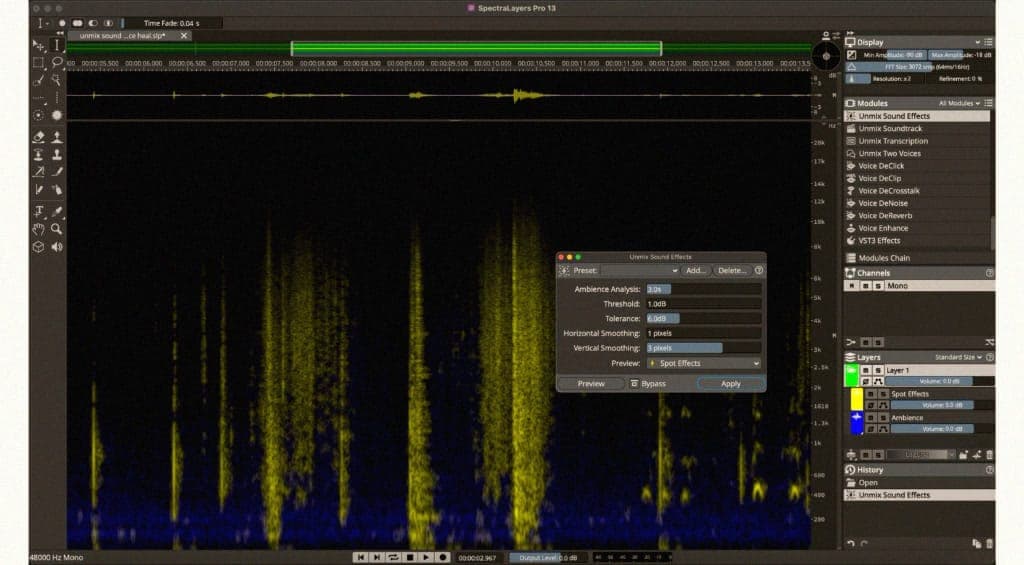
Steinberg has pointed SpectraLayers 13 at the hardest part of pulling a mix apart: what happens to the sound you leave behind. The headline addition, Unmix Sound Effects, lifts short, transient sounds out of a continuous bed of ambience, wind, traffic, crowd noise, nature, and drops the background onto its own layer. Two new voice tools sit next to it. Unmix Two Voices splits two speakers automatically, with no voice profiles to register first, and Voice DeCrosstalk peels a background voice off the main one even when they overlap. Voice DeClick mops up the mouth noise, the lip smacks and tongue clicks, that survives every other pass.
Why does a restoration tool matter on a house producer's desk?
Because separation is how edits get made. Pulling an acapella off a finished record, lifting a drum break or a bassline for a bootleg, isolating a hook for a mashup: that is daily work now, and the quality of the rip decides whether the edit is usable at all. The catch has always been the hole. Cut a vocal out and you hear the wound where it used to sit. SpectraLayers 13 goes straight at that. Reconstruct resynthesizes the spectral data you select, rebuilding tones, transients or noise in the amounts you dial in, and Ambience Heal patches the gap an unmix leaves using the room tone already sitting in the recording.
The old game was separating cleanly. The new one is making the leftovers sound like nothing was ever taken out.
Is this the same as the stems in your DJ software?
No, and that gap matters. SpectraLayers is an offline spectral editor, a scalpel you use in the studio one file at a time, priced at 359 euros for Pro and 89.99 euros for Elements. The real-time stem buttons in rekordbox, Serato or djay are a different job: instant, live, disposable. SpectraLayers is where you go when the edit has to hold up on a big system, not just survive a bedroom listen.