What makes Stream Pro different from the average granular synth?
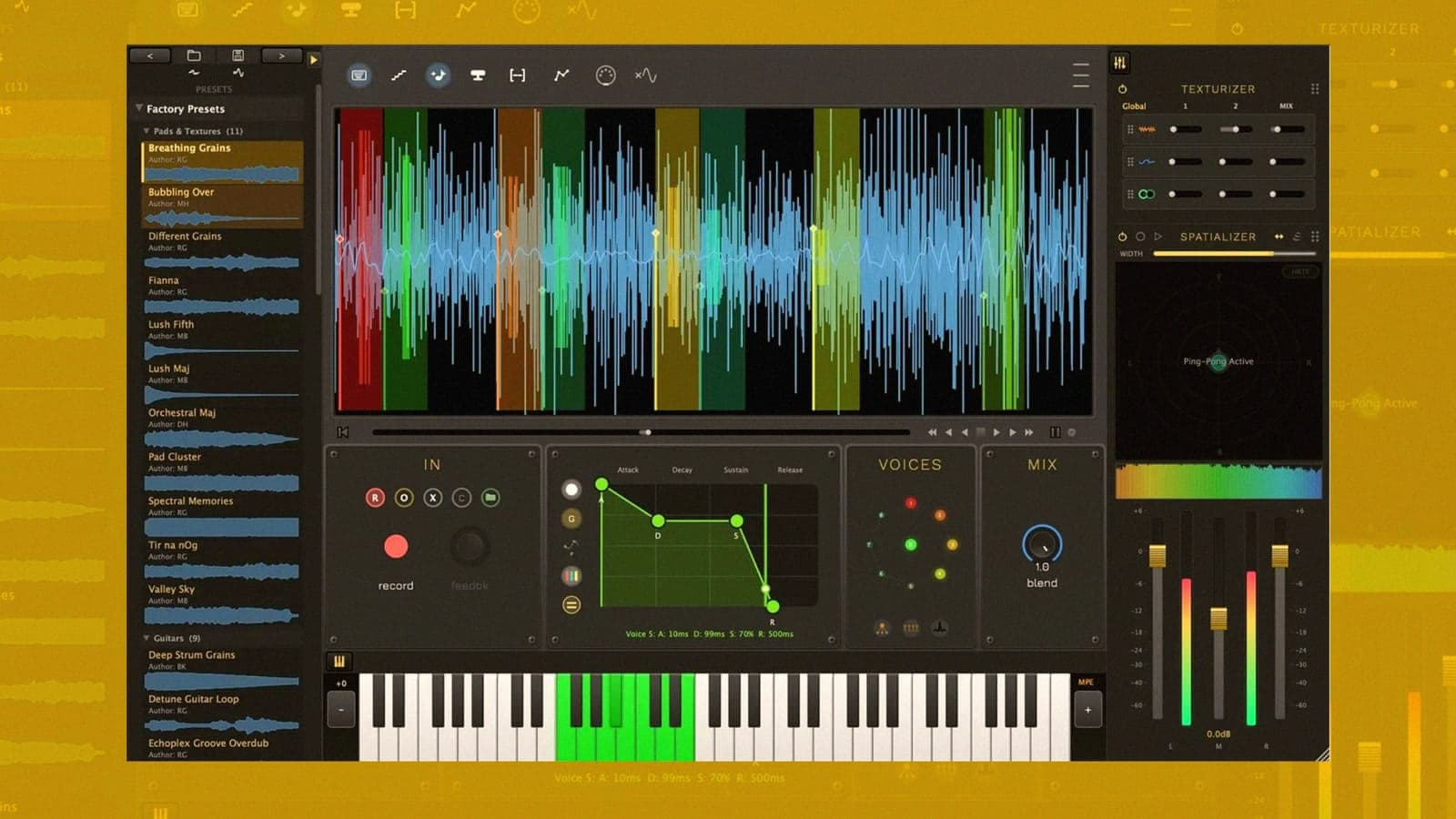
Most granular plugins are sound-design tools: load a sample, chop it into grains, tweak parameters for twenty minutes, bounce the result to a track. Delta Sound Labs' Stream Pro is built around a different premise: granular synthesis as something you perform, not just program. The plugin records audio live and feeds it straight into the granular engine, so a vocal, a field recording or a feed from a mixer becomes playable material in seconds rather than being prepared beforehand.
It runs in two modes. Single mode turns any source into an evolving texture, with time and pitch handled independently and real-time scrubbing through the material. Multi mode spreads the same engine polyphonically across a keyboard, with full MPE support, so a controller that sends per-note pitch bend, pressure and timbre can shape each grain-voice independently while you play. Eight independent playheads track velocity and MIDI in real time, and each voice gets its own distortion (analog or digital modeled) and a texturizer chain of drive, a ladder filter and tape delay with feedback.
How does the 3D spatialization actually work?
Rather than bolting spatial audio on as a separate send effect, Stream Pro builds it into the grain engine itself, using Steam Audio's HRTF (head-related transfer function) technology, the same binaural rendering Valve built for VR and games to fake convincing 3D sound over headphones. Individual grains can be set to orbit, drift or follow randomized motion paths through that 3D field, so a texture doesn't just sit in a stereo image, it moves around the listener. Four multi-wave LFOs feed a modulation matrix that can drive any of this over time, on top of the grain parameters themselves.
Granular synthesis has mostly stayed a studio-only technique. Stream Pro is a bet that it can be played like an instrument instead.
For anyone building ambient, experimental or immersive live sets for headphone or binaural playback, that's a different proposition than running a granular plugin into a separate spatializer afterward: the movement is native to the sound source, not applied after the fact.
Why did it launch as Stream Pro instead of XStream?
Delta Sound Labs previewed the plugin under the working title "XStream" at NAMM 2026 before settling on Stream Pro for the October 8 release. The name change tracks the plugin's lineage: the company has sold its original Stream, a granular texture effects processor, since 2020, and Stream Pro is its first full virtual instrument built on that engine, now with MPE, polyphony and the spatial audio layer added. It costs $99 (the introductory pre-order price was $79) and runs as VST3, AU and AAX on macOS (Apple Silicon and Intel native), Windows and Linux.