Most synthesizers start from a clean signal and sculpt it down. Synthux Academy's Audrey III starts from noise that refuses to behave and asks you to tame it. There is no oscillator bank, no wavetable, no sample library anywhere inside it. Turn the feedback up past a certain point and the circuit starts oscillating on its own, Karplus-Strong string synthesis turning that unstable loop into a playable drone. Switch it off overnight and it remembers: power it back on and the same drone greets you where you left it.
What actually changed from Audrey II?
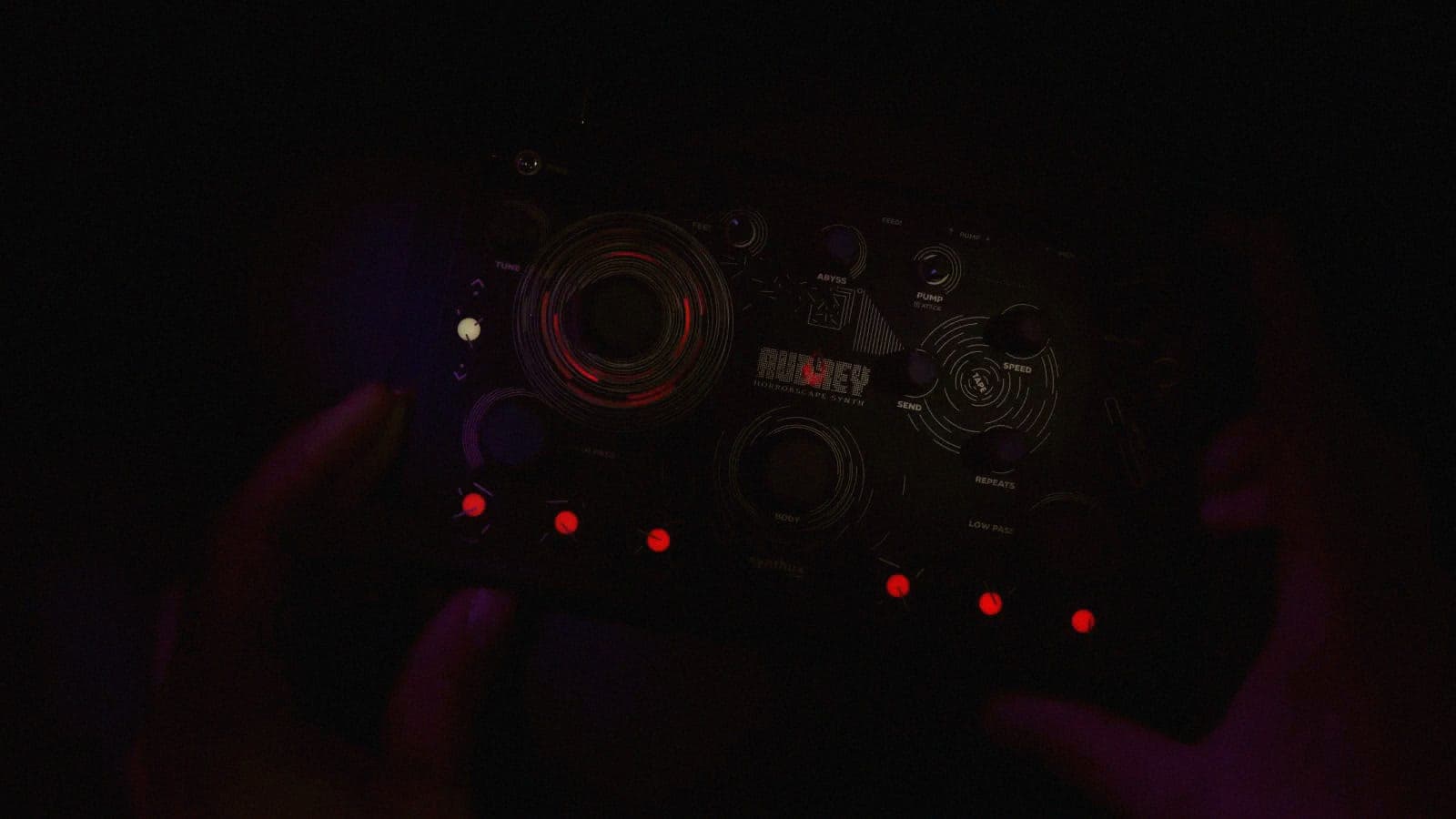
The Dutch studio's first Audrey, released in late 2024, ran a single voice of feedback, loud and fascinating but limited to one line of drone at a time. Audrey III triples that to three independent voices of feedback string synthesis, which is real polyphony on an instrument that technically has no notes to begin with. It is also the first Audrey to take an external signal: plug a stereo source into the audio input and it lands straight in the resonator, harmonizing and adding resonance to whatever you feed it rather than just reacting to its own noise. The chassis gets the same treatment, an aluminum enclosure that matches the look of Synthux's Spotykach looper, with a red circular LED ring on the left that pulses in sync with the sound.
Why does feedback synthesis matter to producers?
Subtractive and FM synths are built for repeatability: hit the same note twice, get the same result. Feedback synthesis is built on the opposite premise. Small changes in gain, in what you plug into the input, in how hard you press a touch plate, cascade into textures that were never programmed and can barely be reproduced on purpose. That unpredictability is exactly what deep-tech and experimental producers go hunting for when a filtered saw wave starts sounding too clean. Audrey III keeps that chaos but wraps it in a signal chain built for a club or a modular table rather than a studio desk: filtering, a stereo tape echo, reverb and a side-chain pump with tap tempo sit after the feedback engine, and all of it is reachable without diving into a single menu. You can also trigger it from a MIDI keyboard or sequencer if you want the noise on a grid instead of a drone.
An instrument that rewards exploration and happy accidents, in Synthux Academy's own words.
What does this unlock live?
No-menu design is the whole point for a performance tool: every knob, the fader and the eight touch plates map to something the player can feel without looking down. That matters more on a feedback instrument than on a normal synth, because the interesting sounds live in the in-between states, not the presets, and you find them by hand in real time. At 499 EUR, shipping in December, Audrey III is priced as an instrument for people chasing texture over melody: harsh noise artists, modular tinkerers, and house and techno producers who want one source in the rack that genuinely cannot be predicted twice.