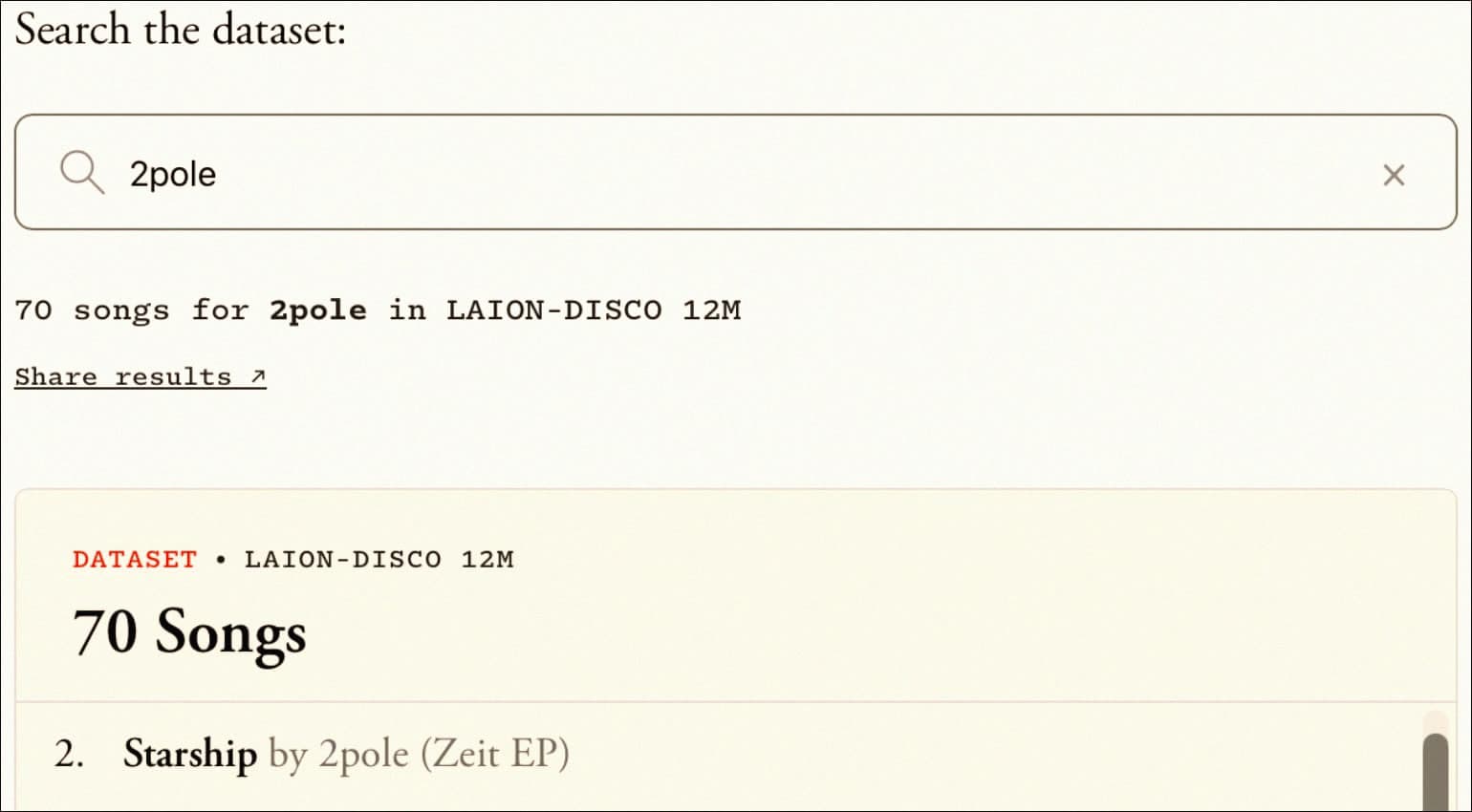
What does the AI Watchdog actually check?
The tool is The Atlantic's AI Watchdog, expanded to music in June 2026 by researcher Alex Reisner. It lets anyone search four datasets of songs that get passed around inside the AI-development world, together holding more than 20 million tracks: the two biggest carry roughly 12 million and 9 million, with two smaller sets above 100,000 each. Three of them were built by scraping YouTube and Spotify links with automated tools that, in The Atlantic's words, bypass logins, ads and anything that might pay a creator; the fourth pulls from the Free Music Archive. Type in your name or your titles and it tells you, dataset by dataset, whether your music is sitting in the pile.
Why does this land hardest on house and underground producers?
Because independent artists are the raw material. According to the Nguyen complaint, Suno's training pool ran past 40 million tracks, at least 60% of them from independents with no deal and no way to get paid. That is the underground exactly: the Bandcamp uploads, the white-label edits, the small-label digital catalogues. The majors have already sorted themselves out: Warner settled with Suno in November 2025 and signed a license; Universal settled with Udio in October 2025 and is co-launching a licensed platform. Their artists get a cheque. The independent producer whose track turns up in a dataset gets a search result and a shrug.
The majors negotiate a license. Everyone else gets scraped.
Does finding your track prove Suno trained on it?
No, and the tool is honest about that. Presence in one of these datasets shows your music is in circulation among developers, not that any one company fed it into a model; absence does not clear anyone either, because other private datasets almost certainly exist. The harder proof is being built in court. In late 2025, experts for the major labels gained physical access to Suno's actual training data and spent two weeks fingerprinting it with Audible Magic's recognition technology, turning up millions of recordings owned by Universal and Sony. Universal and Sony then tried to add more than 61,000 recordings to the case, which Suno is fighting. Sony's fair-use cases against Suno and Udio are heading for a ruling expected in summer 2026, and that decision will set the line for everyone whose catalogue is in the pile.