u-he has spent a quarter-century getting really, really good at faking analog. u-he's Diva models vintage filter circuits down to their component-level quirks in pure code; Zebra and Repro-1 do the same trick for classic synth architectures modelers have chased since the plugin era began. Now the Berlin studio has built one that isn't fake at all.
MELT, released August 27, 2026, is u-he's first 100% analog Eurorack module: a 14HP filter that a modular producer bolts straight into a physical rack, no DSP involved. It costs 299 euros including VAT (251.26 euros net) and, per the company, is meant to work as the final tone-shaping stage of a classic monophonic synth voice, paired with an oscillator and a couple of basic modulation sources.
What does MELT actually do?
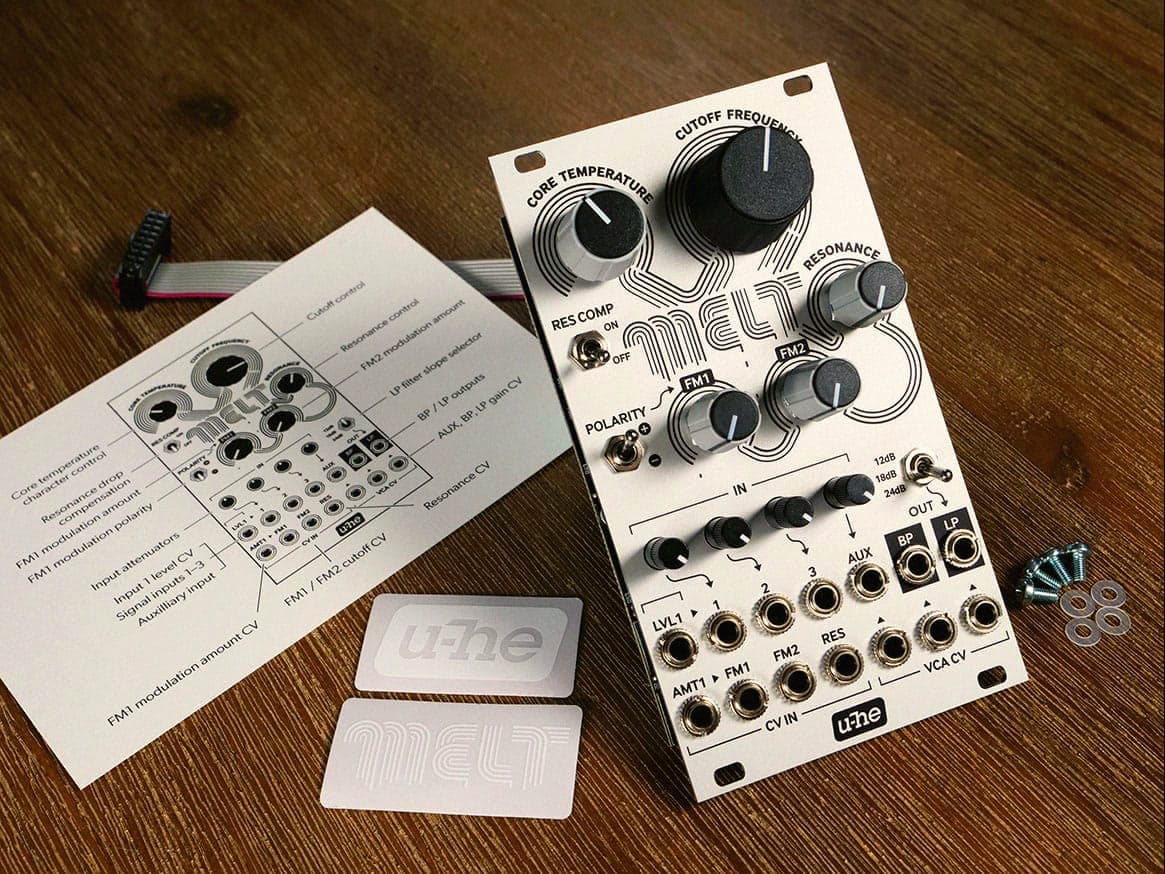
At its core is a four-pole low-pass cascade with switchable slopes, 12, 18 or 24 dB/octave, alongside a band-pass output that runs in parallel, each with its own VCA and CV input. A three-channel input mixer feeds the filter, with a modulatable VCA on the first channel, two attenuated cutoff CV inputs (FM1 and FM2, the first with a polarity switch and its own VCA), and an AUX input that skips the filter core entirely and routes straight to the output VCAs, useful for blending in a dry signal.
The standout feature is CORE TEMPERATURE, a control that reduces the filter's internal headroom as you push it up, creating an increasingly nonlinear interaction between the incoming signal and resonance. Turn it up far enough and the input itself starts to distort.
"MELT's low-pass and band-pass outputs can be used in parallel for a wide variety of tones, and the unique CORE TEMPERATURE control adjusts the character from mellow to truly wild."
u-he suggests bass lines that shift dynamically as they play and percussion built from filtered noise bursts as two of the more obvious uses.
Why go analog after 25 years of software?
MELT isn't u-he's first Eurorack hardware. CVilization, Wiretap and CEN2RION already exist in the catalog, but they lean on digital or hybrid designs rather than a pure analog path end to end. A company whose entire commercial identity rests on nailing analog behavior in software choosing to build the real circuit instead is a notable reversal, and it puts u-he in direct competition with the modular filter makers whose hardware its own plugins have spent decades studying.
The module needs just 70mA per rail and no +5V bus, a small but deliberate detail that lets it drop into almost any existing case without a power budget headache.
Why it matters
Software-only synth brands increasingly face plugin piracy, subscription fatigue and a saturated DSP market; a hardware line gives u-he a physical foothold in the Eurorack world its plugins have always referenced, and tests whether the brand's reputation for authenticity survives contact with an actual circuit board.