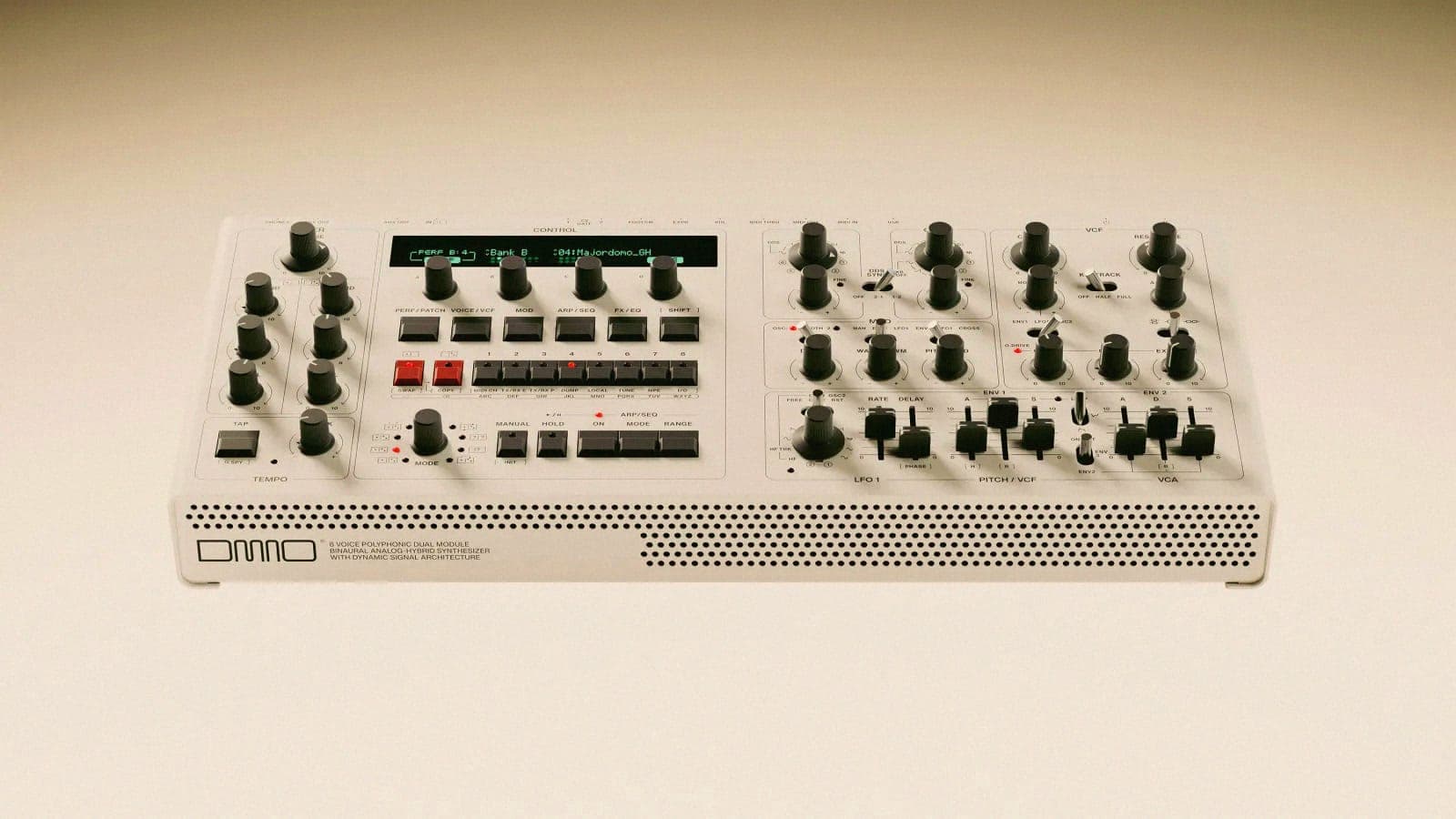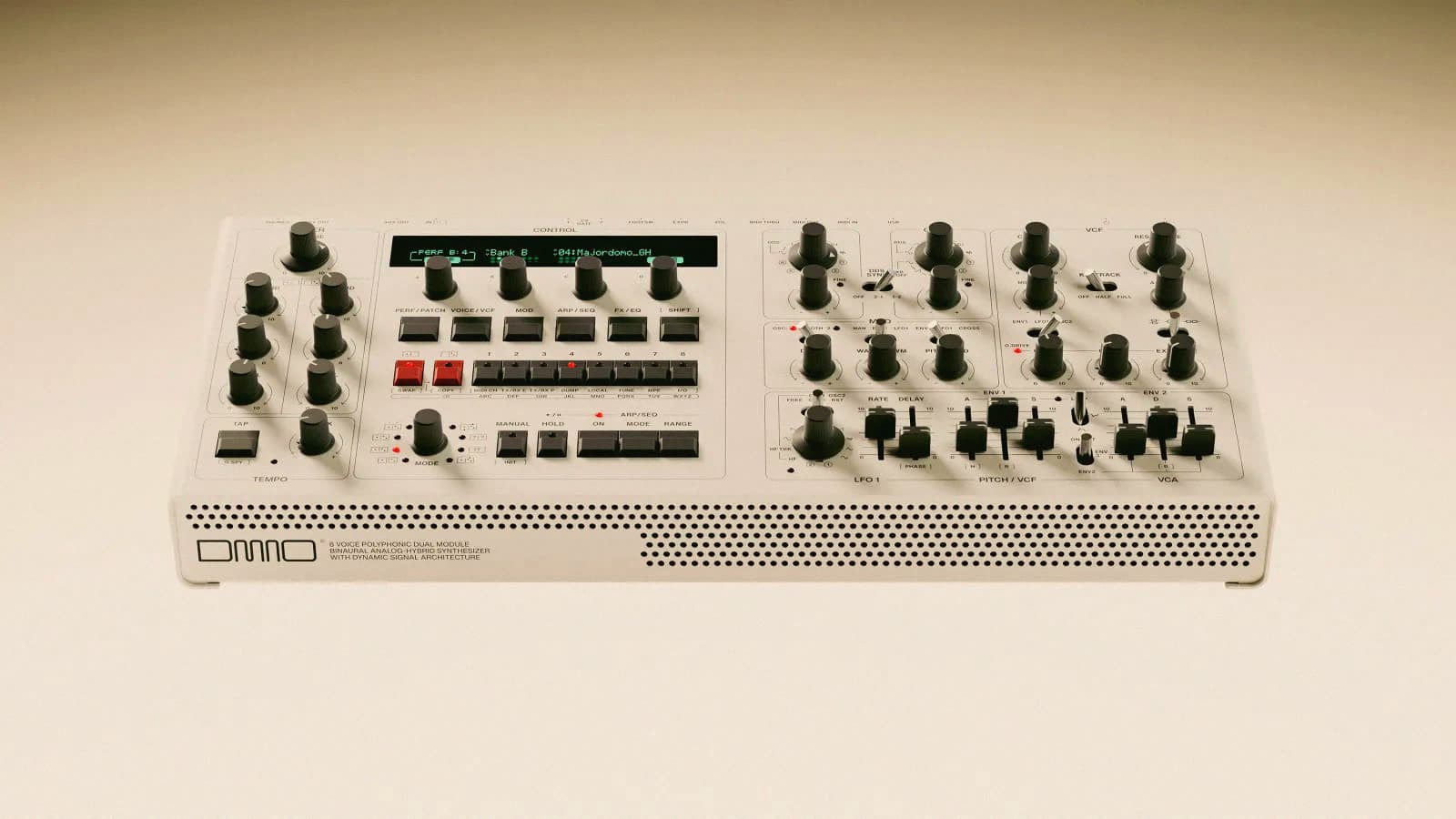
UDO Audio's DMNO was always an unusual pitch: an 8-voice, two-layer hybrid synth that runs FPGA digital oscillators into an analog filter path, built by a small Bristol team that cut its teeth on the Super 6. The desktop version, DMNO ON, finally shipped on November 19, dropping the keyboard and the stand it used to need. It is not cheaper for the privilege.
What does losing the keyboard actually change?
DMNO ON is the same two-engine architecture in a box measuring 487 x 220 x 107mm and weighing 4.5kg, with VESA mounting points so it can live on an arm, in a rack shelf or bolted to a desk instead of propped on a stand. That is the point of a desktop module: it goes where a keyboard synth can't, next to a mixer or inside a modular rig.
The tradeoff is control. The keyboard DMNO gives hands-on access to both of its two timbral layers at once. The desktop base unit only exposes one layer through its own panel at a time.
"You can only control one layer from its user interface. The keyboard has controls for both."
That is why UDO built the ONM-1 Synth Control, a $875 add-on module that plugs in via a screw-locking D-Sub cable and recreates the keyboard's dual-panel layout. It ships at launch. A second expander, the ONM-2 FX Control, is coming later for effects. Buy the base unit alone and you are deliberately working one layer at a time, which fits a performer who wants a focused instrument more than someone chasing feature parity with the keyboard.
How does an FPGA-plus-analog hybrid differ from a pure digital or pure analog box?
Each of DMNO ON's two engines runs a pair of FPGA-based oscillators (classic analog-style waveforms plus user-updateable complex shapes) into UDO's Dynamic Multi-Core Stereo VCF, an analog filter that can be wired in parallel, series or stereo configurations with its own delta-cutoff control. The FPGA half gives the precision and flexible modulation routing you get from a digital synth like a Hydrasynth. The analog filter gives it the nonlinear character a pure wavetable box doesn't have, without the voice-count and tuning tradeoffs of an all-analog poly.
Binaural mode is where that pays off most: each stereo channel runs as its own full voice with independent detuning and modulation, so a single patch can occupy real stereo width rather than a panned mono signal. Stack that with the eight play modes for combining the two timbral layers, a 64-step sequencer with a multi-mode arpeggiator, and a 32-bit DSP chain (delay, reverb, EQ, overdrive, distortion, chorus) and DMNO ON is pitched at someone building a studio centerpiece, not a cheap polysynth.
The new OS update, which also lands on the original keyboard DMNO, adds a Super6 oscillator mode pulling in waveshapes from UDO's older Super 6, plus faster patch loading and more onboard memory for the 256 performance and 256 patch slots.
Why did the October price not survive to November?
When Gearnews covered the pre-order in October, UDO quoted $2,299 for the base unit and $725 for the ONM-1, alongside a €2,449 figure that has not moved. By the November 19 ship date, Synth Anatomy and the US retailers selling it list $2,850 and $875. The dollar prices climbed by several hundred dollars each over the eight-to-ten week pre-order window while the euro price sat still, the kind of gap that usually tracks import costs and currency swings rather than a spec change, since the hardware itself is identical to what was announced.