What makes the DMNO ON different from a normal hybrid synth?
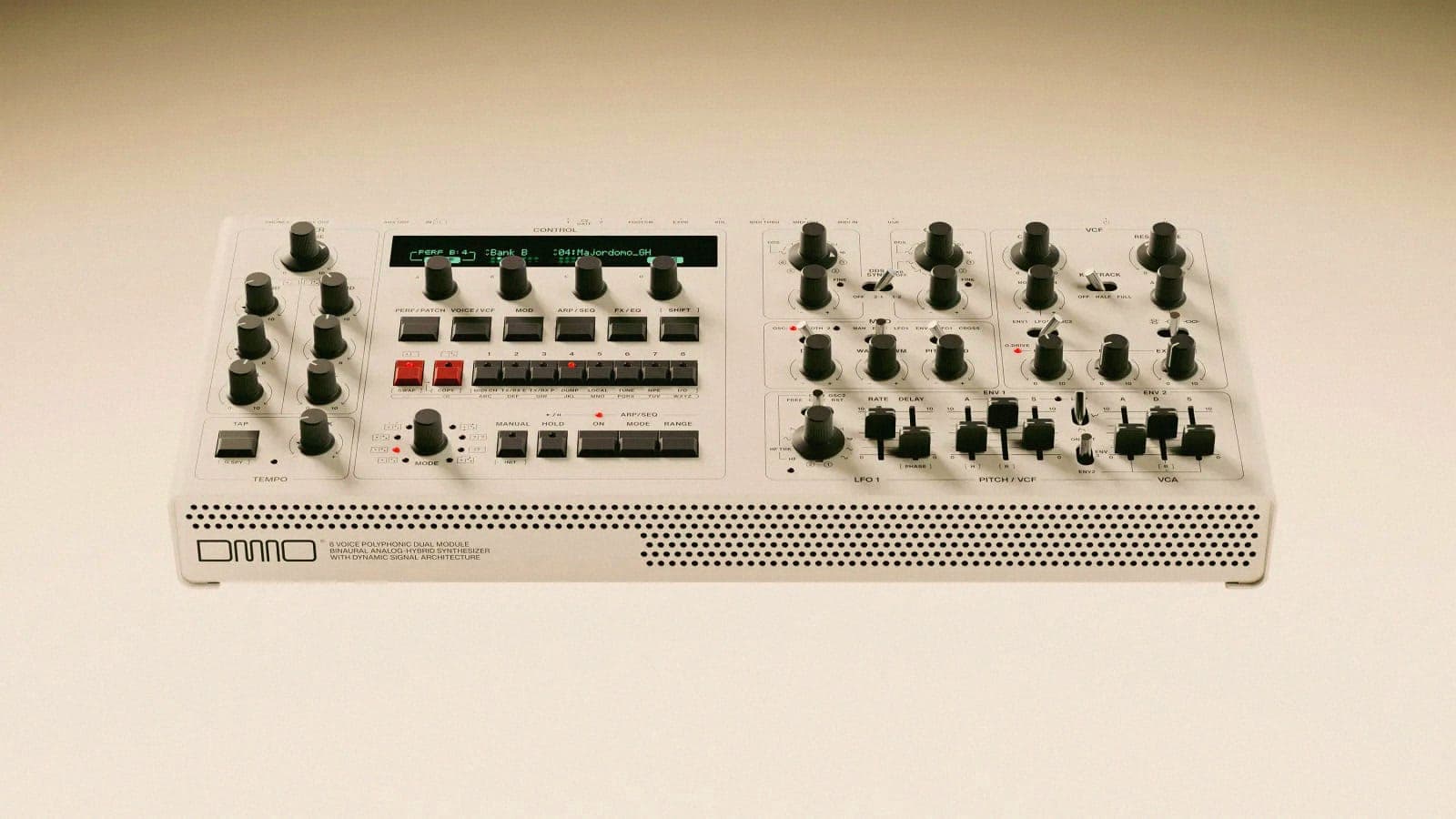
Most instruments that call themselves hybrid just bolt a digital oscillator onto an analog filter. UDO Audio's DMNO runs two independent synth engines per voice, each built around FPGA oscillator cores capable of ultra-high-resolution waveforms that a standard DSP chip can't touch, then routes the signal through UDO's Dynamic Multi-Core Stereo VCF, a reconfigurable analog filter that runs in series, parallel or true stereo. The keyboard version of DMNO already did this across 8 voices and 2 parts. The DMNO ON keeps every bit of that engine and voice count, strips the keys, and puts the whole thing in a desktop box.
Eight Play Modes decide how the two engines talk to each other, from straightforward splits and layers to arrangements UDO calls random and chaotic, so the box can behave as two separate synths, one fat unison instrument, or something that deliberately drifts out of sync with itself.
Why cut the keyboard off a synth that sounds this good?
Because the people this is built for don't need one. A touring techno or house producer putting together a live rig cares about rack space and signal routing, not a five-octave keyboard they'll never play on stage. The DMNO ON doubles as a 24-bit USB audio interface with individual track outs, so each voice or part can land on its own channel in a DAW or on a mixer, and it carries CV/Gate connectivity to talk to modular gear and older analog sequencers. That's a studio-and-stage tool first, an instrument second, and it's exactly the Oberheim-adjacent niche UDO is chasing: the fat, two-engine hybrid sound without giving up a keyboard's worth of desk space for it.
What do the ONM expansion modules actually add?
This is the part that separates the DMNO ON from a one-and-done purchase. UDO sells two expander modules, ONM-1 and ONM-2, that connect to the base unit and physically extend the control surface instead of making you dig through menus. ONM-1 adds a second full synth control panel, so each engine gets its own dedicated knobs instead of sharing one. ONM-2 puts the effects engine on knobs with its own screen. Buy the desktop unit at $2,850 and you're not locked into that starting footprint: the modular approach lets a producer scale the instrument's hands-on control as their setup, and budget, grow, instead of trading up to an entirely new synth later.
Why it matters
For anyone building a hardware-based live techno or house set, the DMNO ON is a rare case of a serious hybrid synth engine getting cheaper to deploy on stage, not just cheaper to buy, and the ONM system means the instrument doesn't go obsolete the moment the rig grows.