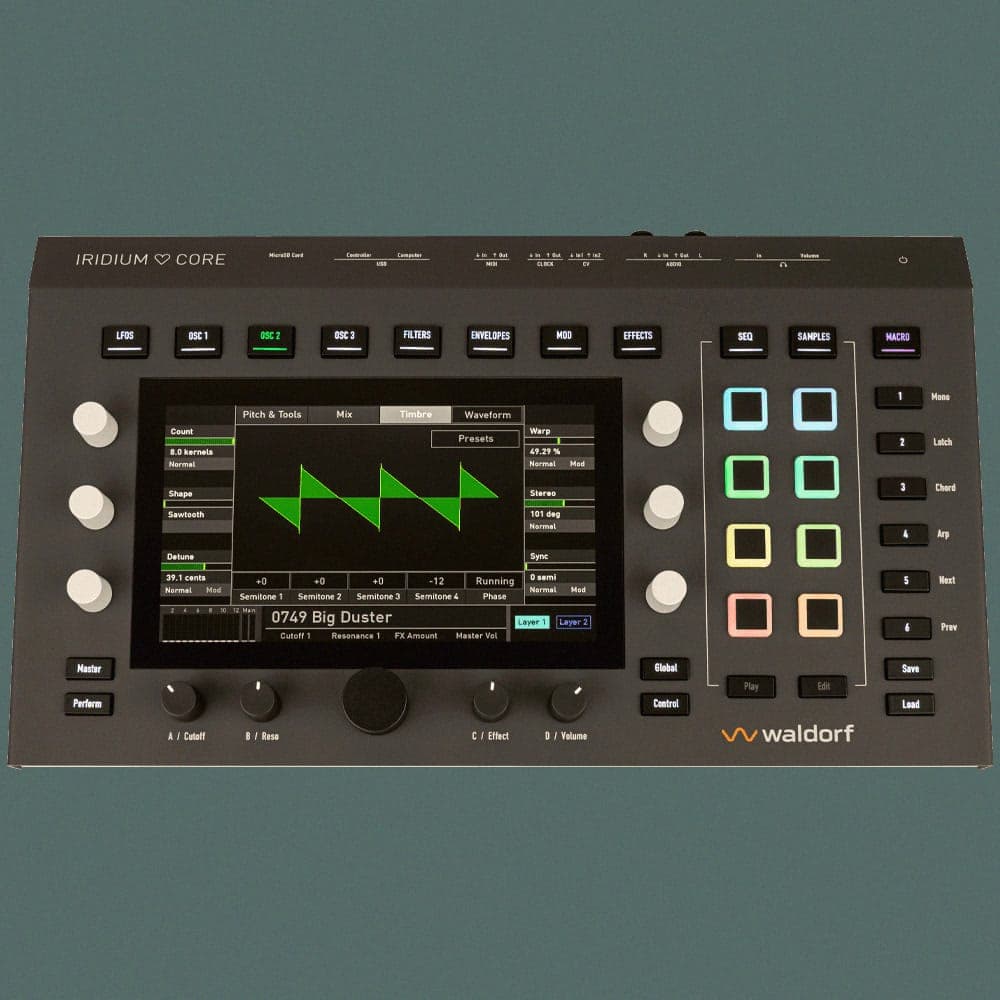
Most synth makers handle a spec ceiling one way: ship a new revision, charge for it, and let the old unit stay exactly where it was. Waldorf just did the opposite with the Iridium Core. OS 4.1.0, a free firmware download, takes every existing unit from 12-voice to 16-voice polyphony. No hardware swap, no paid tier, no "Mark II".
Why does a firmware update change how many voices you get?
The Iridium Core runs the same DSP architecture as its bigger siblings, the full Iridium and the flagship Quantum, just with a lower voice ceiling set in software to differentiate the entry model. OS 4.1.0 raises that ceiling to 16 voices, which Waldorf says brings the Core to full feature parity with the rest of the range. For anyone stacking pads, arpeggios and unison layers, four extra voices on a wavetable and granular engine this dense is not a rounding error: it is the difference between a patch cutting off mid-chord and one that does not.
What does the price drop signal?
The timing matters as much as the update itself. Iridium Core launched at €1,849; it now sells at €1,349, a roughly 27 percent cut. Pairing a price drop with a free spec increase, on the same unit, at the same time, is not something synth manufacturers do casually. It reads as Waldorf pushing the Core harder against a crowded field of hybrid digital-analog desktop synths, using generosity toward existing owners as part of the pitch rather than punishing them for buying early.
Waldorf turned what could have been a "buy the new one" moment into a reason to trust the brand with your next purchase.
Does this change how the scene should think about buying hardware?
It sets a precedent worth naming. The usual pattern trains buyers to expect obsolescence: today's flagship becomes next year's base model, and the fix is always a new purchase. Waldorf choosing firmware over a hardware refresh means the Core you bought in 2024 gets meaningfully better in 2026 without you spending another euro. That is the kind of move that builds loyalty in a niche market where word of mouth among producers and sound designers decides who buys next.