Patchable software synths have become their own crowded subgenre: pick oscillators, drag modulators onto them, route the result through filters and effects, repeat until something interesting happens. What most of them have in common is a plugin format list that stops at VST3 and Audio Units. Warsaw Wave's new synth, Revolt, doesn't stop there.
What makes Revolt different from other patchable synths?
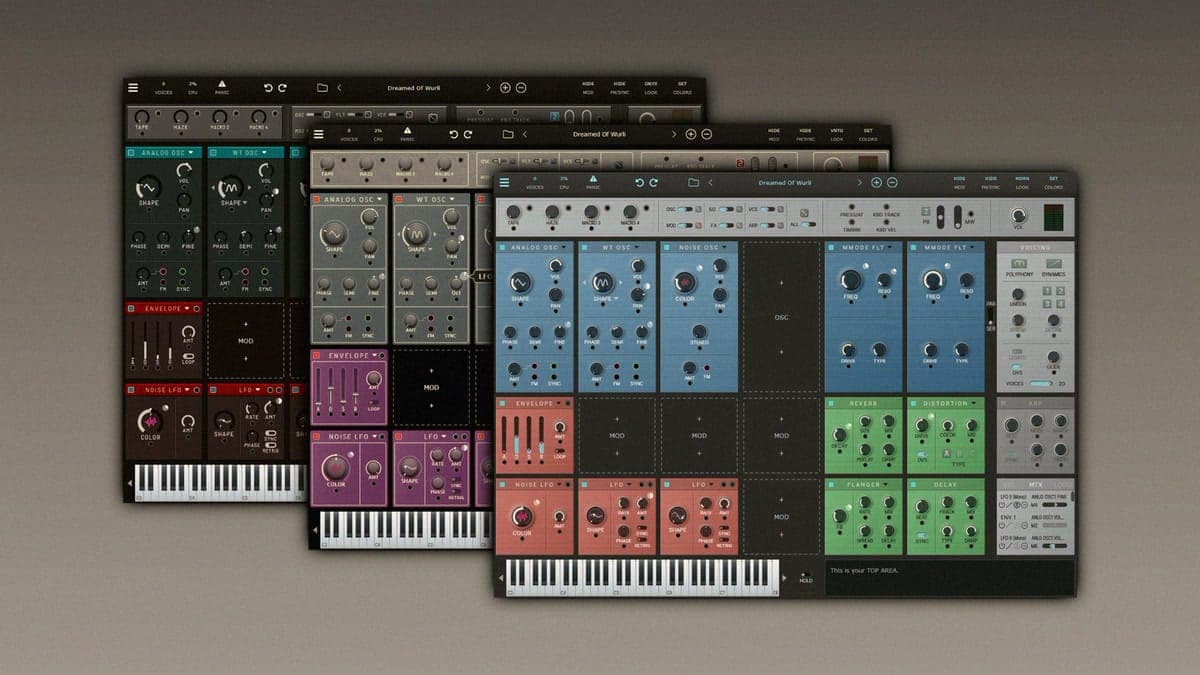
The architecture itself is familiar to anyone who's used a semi-modular rack: four oscillator slots (analog-style, wavetable, or noise, with FM, feedback, and hard sync available), eight modulation slots for envelopes, LFOs, or noise LFOs, two multimode filters that can run in series or parallel, and four effects slots (reverb, delay, chorus, flanger, distortion, bitcrushing) that can be reordered freely. None of that is revolutionary on its own. What stands out is the modulation matrix: it visually follows every cable connection as you make it, so a patch with a dozen active routings still reads at a glance instead of becoming an unreadable tangle. There's also a randomization engine that can regenerate patches from selected parameters and a variation dial, useful for sound designers who want controlled chaos rather than a full reset.
Four oscillators, eight modulators, and over 800 million possible routing combinations, all on one page.
Why does Linux support actually matter here?
This is the real headline for a chunk of the production world. Revolt runs on Windows 10 and up and macOS 12 and up as VST3, Audio Units, and standalone, but it also ships as a native VST3, LV2, and standalone build on Linux. LV2 is the plugin format Linux-native DAWs like Ardour, Qtractor, and Carla actually expect, not a Wine-wrapped VST limping along through compatibility layers. Most commercial synth developers treat Linux as a rounding error in their user base and never bother; a genuinely cross-platform patchable synth that treats all three operating systems as first-class citizens is still rare enough to be the actual story, deal-day pricing aside.
The launch price is $59 through November 11, 2026, after which it reverts to $89. There's also a free version (two oscillators, four modulators, one filter, two effects, scaled-down macros and arpeggiator) with no time limit, plus a seven-day full trial for anyone who wants to test the complete feature set before paying.