The Oberheim Xpander is one of those machines that shaped deep house and techno sound design from the shadows: six-voice matrix modulation, a filter that can self-oscillate into something closer to a scream than a sweep, and a patch architecture deep enough that programmers built entire careers inside it. It also became nearly impossible to own. Used units, when they surface at all, routinely run into the thousands of dollars, and plenty of working ones never leave the studios that already have them.
Why clone an architecture instead of modernizing it?
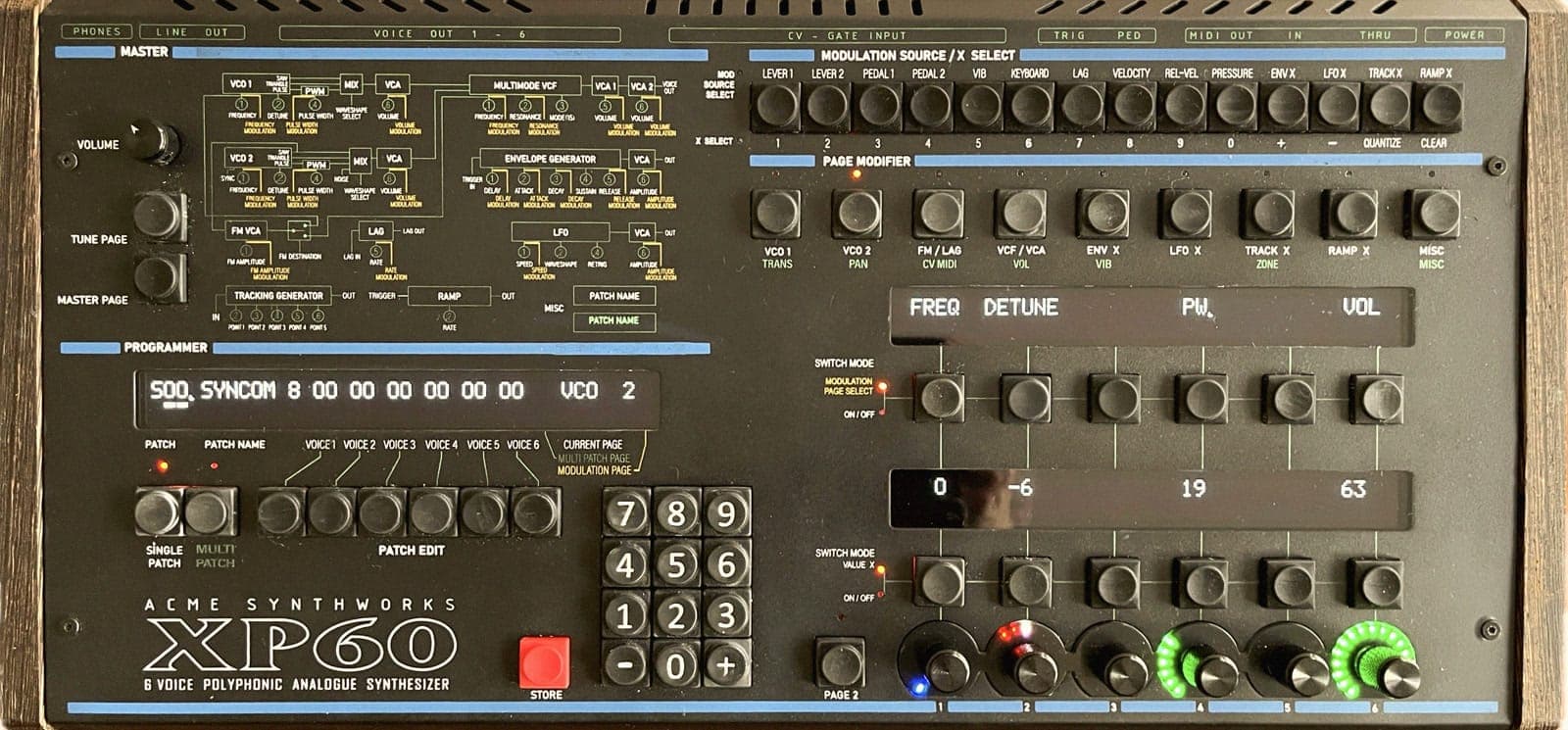
Markus Malik, the German synth repairman behind ACME Synthworks, made the opposite bet to most boutique revivals. Rather than take the Xpander's DNA and wrap it in menus, MIDI polyphonic expression and a touchscreen, the XP60 keeps the original signal path nearly intact: two CEM 3374 oscillators and a 15-mode AS3372 filter per voice, the same chips Oberheim used in 1984, paired with two VCAs, five LFOs and five envelopes per voice. That is a deliberate, almost stubborn choice. The Xpander's reputation rests on exactly how those analog chips behave under modulation, not on a feature a spreadsheet can list, and ACME is betting that producers chasing that sound would rather pay for fidelity than for convenience.
The one real addition is a turbo mode, which pushes the LFOs, lag generators and envelopes 50 percent faster than the 1984 hardware ever allowed. It is a small, telling move: not a reinvention, just permission to push the same engine harder than Oberheim's own components could in the Reagan era.
Voice architecture, modulation logic and overall concept remain identical to the original. Only the size has changed.
Does 2,699 euros actually solve the scarcity problem?
Not entirely, and that is the honest read on this launch. The XP60 arrives in three versions built around their display: LCD at 2,699 euros, OLED at 2,799 euros, VFD at 3,149 euros, each needing a 50 percent deposit now and the balance on completion, plus shipping from Germany. That is a serious outlay for a desktop synth with no keybed. But measured against what a real Xpander costs when one actually appears for sale, often several thousand dollars for a forty-year-old unit that still needs recapping, the XP60 is the first time in years that this exact voice architecture has had a price tag attached to a guaranteed delivery date instead of a waiting game on used-gear forums.
It is also a tiny run. Malik is building in what the announcement calls mini quantities, with the first batch capped at 50 units and shipping promised for November 2026. Anyone who treats this as a mass-market reissue is going to be disappointed; anyone who has been quietly pricing used Xpanders for a decade will recognize exactly what is being offered here.
Why it matters
Most hardware revivals chase the name and simplify the engine. ACME is doing the reverse: keeping the engine and shrinking the box. For deep house and techno producers who know the Xpander's patch architecture by reputation but have never owned one, this is the first real chance to put those specific chips on a desk without hunting eBay for a survivor.
What we think
The turbo mode is the tell here. ACME could have padded the XP60 with modern conveniences and called it an homage; instead it chose to make the one thing people actually complained about on the original, slow modulation at extreme settings, faster, and left everything else alone. That is the right instinct for a clone aimed at people who already know exactly what they are buying.