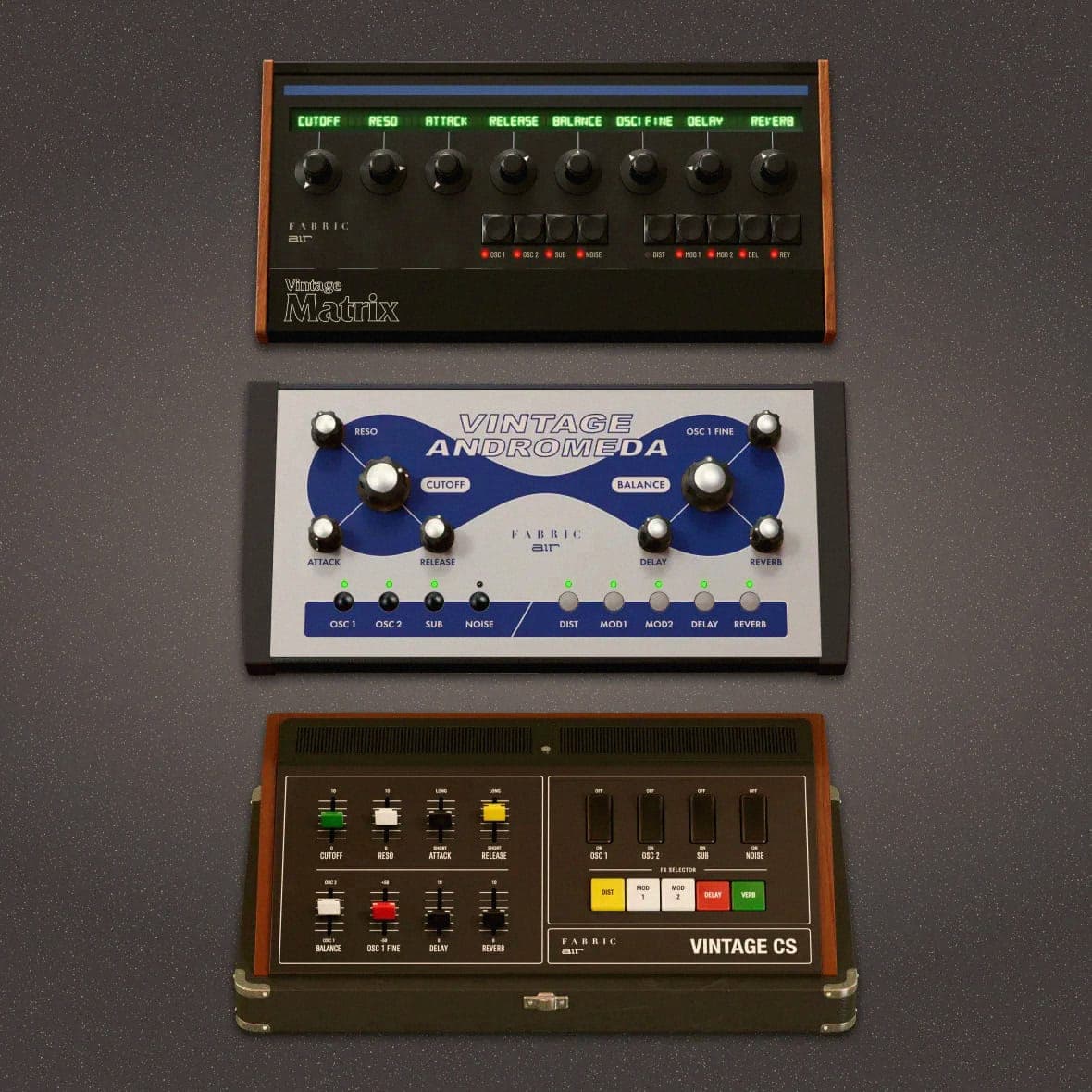
Nobody owns a real CS-80, an Andromeda and a Matrix 12 at the same time. The CS-80 alone runs collectors five figures, the Andromeda has been out of production since 2007, and a clean Matrix 12 is a warehouse find at this point. AIR Music Technology's answer is to sample all three and sell the set for less than a used MIDI controller.
AIR Music Technology, the inMusic-owned plugin house behind AIR Hybrid 3 and the Xpand!2 workstation, put out Fabric Vintage Synths Vol. 2 on August 10, 2026. It is a direct sequel to April's Vol. 1, which sampled the Prophet-5, Jupiter-8 and Memorymoog. Where that first volume leaned into the American and Japanese analog canon, Vol. 2 goes for the harder-to-reach machines: the CS-80's ribbon-controller expressiveness, the Andromeda's dense analog-modeling voice architecture, and the Matrix 12's brutal 12-voice subtractive stack.
How does the Fabric engine actually work?
Each instrument, AIR is explicit about this, is not an accurate circuit emulation. It is a multi-sampled virtual instrument built on what AIR calls the Fabric XL engine: two multi-sampled oscillators pulled from the original hardware, a virtual-analog sub oscillator, a noise generator, AIR's own filter models, three LFOs, three envelopes, a BPM-syncable arpeggiator and a multi-effects section with distortion, delay and reverb. That is a meaningfully different approach from the component-modeling plugins (Arturia, u-he, Cherry Audio) that try to recreate the actual circuit behavior. Sampling trades some of that circuit nuance for rock-solid stability, low CPU load, and MPC compatibility, since MPC Standalone units cannot run a full modeling synth engine the way a desktop DAW can.
That MPC angle is the real reason this exists. AIR is inMusic's in-house plugin brand, and inMusic also owns Akai, maker of the MPC line. Fabric Vintage Synths Vol. 2 runs natively inside MPC Standalone and MPC Desktop as well as VST, VST3, AU and AAX on a normal DAW, which puts a sampled CS-80 inside a beatmaker's hardware sampler for the first time without hauling a rack.
Is $119 actually a good deal?
On paper, yes. The launch price is $119 against a $299 regular list, and each of the three instruments is sold separately at $59 if a producer only wants, say, the Matrix. That undercuts most boutique CS-80 or Andromeda emulations on the market, and it is a fraction of what renting studio time on the real hardware would cost. The tradeoff is the one above: this is sampled character, not modeled circuitry, so purists chasing exact CS-80 ribbon response or Andromeda filter drift will still reach for the hardware or a dedicated modeling plugin instead.
"Completely in love with the vintage vibe of this CS-80 and Alesis Andromeda style bundle. It's analog bliss and now I have no road cases to haul around."
That quote, from producer Peter Jacobson on AIR's own product page, is the pitch in one line: the vibe of three unicorn synths, none of the insurance premium.