What does the Alesis Andromeda A6 actually sound like?
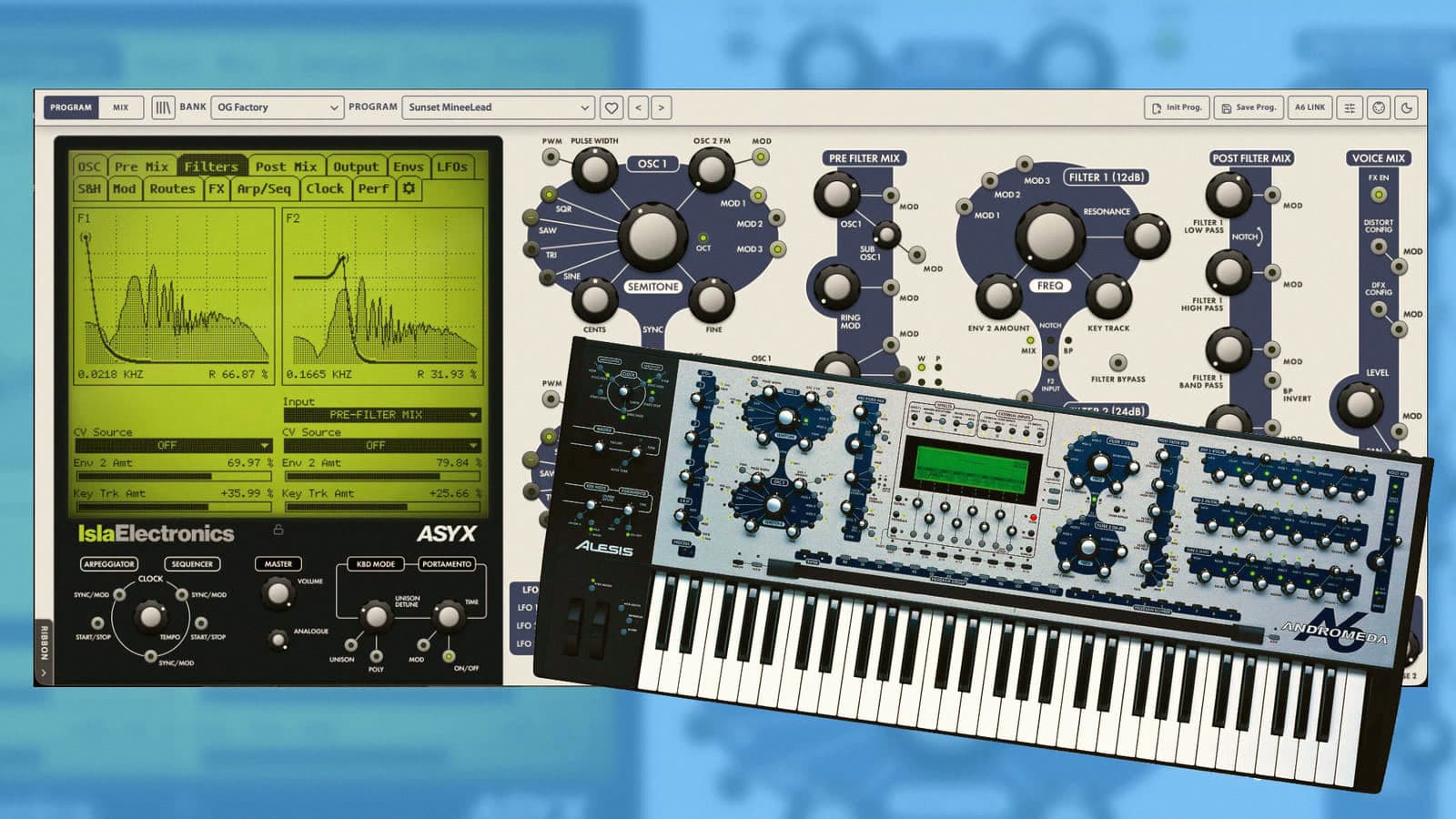
Thick, wide and unmistakably analog. Isla Electronics built its reputation around chasing that specific sound: the Andromeda A6 was Alesis's flagship analog polysynth in the early 2000s, a 16-voice, 16-part multitimbral machine built around two filters instead of the usual one. One side is derived from the Oberheim SEM, the other from the Moog 904A, and producers could run them in series or parallel, which is a big part of why the Andromeda has a tonal range most vintage synths don't: it can sound like a classic Oberheim pad one patch and a Moog bassline the next, or something that's neither. Alesis discontinued it years ago, and the secondhand market has priced it accordingly: units routinely change hands for $10,000 or more, when they surface at all.
How did Isla Electronics replicate that in software?
By working from a real A6 rather than from recordings of one. The company says it measured, compared and refined its modeling directly against original hardware, down to custom ASIC-derived oscillator modeling, rather than sampling the synth's output and calling it a day, which is the shortcut most "vintage emulation" plugins take. Isla Electronics put it plainly in its own announcement:
"ASYX was developed to make this instrument accessible in software. Working directly with an original A6, we've measured, compared and refined its behaviour, while retaining compatibility with original patches."
That compatibility claim isn't just marketing copy: ASYX can import and export the Andromeda's original SysEx patch format, and it links bidirectionally over MIDI with real hardware, so someone who already owns an A6 can edit a parameter in the plugin and watch it move on the physical synth, or the other way around.
What do you actually get for 99 euros?
The full architecture, not a cut-down version. ASYX carries the Andromeda's two oscillators per voice with sync, sub-oscillators and FM, three multi-wave LFOs, three 7-stage envelopes, a 16-step sequencer and arpeggiator, and 29 digital effects covering chorus, delay and reverb combinations. On top of the engine, it comes loaded with more than 1,200 programs: the hardware's original factory bank plus dedicated sound sets from Rob Papen, Joerg Huettner, G-Storm, Dave Bessell and others who built patches for the real thing. It runs as a standalone app, VST3 or AU on macOS Big Sur and later (Intel and Apple Silicon) and VST3 or standalone on Windows 10 and up, with Linux support listed as coming. The launch price is 99 euros through November 5, after which it moves to a regular 149 euros, a perpetual license usable on up to three machines at once.
Why it matters: for every bedroom producer who has read about the Andromeda's dual-filter sound without ever being able to afford one, ASYX is the first real shot at hearing what the fuss was about, and it puts pressure on the rest of the vintage-emulation market to work from real hardware instead of sample libraries dressed up as modeling.
What we think: "authentic emulation" is a claim every plugin maker makes, and the only real test is putting a known A6 patch next to ASYX's version of it and listening. But working directly against hardware and shipping bidirectional SysEx compatibility is a meaningfully higher bar than most software synths clear, and if ASYX holds up to that scrutiny, it's a genuinely good thing for anyone who makes deep, warm analog-leaning house and never had $10,000 to spend finding out what an Andromeda sounds like.