What does False Memory actually do?
It breaks things, on purpose. All The Machines, the small studio that made the SKIIID drum synth, calls False Memory an audio disintegration effect, and that is the honest description. Feed it a clean loop and it can warp, corrode or fully dismantle it.
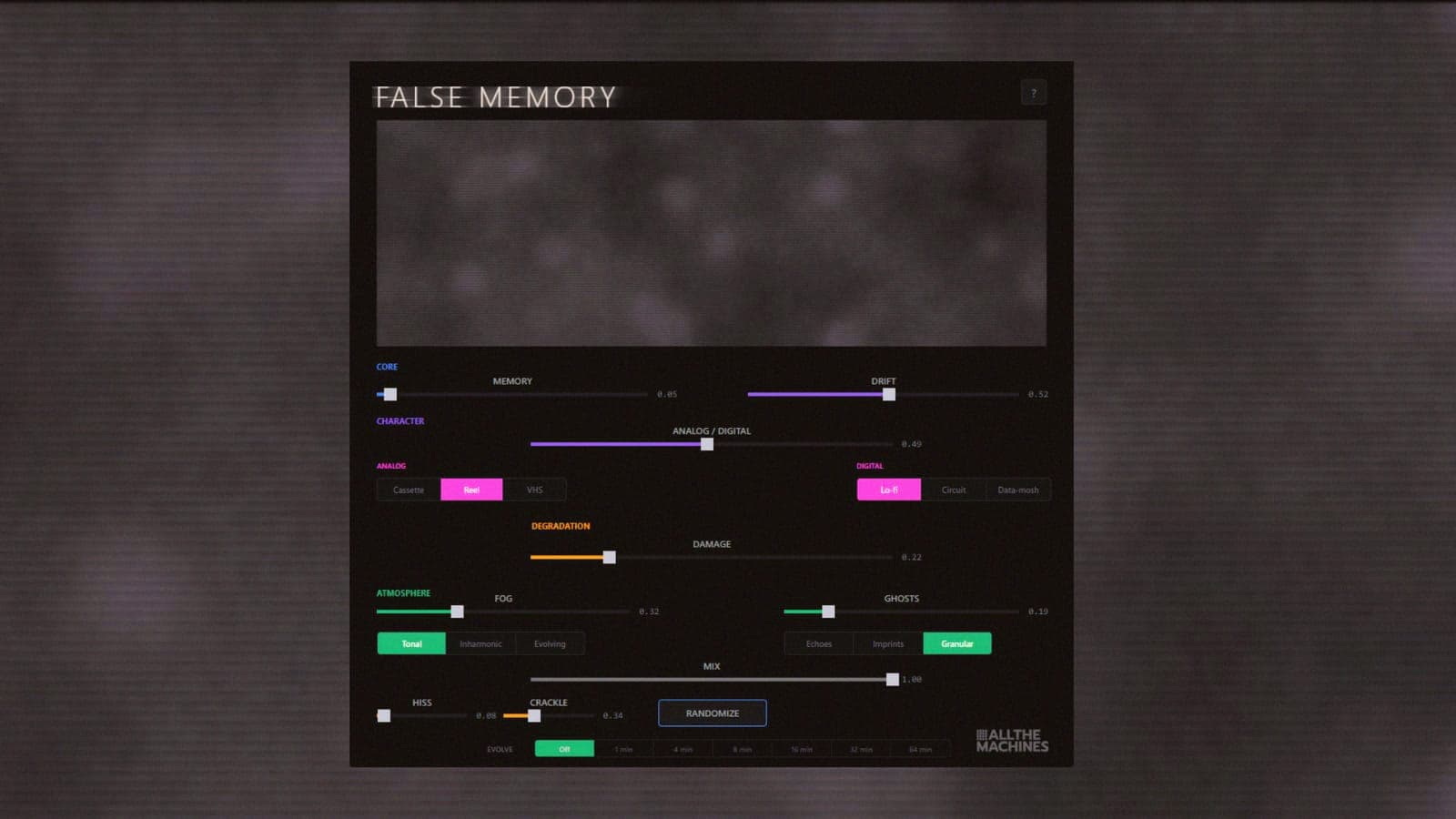
The layout is built around a few engines. A single Analog/Digital slider sets the flavour: push it one way for analog decay, cassette wobble, reel-to-reel saturation, VHS tracking errors, push it the other for digital damage, lo-fi aliasing, circuit-bent glitches and data-mosh artefacts. A Drift control loosens the grip on pitch and time, from a gentle seasick sway to total collapse, and a Damage knob decides how hard the signal gets torn. Then there is the atmosphere section: Fog smears the frequency spectrum into a haze, while Ghosts lets earlier audio bleed back through the present, with hiss and crackle on tap.
The clever part is Evolve. Switch it on and the effect deepens by itself over a window you set, anywhere from one to sixty-four minutes, without you touching a control. Leave a pad running and come back to something that has quietly fallen apart.
Why would a house or techno producer want it?
Because texture is half the job now. Dub techno, organic and deep house, hauntology-leaning ambient: a lot of the records that feel warm and lived-in get there through tape saturation, bit-rot and noise, not pristine signal. A box that does all of that under one roof, and can be automated to morph across a long arrangement, is a fast route to a sound that does not feel like a stock preset.
The Evolve mode is the standout for anyone making longer-form or live material. Set it across eight or sixteen minutes and a held chord becomes a slow decay you could build a whole intro around. It is the kind of motion that usually takes a rack of automation lanes to fake.
Is it worth it at 19 euros?
At an intro 19 euros on desktop, and 3.99 on iOS, this is an impulse buy, and that is exactly the point. There is no shortage of glitch and lo-fi tools, and False Memory is not reinventing distortion. What it offers is a lot of destruction under one clear interface, on every format including the phone, for the price of a couple of drinks. For producers chasing character rather than polish, that maths works.